
PART I
SHELTERED VALLEYS
1. A BOY'S DAY
THE sky paled as morning came over the mountains. The velvet dark peaks stretched themselves into the lake until water and earth were one. Their still shadows on the water no longer held stars. Slowly the lake brightened into blue, and when the wind poured down the mountain side and broke it into shining fragments, day had come.
The wind carried the fragrance of deep woods and high sweet pastures into a room where a child slept. He stirred as if called. In his sleep he heard the cowbells, clear, irregular, as the cows moved knee-deep at grazing. A rooster crowed under the window, and he wakened like a puppy, all at once, scenting the day sharply.
The rest of the parsonage lay quiet under the brightening sky but the boy's room, washed through with the clean air, woke with him. In every corner but one. The low-hanging roof of the Swiss chalet still held its shadows there around a small curled-up figure on a cot. The boy moved from the window where the mountain tops were turning to gold, and as he advanced on the small figure, he seemed to blow the last shadows from dark corners.
"Wake up, Auguste," and whether he would or not, Auguste had to awake. He stretched shivering to pull back his blankets.
"Please, please, Louis," he begged, "it is not time."
"It is time." Louis was inexorable. "I am up."
And so Auguste knew that it was time, and he got up. But before he had rubbed the sleep out of his eyes, Louis was dressed and racing down the stairs. Auguste looked at his stripped cot a moment, but then he sighed and began to pull on his clothes.
Outside, the yard had the curiously empty feeling of early dawn as if all sleeping things had taken away with them the essence of themselves and left behind nothing but their quiet bodies. The great apricot tree stood pale as moonlight in the dawn, alive only in its fragrance.
When the door of the house opened, the yard woke as if the boy's vitality, like the wind pouring down the mountain, had roused whatever it touched. He moved swiftly and surely, and the apricot tree hummed with the bees at work, small squeaks and chatters rose from tiers of slatted boxes, and the clear water of the great stone basin rippled with the silver backs of fish.
The boy's competent fingers unfastened each cage, selected with precision the proper food, and moved to the next in steady rotation. Mice, rabbits, birds, guinea pigs, snakes, fed and somehow greeted by the keen dark eyes bent upon them, fell to satisfied munching. Now and then Louis drew a homemade book from his wide pocket and made brief notes of new arrivals or of oldest inhabitants. Once he made a quick sketch, intent eyes on a crawling snail, and nodded with satisfaction at the result.
As he sprinkled fish food over the pool he suddenly became aware that everything in his household had had its breakfast except himself. Almost he could have finished the fish food himself. He flung it at the leaping fish, and ran.
At the door he passed Auguste on his way to the yard. "I gave your collections no food at all," he said. "If they are to live and grow, you must take care of them."
Auguste was hungry, too, but he went on to his corner of the yard.
Then Louis laughed. Laughed because of the beauty of the new day, and the strong life that ran in his veins, and the disgruntled face of his young brother. When his laughter rang out a chaffinch in the apricot tree burst into song and instantly Louis whistled the song back to him. Auguste broke into a canter and when the door had slammed, he whistled too, but the chaffinch paid no attention to him.
In the clean warm kitchen Louis pulled up a chair to the scrubbed table. The stout woman who helped his mother gave him his hot rolls while she stirred about the business of real breakfast. He talked companionably to her and ate rolls and honey and sweet butter, and drank large glasses of creamy milk. Auguste joined him and the two boys finished the basket of rolls while they discussed the day ahead of them. The Swiss woman groaned but she filled the basket again and set the pitcher of milk where they could reach it. Rose Agassiz saw to it that these boys had plenty to grow on. The little family that she had lost in the hard north still haunted her. These children of the sunny vineyards should have every chance.
Louis sniffed at the rich aroma of chocolate simmering on the stove for the family breakfast. "One small drop," he begged, and then needed another roll and honey for the chocolate. Auguste sighed. He could never hold as much as Louis.
The sun was over the mountains and had swung the clear day into its course when the boys raced down the shore of the lake of Morat. The fishermen who were dawdling over their boats straightened into activity. "Here, but here!" they called, beckoning, waving ends of nets, pointing to their fine red sails. Auguste slipped into the nearest boat where he watched his brother. Again that vitality poured out and got its response. Dark faces, gesticulating bodies, gay French greetings, the shore was alive in its competition for the pastor's son. When Louis chose the boat which had saved him a perfect shell, Auguste smiled a little apologetically at his sailor. He knew that nothing he could offer would rouse the laughter, the activity, the very luck with fish, which would follow that other boat sailing out into the sun.
By the middle of the morning they were back again, Louis with a new trick at catching fish and two odd specimens for his pool. Auguste was already in the quiet dark study, his fair head bent over the day's lesson. Louis rubbed the fish scales from his hands and reached for a book which might help him with his new find. His father waited until the lad had identified his fish. "Latin now," he said, and the day's lessons started. Auguste nodded now and then, for the sun and wind on the water had been strong. But Louis sprang at his problems with the zest of a sharp mind, well-rested and longing for exercise.
"Not so quick, pas si vite," the pastor warned that he might not show his pride. "Some day you will leap so hard on a wrong conclusion that you will ache well," But slowness was not in Louis. And of all his pupils whom the pastor taught with consummate skill and deep love of it, not one could touch his son. When he spoke of this brilliant child to his wife, she did not rebuke him for his worldly pride. "We must find ways to feed his mind as well as his body," she said, and fell to thinking of the ways.
Louis was ten years old this spring, and when the fall vacation was over he must enter a real school. They had done well by him at home. He had all the strength that those earlier frail children had lacked, his mother's heart was at rest about his health. Now he must have the stronger meat which his mind craved. She called to him when he left the study.
"Louis, my son, would you like to enter the College of Bienne when it opens again?"
Louis flung his arms around his mother's waist. "Ah, ma mère, I would like it better than anything in the world."
If in his eagerness to try a new world he forgot to regret the old, his mother showed no hurt. She brushed the fish scales from her skirt and smiled, understanding her son. "It is settled then," she said and went on with the ways and means of his departure from her.
Through the long June afternoon two young figures, intent, cautious, crept along the lakeshore. It was no game of pirates which held them to their course. Each boy swung a milk pail on his arm, a pail which grew heavier as he went on. Out of the golden heat into dripping caves where the water was green around their knees and they had to bend to see the small creatures who lived in it. Quick as a humming bird's flash, and from Louis the sound of the satisfied hunter. Out again into the sunshine where under rocks piled against the lake wall a fish might reasonably expect privacy, their quick fingers pried and captured. If at times Auguste looked wistfully at a stretch of clean dry sand, he expected no encouragement from Louis. Rest was not in the boy.
At last he straightened from a weedy pool and in one swift stretching motion shed his few clothes. This was the part of the hunt for which Auguste waited. With long slow strokes the boys slipped as silently through the water as the fish they sought. Then flat and still on the surface while Louis made odd crooning noises in his throat and moved his fingers lightly as if beckoning in the water. The fingers closed, the white young body tread erect, and thrust upward, a wet hand like a boy fountain holding his fish. Auguste stopped his futile waggling and paddled beside Louis while they examined the fish. It had stopped struggling in the firm grasp. Louis opened his fingers and the fish swam unhurriedly away.
"Go," said Louis, "and trouble me no more. I have dozens of you. See, Auguste, this is the way you do it," and he turned again on his back.
But Auguste had discovered that the sun was low, and that a lake fed from the Oberland was still cold in June, and that he was hungry. When Auguste made up his sturdy mind to differ from his brother, Louis knew better than to object. He swam toward the shore. It was, after all, chilly and he was suddenly devoured by hunger. But tomorrow he would surely teach Auguste to catch his fish alive.
Supper was a leisurely meal in the pastor's family. At the end of the long June day while it was still so light that they needed no candles, they sat about the big table and told the day over to each other. The two little girls, brushed and clean, sat at their end of the table quietly attentive. Experience had taught them their role. They ate the wild strawberries which they had patiently picked in the sweet-smelling pastures, and looked at each other with pleasure when Louis asked for a third dish of them. They listened intently to his tale of the new fish for the aquarium.
"I will draw it for you tomorrow," Cecile said. "It will be less difficult than this troublesome mouse," She held up a sketch from the pile by her plate. The father took it, examined it, and passed it down to Louis and Auguste at their end of the table.
They looked at it and Auguste shook his head. "I would have no notion that it was a mouse," he said. But Louis flashed his brilliant smile down the table at Cecile. "You have the joints just right," he said, "the rest will come."
"I am better at landscapes," she sighed, "but I am sure that I can do your fish."
"We will look at it together after supper," promised Louis, and Cecile had the comfortable feeling that the fish would be right because Louis always knew the important details to point out to her.
"My doll's shoes are not finished," Olympe said firmly.
"They shall be," Louis assured her, "but while it is light we must examine the fish. I will make them exactly like the shoes that the traveling shoemaker made for you last week. You shall see."
Olympe could see the perfect little shoes already on her doll's feet. Louis could do anything. All he had to do was to watch with those intent eyes of his, the tailor, the cooper, the shoemaker, and in a few days her dolls had profited. She could afford to wait.
Supper was finished and the pastor again gave reverent thanks for the bountiful food. But when they rose, Auguste still sat with his head bowed. Louis laughed and ran a long finger down the bent neck. Auguste stumbled to his feet and spoke thickly through his sleep. "The fish . . ." he said, "the fish . . . the fish . . ." and then because he could not remember what he meant to say about the fish, he said good night with the dignity of a sleepwalker and climbed the stairs. When Louis came to bed an hour later, the shoes finished, his brother in the darkened corner under the eaves did not stir to the quickening of a breath at his greeting.
In a few minutes the candle was out and the room as silent as if it were empty. Yet the feeling of life filled it with its presence, rich and plentiful life drawn into the two young bodies from the cool air, and the quiet, and the watchful house which sheltered them. The rhythm of renewal and of growth caught them up and swept them on toward the next dawn when the sun should ride high over the mountains.
2. OUT OF THE MOUNTAINS
AWAY up in the Jura mountains at the beginning of the nineteenth century lay a small valley. It was remote from any of the thrifty Swiss villages of the countryside, it was barren, the bitter cold of the winter softened only to penetrating chill in the summer, it was a small lost valley where men found it hard to live.
But the Swiss do not easily capitulate to hardship nor did they leave St. Imier because it presented such problems in living that some of them could find no solution and died. They struggled along with their scanty crops on weekdays, and on Sundays went to church for the much needed encouragement of the Lord and of their pastor. If the pastor, cold, ill-nourished, found such encouragement hard to deliver, they called another man, and somehow they always found their minister. A young man, perhaps, in his early twenties who had a young wife still in her teens, and who was sure that given a little practical experience, no parish in Switzerland would be closed to him. With high hopes and little else the young pair could face this bleak valley because the time would be so short.
For those first years of the century young pastor Agassiz shepherded his mountain flock. Beside him labored Rose, his wife, labored at her tasks, and at bearing and losing children. One after another the babies came, struggled feebly, and went away again. When they had said the prayers for the dead over the fourth small grave, Rose and Rudolphe faced the dreary future. They could bear St. Imier no longer. It had taken the freshness of their life together and the heavy toll of their young family. Empty-handed as they came, they left.
As intolerable situations have a way of ending themselves when they are grappled, so the new life began to make up for the old. The parish of Motier was neither rich nor large, but it was a land of promise to the weary young pair. Almost like a fair island with the lakes and river bounding it and furnishing it shelter and fine growing soil. The vineyards were thick and green when they settled into the new parsonage, and in the yard a great apricot tree lifted fragrant blooms to the very sky. Rose felt the blood warm again in her chilled veins. Her bereft youth breathed the sunny air and flickered into hope that life still held something sweet for her.
The loneliness of the bleak valley with its little graves was a bad dream. Here she felt safe with her father, the good Doctor Mayor, at Cudrefin only a few miles away and in their own parish. For Rudolphe, the pastor, it was home land, too, with friends on every hillside ready to welcome him back. The parsonage was roomy and comfortable with sunshiny rooms where children could thrive. The wan young wife bloomed again into health and a quiet happiness growing from maturity which never left her.
On a spring day, May 28, 1807, the baby was born, the fifth child and yet the first, the real beginning of new life for Rose. A boy with a fine strong body and eyes of the dark blue that turns to brown, their eldest child now. They called him Jean Louis Rudolphe Agassiz when they baptized him, and Louis when they talked to him. They had no way of knowing that they had bestowed and were using a name of such greatness that the whole world would finally speak it. But his mother, Rose, though she had an inkling of what was to come, still felt the shadows of the dead too close. She dedicated herself to the care of this child. She set to work to earn those long years of rich companionship which lay ahead of her until she left her son in the ripe fullness of her years.
Yet with all her fears, Rose Agassiz was a wise mother. She had learned what children need when she had none of it to give them. Fresh air, sunshine, plenty of good food, and freedom to work and to play she allowed her children. For in two years there was another baby, the fair-haired Auguste, who tried from his first gurgle to make it sound like the adored Louis. Then a girl, and then another girl, sound and splendid children, who slept and ate and cried and laughed when they should, and who all grew up together in the usual way. Usual, except that one of them to his mother's mind was not a usual child. Her eldest son seemed to her as one set apart. She treated them impartially but this boy she watched and brooded over.
In those days the intelligence quotient was still an unknown quantity. There was no way of measuring children except by the opinion of a mother like Rose Agassiz who with other mothers might conceivably be mistaken in the estimate of her child. Not much was known about the curious business of inheritance whereby a child may turn into a small replica of an unknown or a too well-known ancestor. Nobody knew exactly how important a bearing on his future a boy's environment could have, or if those splendid shining mountains helped him to climb the hills of life.
But Rose Agassiz knew certain truths without waiting for them to be discovered. She needed no measurements to know that her boy would exceed almost all that might be applied to him. She had no texts to help her to direct his active mind, but she seemed to need none. Louis liked to make collections. So did dozens of other boys, but the collections of Louis were ordered from an inner need to know. They took form according to that need. His mother knew that these were no ordinary collections. They were the first sure steps of genius which could walk before it crept. She made room for his collections in her clean Swiss house and yard, and encouraged him to search for more. She allowed him to turn the great Alpine boulder which was the parsonage fountain into an aquarium for his fish. She set aside part of her orderly yard for his boxes where he bred and watched animals of strange odors and sounds. She turned and made over her clothes until they would turn no more, and then fashioned them into neat frocks for the girls. A new book for Louis meant long saving. A pastor with four children could lay aside little money, and his wife must do her part.
On her early fears for the boy's health, she built the plan of his education and the child could have fared worse with a happier foundation. For the first ten years of his life Louis had as modern a training as ever came hot from the most radical experimental-school curriculum. Though here luck was with him. If his father had been no better teacher than preacher, the boy might have been slowed down by their constant association. But Rudolphe Agassiz was an inspired teacher, a rare gift of God to the child who feels its contact. If Louis inherited that fine touch, or if he came by it through his association with it, is a matter of speculation, but he too could teach with that effortless clarity with which his father made the pursuit of learning one of its greatest rewards. His mother might urge him to search with sharpened senses, but his father could teach him of what other men, greater than he, had discovered. Perhaps Louis' first real piece of good fortune was in the parents who raised him.
As for the parents, a young genius in the family may be considered good fortune or not. However dearly they love him or deeply admire him, he tunes life in too high a key for most of them to reach. He sets a pace which leaves the others far behind. He finds, as he must, his own desires and needs more important than those of anybody else. A genius is too absorbed in the drive which makes him outstrip others to attend to much of anything else. It is a strong wind behind him, and a fair prospect ahead of him, and all of life must be used for its purpose. If its demands upon his vitality are too great, he is no genius.
But of the vitality of Louis Agassiz there was no end. Four births and deaths had not depleted his inheritance. It was as if his mother had been saving it all for him. And now she was hard put to it at times to guard that activity. Hers was never the dry monotony of discovering new projects to quiet the drone of, "What can I do next, mother?" Active as her own imagination was, she could never quite forestall that of her son's. It is to her everlasting credit that her early fears did not curb her boy into a state of frustration or, since he had that genius which could not be suppressed, a state of rebellion which would have troubled his warm affectionate nature almost as much.
Again and again the mother's endurance was tested. The lake froze through the long cold winters and the children skated as easily as they ran. There was the day when the pastor drove around the lake to the fair in town. The tales which the seven-year Louis heard about the fair convinced him that he should see it. He and Auguste could easily skate across and drive back with father. He and Auguste did skate across, and they came to a wide fissure in the ice just as their mother, searching the white distance with her glass, discovered them, small valiant explorers. As she watched – and how her very breath must have choked her! – one child seemed to fall. If Louis had gone through the ice, no one could reach him now. Then down crept the other boy, a mere baby, and she saw that Louis had made a bridge of his strong young body in order that Auguste might cross. They rose and skated on, hand in hand.
It was then that Rose Agassiz did give her boy a taste of bitter frustration. For the swift skater whom she sent after her children reached them just as they came to the shore, and dragged them ruthlessly back with him to the parsonage. No sight of the fair and no drive home with the pastor; only a tired little brother who cried a great deal, and a mother who was queerly white and silent. Even if in later years Louis understood his mother's terror, he must have been filled with fury then. For he always remembered the incident.
Rose Agassiz saw, too, that her eldest son was born with that gift which makes or breaks a human being according to the fiber of which he is formed. She knew that the fiber was strong, tough in its resistance from both sides of his inheritance. Three hundred years of men and women who had weathered harsh living in the Swiss Alps, who had been doctors for bodies and souls for generations, who decided right and wrong after deep thought and hard struggle, and who lived up to their own standards. She could reasonably expect that Louis would be no weakling, but it might well be that not one of those strong and righteous ancestors had needed to watch the pitfalls that this other gift would set for young Louis. She could not know that it possibly was she, herself, who had passed his defense on to him.
For Louis had that dangerous, lovely quality which we call charm without knowing exactly what we mean by it. Part of it lay in his intense vitality which drove him into constant and splendid activity, and which might well have its source in the adequate service that his glands offered him. But more than one active person has presented no more attraction than a boomerang.
He was, as now and again we say of boy or man, a born leader. But bullies are sometimes born leaders, and cruel men, and hated men. Louis was a leader because, perforce, people would follow him. His mother watched him with the other boys and saw that they were eager for his direction, and that the direction was amazingly wise. This lad had to be first, but his leadership was not of a gang of mischief makers. He somehow, through his own belief in their exciting quality, made these Swiss peasant boys excited about worthless objects like fish which you ate, and stones and shells which you walked on. If an undamaged specimen made Louis' dark eyes glow and his voice vibrant while he explained it, then undamaged specimens were worth the search. Nor were those hardy outdoor boys to be fooled into listening to sugar-coated lessons. Louis was no teacher to them but the boy who could swim farther, wrestle better, run faster, eat more and laugh harder than any one of them. Why not keep at his heels, and if they lost sight of him as he forged ahead of them, why not wait for him to come into range again? After all a leader has to have some freedom for projects of his own which need concentration, and Louis always came back with some new and undreamed value to heighten life for them.
Rose Agassiz saw this uneven relationship which has turned steadier heads than a child's, and has bred resentment in older hearts than a boy's, but she saw that for Louis it was only a means to a profound urge toward something which neither of them understood just yet, but which would not harm the young leader or his followers. Louis would always be a leader because of that quality which made people follow him, that intangible grace which is grace only when it is unconscious. His mother saw a boy so engrossed in his interests that he had small room for personal vanity or self-aggrandizement, and she did not try to curb him. His alert attention and desire to find out about things would always displace any trace of self-consciousness. And therein lay, perhaps, a share of his charm. An outgoing, friendly boy who was to grow into an outgoing, friendly man.
The boy approached human beings much as he did his specimens with a passionate hope that here might be something new and interesting. Few people, young or old, can resist this tribute to their personality. An honest expectation is likely to meet with a degree of fulfilment. There was nothing devious about this broad-shouldered fair-faced Swiss boy. He had no fear of older, wiser people because they were after all in his gifted class. He had only eagerness to learn from them the wisdom which a few extra years had allowed them to acquire. And all through his youth older and wiser people gave generously to Louis Agassiz, seeming to value greatly the respect and admiration of the brilliant boy. If he used his charm to get what he wanted from them, it was not evident to them, nor to him. Here was a boy whose clear dark eyes met theirs as an equal, and yet who asked most humbly and honestly for what they had to give. In return he gave quite simply anything which he had found out for himself, neither undervaluing his contribution nor overestimating it. They wished him well, and saw to it whenever they could that he should be put a little further on his way.
Rose Agassiz realized the need for satisfying the unquenchable thirst of her son, and knew that it was time for him to go. His body was strong and sound, thanks to her watchful care. His mind was alert and thoughtful, thanks to his father. Now he needed direction. Like most brilliant boys, he could do anything well. His interests were scattered rather than deep. Before his life had conformed to a pattern of diffuseness, he must be sent away to a school where the impersonal direction would help him to focus. The College of Bienne was only twenty miles away and a minister's son could live cheaply there. Louis was now ten years old but his mother had tested the maturity of his mind and she knew that she could trust him away from her.
When the new term opened after the fall vacation, Louis was ready to go. Clean pressed clothes, cheeks red with excitement and scrubbing, dark eyes on fire, the boy drove away from her almost forgetting to wave good-bye in his eagerness to push on to his new experience. Rose Agassiz turned back to comfort the bereft Auguste with the promise that he should follow in another year. But her mind and heart were with the lad who drove briskly along the lake road with his grandfather toward his first high goal.
3. HARVEST; AND SEED-TIME
THE road was gray with the dawn and empty of all life except when the hedges stirred with the flutter of fall birds gathering enough food to last for a long day of their migration. Out of a cloud of dust and early morning mist trudged two young figures, well-grown, sturdy boys deep in talk which seemed important to both of them. Now and then it was abruptly broken by the sudden departure of the older boy on a jaunt of his own to investigate a bird note or wing annoyingly unlike its way in the spring. The fair-haired younger boy waited patiently in the dust, his thoughts going on with his interrupted speech. Then he would speak, looking absently at his brother's dew-wet shoes on which the fresh dust caked.
"We must move along without so many stops. We have far to go. And much to be decided at the end of our journey." His face was anxious. "You are too light-hearted, Louis. Have you no regrets at leaving Bienne? Or no fears about what they will decide for us at home? If it were I, there would be no cause for worry because I should like to enter the great commercial house of my Uncle François. I would make a good clerk for him. But you . . ."
Louis watched the bushes stir a moment more before he spoke. "Auguste, I have made my plans," he turned grave eyes on his brother, "and now is no time for fears. I shall never make a good clerk for mon oncle. And you must help me to escape."
Auguste trudged on. "What can we do? Who will listen to you, scarcely fifteen years old?"
Louis' eyes lightened with laughter. "They will all listen. I have already written them that I wish to advance in the sciences, and told them what I should need to carry out my plans up to the time I shall be twenty-five. That is far enough to plan ahead." His laughter broke out, young, infectious.
Auguste shook his head. "How can you alone convince them of your need?"
"I shall not convince them with my word alone. See what I have taken pains to collect." He held out a small packet of letters which one by one Auguste read intently.
"From the headmaster, himself! And all of these teachers! Louis, what fine things they say about you!" Auguste burned with pride. "You have small need of my help."
Louis swooped and snatched a small unwary snake from its dusty crossing of the road. The snake stopped writhing and submitted to his careful inspection. Louis laid it down where it meant to go and rubbed his hands dry on his stockings.
"You will talk a great deal about my successes, and a little of how poor I am in the mathematics which a good clerk needs. We will show them these notebooks which are indeed heavy to carry but which I would not trust to grandfather's old white horse when he comes for our bags. We will show them our records, for yours are good, too, and we must go on together for a while," He hugged his brother's shoulders with his free arm. "Now that we have had the four years at Bienne, we should have no regrets. There is still Lausanne, isn't there?"
Auguste looked as if his heart had unaccountably lifted. But his voice was still doubtful. "With no money? And shall you not miss Bienne where we have been so happy?"
Louis nodded carelessly. "Bienne has given us all that it could and we have grown on it. We know now how to study nine hours a day, and not tire with it. It was sad, too, to let my birds and snakes and excellent fall tadpoles go. But there will be more at Lausanne."
Auguste wondered at his assurance, and found that in spite of himself he shared it. His spirits rose with the sun and he kicked briskly through the dust without his usual caution. They were crossing the tedious Seeland now, but already Louis was sniffing at the sharper air.
"The grapes!" he cried. "I smell the vineyards! Tomorrow the roads will be filled with the vendangeurs. And we shall be there before the first one. Now, Auguste . . ." and they fell to planning their share in the "vendanges" as boys without a care in the world would do.
Many times during their four years at Bienne they had traveled their twenty miles home along this dusty road with no thought of fatigue. At least on the way home! Sometimes it seemed unaccountably long on the way back. Never long when they were tramping toward the grape gathering at Motier. This time Louis meant to arrive early enough to have the family council over and to leave him with a free heart for celebration. He was, then, pleased when late in the afternoon after the bread and cheese of lunch were quite forgotten, he saw ambling up the road toward them grandfather's little white horse who had learned in all his years of doctoring not to hurry unless in an emergency.
The boys climbed into the buggy, one on each side of the old doctor, and found it very pleasant to sit down. Louis piled his notebooks on his grandfather's lap and held the reins while Dr. Mayor looked at them. He kept up a running fire of explanation until the old man gently remonstrated. "Be quiet, my son, and watch your driving. The small horse knows the way, but he is not used to these excited jerks. And after all, I, myself, know something of the subjects you have recorded," He turned over the pages filled with fine, stencil-clear writing. He approved the accurate drawings. "They are excellent," he agreed. "And now Auguste, we will look at yours."
Auguste looked up at his grandfather with honest surprise. "My notebooks? Oh, they are of no importance! I left them with our bags for you to bring when next you go to Bienne." Then as if he had recalled a sudden idea, "You see, grandfather, I am not like Louis who sees so clearly and records so accurately. He is the gifted one. All of the teachers . . ."
"What nonsense!" Louis' voice was so sharp that Auguste peered around his grandfather to see if he could believe his ears. Hadn't Louis told him what to say? "What nonsense! Auguste is gifted in a different way. You cannot make notebooks of mathematical problems. It is only that I am older and that I have been at Bienne a year longer." He looked so fiery that Auguste shrank back. Then his voice softened. "Now you may go on, mon frère, with what you were about to say."
Out of Auguste's confusion rose faltering phrases to which Dr. Mayor listened with eyes that twinkled. Louis listened, too, first with anxiety, then as the tale grew more incoherent, with laughter.
"Enough, Auguste, enough! Good as I am, you would spoil my chance," Poor Auguste gave up and sank behind his grandfather's broad shoulder. "You see," Louis explained, "I told Auguste to speak highly of me. It is hard for him, but I can tell you myself if you will give me your attention."
The doctor stopped chuckling as the boy went on to explain his plans. Two years at the College of Lausanne which were to be shared by Auguste who had as remarkable ability for figures as he, Louis, had for languages and science. Then a German university, and finally the future of a naturalist and man of letters. As the boy went on, producing his reasons with clarity and decision, he realized that his grandfather was treating the situation with the respect due to an older person. His confidence rose at the outcome of this first issue. When his grandfather spoke, he listened with the absorbed attention which always won the approval of his elders.
"This is all very well," the old man said, "and I can see that you are not cut out for business. But after all, a man must earn his way and your plans do not include this item." Louis started to interrupt, then shut his lips firmly. "Behind you on the one side are generations of ministers, and on the other generations of physicians. Would neither of these honorable professions suit you?"
Louis considered. "No," he decided, "but of the two I would rather be a famous doctor like Uncle Mathias."
"Very well," agreed his grandfather. "Mathias will come to Motier for the festival. Your parents and you," as if he suddenly realized that the boy was his own best advocate, "shall discuss the matter with him and we will come to a conclusion."
Louis leaned back with a deep satisfied breath. As far as he was concerned the matter was settled. He knew that he had Grandfather's support, and Uncle Mathias always managed the parents. Louis realized shrewdly that money only was the reason for their hesitation and he was confident that he could earn the little that he would need. The study of medicine would not take him far afield from his intended direction. Yes, Louis was satisfied. He now prepared to enjoy the vendanges which would begin tomorrow.
"Grandfather, Auguste has a song and I have learned a new dance . . ." the future was bounded by tomorrow's limits. Auguste came out from behind the big shoulder, and the small white horse pranced into the parson's yard.
They were all there, a family which seized upon any excuse to gather together. Louis glowed with love for them all, especially his mother whose arms stayed around him perhaps a trifle longer than the shyer Auguste. Yet it was beside his uncle Mathias that Louis managed to secure a place when they drew their chairs up to the long supper table. And it was to him that he talked though he could not help noticing that the others listened, too. Once he left the table to bring a notebook that he might make clear his point to his uncle. There was hardly room to put it on the table so loaded was it with good Swiss food which Aunt Lisette, famous for her cooking, had helped to prepare. Louis did not allow his lecture to interfere with the satisfaction of an enormous appetite. His mother smiled affectionately at the vigorous attacks of his mind and his body.
Auguste, who was tired now, would have postponed the critical question of their future, but he knew no way to stop Louis once he had set out to overcome an obstacle. Anyway he seemed to need no help, and Auguste leaned sleepily against the shoulder of his uncle François. Whatever they decided would suit him, warmed and comforted by the good food. He heard them as from a long way off.
As Louis had intended, the real decision had been reached when they rose from the table. His doctor uncle had been genuinely impressed by the boy's knowledge of anatomy and by his ability to classify what he knew. While Auguste climbed the stairs to his old cot under the eaves, Dr. Mathias and Louis swooped the cloth from the end of the table and made room for the rest of the notebooks. When they had finished Louis gave a mighty yawn and bade them all good night. He could safely leave the issue with Dr. Mathias who was even now talking earnestly with the parents. Grandfather nodded over his pipe but Louis was sure of his help if any difficulty arose. Lausanne with special work in anatomy from his uncle, who had an excellent practice in the city; it was settled. Louis slept soundly.
The fall days had shortened and the sky was still dark next morning when the windows of the parsonage shone yellow with lamplight. The whole household was astir making ready for the arrival of the grape laborers. Soon they would come pouring in from the cantons around the Lake of Neuchâtel and the picking and crushing of the grapes would begin. Even Louis was not ahead of Aunt Lisette in the kitchen this morning.
The clear edges of the mountains and the keenness of the frosty air gave promise of perfect grape weather. The women shooed the boys out of the great kitchen. Cooking on a large scale had begun, and Louis knew that already the cellar was well filled with bread and cakes and fresh cheeses and cold meats. He tested them while he waited for breakfast, and then ate with no dulled appetite the rolls and honey and chocolate. "It is no wonder that you grow fast," his Aunt Lisette told him, but she poured him a special glass of rich milk.
With the gold bright dawn the dimmed lamps were put out and the first pickers came singing up the road from Berne. The boys heard them while they were still specks on the road and ran to meet them. "Has Carl, has Alex, has Max, has Emmy, has Anna yet come?" The road rang with their shouts. "Are we the first? Tell Mary to meet us in the lower vineyard. . . ." Even Louis with his genius for classification found it hard to put in order these groups of friends who perhaps saw each other only in vineyard time.
Soon the fragrance of the grapes hung sweet in the air. Soon great baskets of heavy fruit, purple, white, amber, ready for anyone filled shady corners. Soon pitchers of fresh grape juice cooled the thirsty laborers. Soon voices called greetings from vineyard to vineyard. Vendanges had swung into its rhythm. It swung to the rhythm of song and of laughter and of steady hands moving from vine to basket; to the gaiety of spirit which underlies the French-Swiss temperament. Grape picking was no more work than marching to the music of a stirring band.
Yet at the end of the long day everyone, even Louis, was ready to stop. For the last hour the savory odors from the kitchen and from the long board tables outside had won them away from the fragrance of the grapes. The parson always fed his guests well. When the horn yodeled down the long vineyard arches, there was sudden silence, and then the rush and scramble which mean that men are hungry.
Rose Agassiz would allow none of the women pickers to help. They were hungry and tired, too. Her two young daughters, Cecile and Olympe, sweet in their fresh clothes and with neatly braided hair, undisturbed by all the confusion, stood ready to serve the long tables. Girls from the village ran back and forth at their word. In the kitchen their mother directed her helpers with quiet competence, and Aunt Lisette commanded the great oven. Out in the yard the parson stood at his end of a long table with his two sons who had worked all day on either side of him while he offered grace over the bowed heads. Grandfather and Grandmother Mayor were serene and gracious at their table, and the two uncles kept spirits high wherever their voices could reach. Abundance of everything, good food and drink, friendliness, and well-being. Louis was glad through his hunger that he belonged with these people. He joined with a voice that shifted unexpectedly from high to low in the songs, and enjoyed his own singing as heartily as if he could depend upon it. Was it not a sign of coming manhood which had no indication in the high treble of Auguste across the table? He ate as if he would never be done!
The great platters were well emptied, the sky was darkening, the air tingled without chilling bodies warmed by good food and drink, when the real singing began. One by one, first a rich deep baritone, then the high soprano of a woman's voice, answered to the calls of the crowd who joined zestfully with a chorus which seemed to rise to the black mountain peaks. The young treble of the boy, Auguste, ended the song-fest with its clear yodel. Louis listened pridefully. He knew that his turn would come later.
The frost in the air hurried them all into the big barn hung with dim lanterns, and sweet with new hay. The floor was brushed clean and from a great hayrick the musicians tuned up their strings. A startled cow lowed softly and stumbled to her feet, and under the floor a pig snorted. But soon no one could hear them through the shuffle of feet and the laughter. Even the lanterns swayed. Only the strong could have danced thus at the end of a day in the vineyards.
The parson's children, Olympe, Cecile, even Auguste, had slipped away exhausted, but Louis was still stepping out with the prettiest of the village maidens when he saw the great ring begin to form about the barn. Hand in hand, sliding slowly in a wide revolving circle, calling his name. He sprang into the center of the moving ring and it slowed and stopped. A handsome, straight young figure on whom more than one village girl looked with favor, a boy of whom anyone might be proud. Louis was proud, himself, and full of gaiety and zest no whit depleted by the long day. "Is the lad never tired?" his mother thought through weariness which lightened with her pride as she watched her son. His dance was like him, with a strong grace and fire which won a long hand of applause. Even Louis was satisfied with the response, though he would have gladly stayed on and danced to its tune with the girls for another hour.
But the floors of the barn and sheds were for sleeping now instead of dancing, and the haylofts turned into soft beds. Lanterns burned out, a horse snuffled comfortably at the quiet, the cow sank back again on her knees into her straw, the rhythm of the first day of vendanges had swung into silence.

4. GROWING UP
THE Bienne experiment had proved successful. Both of the boys had waxed strong on hard work and plain living. For the first time Louis had been pitted against competitors who had some of his own vigor and quickness of mind. The lads from the Vaudois region were keen and active, too. If Louis stood high among them, he had to work for his place. Probably nothing better could have happened to him in the formative years from ten to fourteen. No longer could he carry his leadership unquestioned as it had been by the village boys. Louis had to be first, but now he kept his place through work on which he throve.
Again, as with his father, Louis had the benefit of what we call our modern ideas in education. Instead of settling down to five hours of heavy-footed work which end with fatigue and boredom, the boys at Bienne carried nine hours of study hardily with their intervals of play and freedom. They scarcely knew when they drifted from the one to the other. His preparation with his father made Louis at home with this kind of work, and placed him at once on a level with the rest of his class. He needed no handicaps given him after the years spent in the parson's study at Motier.
Both Bienne and Lausanne stressed what were termed the classics, Latin, Greek, French, German, Italian. Louis was an expert with languages, a gift which had a good deal to do with his career. Because he could speak and use German like a native, he chose German universities where science was at its height. Without his Latin his passion for classification would have been thwarted. Louis made use of everything he knew. When he needed to find out something new, he wasted no time about it. The boys sometimes got discouraged by the way he always caught up with them. No lead was sure if Louis became interested in it!
Yet at the end of these four years at Bienne where the emphasis had been on the classics, the driving force which sent Louis on to Lausanne was the magic of natural history. Never could he find out enough about the earth, and the life of its land and sea. Never could he rest while their mysteries were unanswered. Never was he so alive, so completely himself, as when all of his power, like a strong searchlight, was turned on their solution. Yet never, and here probably was the characteristic which made him a great teacher, did he shut himself away to brood, as scientists have done, over discoveries. From his boyhood he shared his rich life, pouring out his gains and his losses with such enchantment that audiences waited breathless for Louis Agassiz. Too often, as his father had warned him, he was to leap so hard on a wrong conclusion that he would ache well. But no pain could teach him, boy or man, to be miserly with his gifts.
The Agassiz children were growing up. The girls needed no elaborate education, but Cecile was talented and should have some art training. Even in a small village like Motier a girl must have pretty clothes, something to set off her youth. The parson's salary was small and often eked out with provisions instead of money. To continue to send the two boys to college meant constant planning, constant scrimping; it meant that a whole family must see ahead far enough to realize that the end was worth the struggle.
It was a wise and gentle family from which the vigorous Louis sprang. They all knew that it was reasonable to expect the eldest boy to help out as soon as possible. They all knew that no boy could have a better beginning than was offered Louis with his Uncle François. But they knew, too, through some alchemy by which Rose Agassiz transmuted her thoughts into theirs, that Louis was a genius, not a business man.
Louis himself never considered anything else than science which was fortunate in view of his light-hearted way of handling money all his life. What he had, he expected to share with anyone who needed it; what others had, he expected them to share with him if he needed it. When he was faced with any project which needed money, a microscope or a museum, he told people of his need and such was his conviction and his charm of manner, that the listener became convinced and, sometimes to his own amazement, gave the needed sum. For Louis Agassiz, money was of value only as he could spend it, not always wisely, on the urgencies of something so much greater than himself that he had no personal needs beside it. Not an asset for a business man! Not always for a man of science, but to all human beings, then and now, struggling out of the darkness of ignorance, an imperishable gift.
In their wisdom, then, the Agassiz family with Rose to lead them, pinched a little closer and worked a little harder now, that the eldest boy might prepare himself for the long future when he would repay their sacrifices, not to them, but to a world which needed it more. Because Auguste was too young for Uncle François, Louis' power of persuasion won for him, too, a year or two more of school life. Perhaps Rose Agassiz saw how much her brilliant, hot-headed boy needed the balance of his brother.
Lausanne was settled for both boys, then. Louis, the country boy, country schooled, brought the freshness of his vision to a college where, for the first time, it could measure the work of real scientists. As so many of his professors were to do, Chavannes, the entomologist, took an immediate liking to the vivid, eager lad. Louis had never seen a real museum made by adults who considered with respect the business of collecting that so fascinated him. It was a small canton museum, directed by Professor Chavannes, and to Louis it was one of the wonders of the world. Find a director who will not respond to that feeling about his dear project! Chavannes gave Louis access to the museum at once, and never, so far as one knows, did he regret it.
Nor was Chavannes alone in his generosity. Again and again as Louis forged his way through universities, he was to meet this response to the magic of his personality, though doubtless his professors thought it due to his scholarship. But never, perhaps, did it count more toward his progress than during these early years when his career depended upon it. Jean de Charpentier, a fine and sensitive scholar, a man who had reverence for latent powers of a boy, encouraged Louis too in his convictions about his future. These men talked him over together, Chavannes, the uncle Dr. Mayor, and de Charpentier, talked him over, and talked with him. Louis knew now that he must become a naturalist. Life could offer him nothing else so rich.
It was quite another thing, he found, to make his family believe in that sort of riches. They could not, after all, be expected to contrive and scrimp all their lives in order that the eldest son, who by now should be adding to their small income, might enjoy digging up strange fossils or classifying odd fish. He was brilliant, to be sure, but the world needed brilliant physicians perhaps more than anything else unless it might be brilliant ministers of the gospel, though Pastor Agassiz knew well that other qualities had been of more use to him. These other qualities may have made his conviction the more unshakable that Louis should adopt a profession which would bring him an adequate income. He little knew that Louis was never to define the word income. It was always outgo with him.
The boy was reasonable. He understood his father's point and his proud spirit resisted dependence. He suffered, too, from that handicap of most highly intelligent youngsters, he could do anything well. His uncle and his grandfather felt that here was a lad well equipped to honor the profession which had always belonged to his ancestors. Louis' long sensitive fingers could make a dissection almost as perfect as Dr. Mayor's when they worked together. The interest which Louis showed in anatomy, and his skill with its problems surely pointed to skill in medicine of which anatomy was the very foundation.
Somewhere in the equipment of genius resides a persistence which turns every opposition into an asset. It feeds itself with whatever it needs. It is an irresistible force which sacrifices everything to its own demands. It found without, perhaps, letting the boy know just yet, that anatomy and many other medical subjects would suit its ends better than most studies. It permitted Louis to agree with the proposition that he study medicine to provide himself with a proper career. And it allowed that decision in no way to interfere with its purpose. Louis was inescapably a naturalist, and nothing could deflect him.
Bienne, as Rose Agassiz expected, had served to direct the energies and interests of a mind which never in youth or age could limit itself in a truly scientific fashion. It trained her boy to the kind of hard work that made him unable all his life to tell where work left off and fun began, or how to enjoy the one more than the other. It treated him as an individual without spoiling him. It proved to the rest of the family, what she already knew, that Louis rated nothing less than the best. Just what that best would be, must largely be decided by the boy himself as, little by little, he found it out. The destiny of a whole life could not be settled by one ready-made plan. It must develop according to the need of that strange force which his mother may not have called genius but which she respected as such. At fifteen Louis was not ready for business; he was ready for Lausanne, and Lausanne he must have. When Lausanne was finished after two years more of brilliant records, the concept of Louis as a business man seemed to have been lost somewhere along the way. To be sure, since the boy was seventeen, he might reasonably be expected to consider a preparation for earning a living. But what more honorable and useful way of earning a living than ministering to the sick?
With no disagreement whatever, except from that hidden force within the boy which could bide its time and waste nothing, the whole family in all its generations agreed upon a medical training for Louis. A medical training meant the University of Zurich, a place which his mother must have felt well suited to his needs. Here he could see the world and realize a culture which was German in its foundation and broad in its scope. Here he would be especially equipped through his complete mastery of the German language to extract the best from the education he needed. Here he would find men who would stimulate him in the right direction. Though, right direction as Rose Agassiz saw it, pointed a different way from the implacable needle of the boy's inner compass which always held him to its true north.
Louis, who was easily guided along a way he intended to go anyway, accepted Zurich thankfully. Perhaps it was a relief to him, torn by conflicts about his future, to have the next two years of it settled for him. Who was he at seventeen to argue with his elders about a means to an end? He had the inner security that all means could be turned toward his ends before he was through with them. As far as he knew he had the best intentions toward a doctor's life when he entered Zurich. But meantime he had two long years to find out everything that Zurich could tell him about animals and plants and rocks which on the whole were much more interesting than diseases. Louis found the arrangement completely satisfactory especially as it included Auguste. The two boys could live together cheaply at a private house, though perhaps the landlady might have raised their rent if she had known that her pleasant room was to be turned into a zoo. Not that she ever complained. Louis probably made her so interested in his birds and beasts and fish that she wondered why she had not always used the room for a zoo. He taught by sharing his enjoyment with a sunny conviction of its value which proved irresistible to more than a landlady.
His seventeenth year, then, saw Louis settled in Zurich where the idea of medicine was to dim before the radiance of a natural world which offered endless exploration.
5. COLLEGE AND A GIRL
IT WAS not often given to the University of Zurich to be surprised. The students knew what to expect of the professors and the professors knew what to expect of the students. They had mutual respect for each other, they all worked hard together, and among them made Zurich a solid, rather grim, seat of learning. It was German in its thoroughness, its tongue, and its conviction that no other nationality knew anything about science. The German-Swiss mind which did the thinking of the place plodded patiently, slowly, joylessly toward its goal, satisfied with the business of reaching it. That the way might be illuminated into radiance and quickened into gaiety was as yet an idea wholly unrelated to that of scholar. Zurich was due to get its surprise.
Louis Agassiz stepped into the classrooms, his proud head high, his dark eyes friendly, laughter on his lips. Heads bent over microscopes lifted, and stared a little stolidly. It was touch and go as to whether this light-hearted lad should be ignored as a superficial outsider, or allowed to share the learning which the University cherished. But when had Louis ever been ignored? When had any temperament refused to succumb to him? Zurich had no chance in the world against its outsider!
For not for one moment did Louis look upon himself as an outsider. Different, yes, but humble before achievement and honest in his need. If his thoughts brushed past theirs with the swiftness of wings, he was not consciously outstripping them. If his wit was sharp, it was not at their expense. His laughter was never at them and at last some of them learned to laugh, too. When they were over their astonishment!
Unhurried in their judgment, the students observed this strange creature methodically as if he were a new specimen under their microscope. Was he a playboy or could he really work? Here they came up against something which they never quite understood in Louis Agassiz. He could do both at the same time, or rather, he could be in a state of obvious enjoyment over something which seemed to them to call for nothing but the attitude of unremitting toil. But they discovered that, toil or play, he could spend more hours without tiring than they could, and that he managed to produce better results. A quality to which the German-Swiss willingly paid homage.
They began to wander over to his strange room at odd hours to smoke a pipe and to look with tolerant amusement at the newest addition to the room's occupants. Not until they at last suspected that this hodge-podge of birds, beasts, fish, and rocks had some significance in its confusion did they give it real attention. Then and there began the first classroom of Louis Agassiz. With the boys lounging about, ready to challenge any statement, he produced the evidence for his latest idea and clarified it for himself as he made it clear for others; one of the rewards of teaching which the pupils seldom hear about. Then wondering whether they had been to a party or a lecture, the students would go back to the laboratory to try to quiet the exciting thoughts that raced between them and the slide under the microscope. Yes, this lad could work, but in what strange ways!
Could he, they went on with the business of sizing him up, hold a place among them in sports which they took almost as seriously as work? He was well grown, and he seemed to have enormous strength, but had he skill in using it? They rated fencing very highly, the older students speaking darkly of duels. In a short time Louis taught them new tricks of fencing, and the talk about duels became more and more vague. Yet they discovered that he would never hunt with them. He refused to shoot any of these animals or birds which so excited his curiosity, but human beings did well to dodge his rapier. He could also meet any of them on or in the water, and he could walk and climb endlessly. But nobody ever caught him on a horse, or a donkey, or indeed anything but his own sturdy legs. At Kommers no matter how early or how late students might drop in, Louis was still there eating and drinking as if he had just come. Yes, this boy seemed to have considerable capacity in every direction. The students finished with their speculations about him and began to try to keep up with him.
Nor were the professors unaware of the new member of their classes. They went about their own ways of sizing him up which were not unlike those of the students and which led to much the same conclusions. Professor Schinz watched the boy awhile and then gave him the key to his private library. In the whole University here was the man to whom Louis would most naturally gravitate, the man who held the chair of Natural History. Not medicine for his specialty, but birds! And Louis for whom birds had always been a recreation and delight, turned another labor into play. Outdoors, a new area to explore for identification; indoors, a collection which Professor Schinz had made complete and had put at his service. Again the magic of Louis was at its work!
Yet what schoolman would feel that he had been charmed into foolish generosity when he saw the dark head bent hour after hour over one of the books from his shelves while Louis, with help from willing Auguste, copied page upon page until the manuscript was complete? Louis had no money, but he had something which the old naturalist prized more, a quality which did well to underlie the charm.
The two boys still tramped the highways on their way home which was now in Orbe. They had a long distance to travel and it is not unlikely that they used a form of hitch-hiking. There is no evidence that it was a thumb which stopped a fine gentleman in a fine carriage one warm day. It may have been curiosity as to what two boys of that age could find so engrossing to talk about; it may have been wonder that such proud, high-stepping boys should be so dusty and travel-worn; whatever the motive, he drew his sleek horses up beside them and offered them a lift. And at the same time presented himself with a return far out of proportion to his generosity.
For then and there, this fine gentleman from Geneva found the kind of boy whom he would have liked for his son, liked so much, indeed, that he decided then and there to look into the matter. Louis was in good form, on his way home, excited about his university life, radiant with health and good will. He felt at once the warm interest of the stranger and responded with the unselfconscious friendliness which his elders found so engaging. The man had an excellent lunch aboard and Louis was always hungry. The man was interested in what Louis did at the University, and what he intended to do when he had finished there. Louis always enjoyed talking about himself and his plans and his ideas. The two got along together admirably.
When the lunch was eaten, and the man probably had small enough share of it, while the talk still ran on unfinished, and the man had small enough share of that, the horses drew up before the parsonage and Louis sprang into his mother's arms honestly forgetful of his fine friend. But Auguste gravely did the honors and when the carriage drove off down the road it took with it a man who had made several new friends.
A few days later Pastor Agassiz called his son into the study. Rose watched his gusty entrance and then dropped her eyes to her mending. If Louis had not been so engrossed in his plans for the day he might have felt the depression heavy in the room. His father passed an open letter to him, and his mother examined the heel of a sock. Louis ran rapidly through the letter, and now his mother watched him. She remembered how he had leaped at the chance to leave for Bienne. Would that eager young spirit leap at this new chance and leave her now in a deeper, more final way? She watched his face change as he read. Then he threw the letter on the old desk and laughed at their worried faces.
"Is the man mad!" he cried. "Why should I want to be adopted by anyone? Have I not two good parents?"
The pastor sighed. "Good perhaps, but not wealthy. We cannot dismiss this offer so lightly, my son."
Nor did they dismiss it lightly. For hours they discussed it. And at the end came out where they went in. It was true that the adopted son of a rich, well-born man would have opportunities which Pastor Agassiz could never offer his brilliant son. But it was true, too, that a boy could not give up a pair of parents who loved and understood him without losing more than he gained. And it was true, wasn't it, that he never would be bettered by a training for a station which could not be his own and for which he cared nothing? "Unless of course," and Louis' dark eyes gleamed at his mother, "unless you are tired of these too painful sacrifices?" Rose laughed back at him, and the pastor folded up the paper. He still looked grave but the worried wrinkles had gone with their laughter.
It gives one pause to think what might have happened if Louis Agassiz had grasped at this offer of adoption from a man who would have given him everything which his heart most desired, education, travel even to exploration, opportunity to write, freedom from concern over money matters, all the assistance which he desired and Louis demanded a great deal, anything which would forward a brilliant young man toward a brilliant career.
Probably nothing much would have happened except perhaps a brief financial release for the boy's parents. In an incredibly short time neither Louis nor his foster-father would have had a cent or a sou. Even when Louis worked hard to gather a sum for a cherished project, he was always amazed to discover that it was spent just when he needed it most. If he had found himself with an apparently inexhaustible fund while he was still too young for definitely formulated plans, his career might have exploded into a shower of fireworks sparks. He seemed to need the stabilizing effect of poverty to teach him that a man could not give himself to every interest which life offered; that sometimes a channel had to narrow for depth. He seemed to need the struggle against poverty as an outlet for his vitality, his vigor, which might easily distract a rich man's son. Unlike Darwin, whose fragile body would have broken if the burden of support had been laid upon it, and whose rare mind could not have squandered its riches in a clerk's office and had strength left over for creative thinking, Louis needed just this challenge to his strength to keep him steady and true to his gifts. Nothing, probably, not even great riches, could have deflected his genius permanently, but the flowering of it might have been delayed.
But for Louis the matter of adoption needed no consideration whatever. The question was as simple for him as the classification of birds. A robin did not step out of its tribe to become a nightingale. Louis was born an Agassiz and he fully expected to stay an Agassiz and to beget sons who were true Agassizes. He had no notion of becoming a graft on the tree of somebody else. He went back to the business of copying the book which he needed without a thought of the easy dollar which might have bought it for him. He probably had little more thought for the man who would have given it to him so willingly, unless the mail brought a letter from him. Yet such was the effect that Louis made on that sunny morning tramping through the dust, that for as many years as the man lived his letters came regularly to the boy whom he would have liked for a son.
The two years at Zurich were over, finished so quickly that to Louis they seemed scarcely begun. The brothers cleared away their collections again, but this time sorrowfully for Auguste could go no further with Louis. They packed up the great rolls of paper on which they had copied the two volumes of Lamarck's Animaux sans Vertèbres, and congratulated each other that now Louis would be able to use their learning when he went on to Heidelberg. Auguste had already forgotten their contents, but Louis could have lost all the manuscript he copied and still known its pages. They set their animal boarders free, and gave away their collections. They thought that they had cleaned up their room into a state of perfect orderliness but it is not unlikely that their good friend, the landlady, had a different opinion. Yet she grieved to see them go, two such good-tempered, honest boys, and kissed them on both ruddy cheeks when they left her. They could not wave when they looked back because their arms were so filled with odds from which it was impossible to part.
Of the two, it may have been Auguste who felt the separation more deeply. He was ready for business with his uncle, he had no further desire for learning, but his thoughts and desires had grown for so long from his brother's needs that now his own must have seemed too shaky and newborn to furnish enough motive for action. It was time, indeed, that the younger boy had his chance!
Louis, even as he said good-bye to Zurich, had his face turned toward Heidelberg. He could not see how to get along without the brother who had been his very self, but if the future could not include Auguste, then he must learn to manage without him. Louis had a background and training which had made him profoundly religious. He had faith in God's intentions in regard to himself as well as to the rest of the world. He never lost that faith.
Curiously enough, with that immovable core, he had an exterior which had a chameleon-like tendency to take on the color and flavor of the people closest to him. When Auguste left him, so, too, did his Swiss ways of thinking, speaking, feeling. He seemed to himself quite German as he identified himself with German university life, just as later he became thoroughly American. A happy faculty for one who was to belong to so many nations!
That year and a half at Heidelberg which carried Louis over the border of his twentieth year, bore him over other borders of life into broad distances which spread out fan-like and which he never finished exploring. Bereft of Auguste, he found himself acquainted with friendship. Rich with his growing maturity, he fell in love. Small wonder he left his boyhood behind him in Zurich.
All his life Louis was to go on making friends, and often losing them because his judgment was likely to be blurred by his enthusiasm, but he never made a sounder choice than when he walked into the botany lecture room that May morning in Heidelberg. He looked about for the young German whom Professor Tiedmann had mentioned the evening before in their interview. The lad had sounded like his sort. Over in the corner sat a quiet boy with a sensitive face and clear, intent eyes. Instead of scribbling down everything which Tiedmann said, he seemed to consider the words as they flowed past him and when they suggested a new idea he wrote it down. Most of the time he listened. Louis moved over next to him.
When the lecture was over they looked at each other. "You are Alexander Braun?" And, "You are Louis Agassiz?" Then as one, "Tiedmann told me about you," and they walked out of the classroom together, not really to be separated again during their lives. They moved on into the laboratory, discussing one of the few points which Alexander had written in his notebook. As they passed down the row of heads bent over microscopes, Alex plucked one from its observations by the thick hair on the crown.
"Louis Agassiz has come," he said. "Give him greeting." And Karl Schimper walked away from his microscope with them. The triumvirate was formed!
What was it that gave such zest to study in those days? Was it because so much offered itself for discovery that even a lad might contribute something new? That young Alex and Karl could experience the excitement of finding out a law which everyone knows now, the neat uncrowded arrangement of leaves called phyllotaxis? Was it because only boys who were driven by the terrible need to know what had been known, and to contribute more in payment, only such boys would cloister their youth behind academic walls? And are we now so discovered and so exploited that study has forever lost its excitement? And instead of struggling to push back heavy stone doors, are the boys ushered too easily by doormen into luxurious academic hotels? In all the world nothing can be so exciting as the discovery of something new, some small event of life which no one has known before, some great illumination of thought by which the old takes on a new form that clarifies the problems of the race. In those student days the boys knew that excitement and worked like young gods on offerings for the greater gods. Who sometimes were greatly amazed and looked warily to their own academic fame!
The three boys wandered through the spring woods together, the two botanists exchanging all they had for the zoology which Louis had to contribute. And it was a fair exchange. Alex wrote his father that here was a naturalist who knew all the mammals, could recognize a bird as far as he could hear it, and could name every fish that swam. A boy who would teach him how to stuff fishes and with him make a collection of every native kind. And that he was very happy now because he had found someone whose occupations were the same as his own. The hours spent preparing and mounting specimens were no longer dimmed by monotony; while one worked the other read aloud, physiology, zoology, anatomy, or they worked together exchanging what Braun called scientific matters in general. Listen to them. Echoes of freshman days from every university on earth with youth settling all of life's problems. Yet from the fire of those discussions some warmth still lingers, and there is no reckoning the conflagrations which they started.
Leuckart, the zoologist, made his lectures far more interesting than did Tiedmann who was kind and often dull. The boys demanded extra lectures, and got them, though sometimes after waiting while the college clock struck seven and the five minutes after, they had to go in a hilarious body to Leuckart's house and get him out of bed. Bischoff, the botanist, went off by day with his brilliant boys, and spent extra hours with them over the microscope giving them his skill in handling it. Bronn, the paleontologist, who knew so much that the time allotted the course bade fair to finish before he was well started on it, left his precious details in despair, and turned over to the boys such a collection of fossils as made the horizon of life stretch and expand itself into new aeons. With their eager minds shooting questions at him, drawing conclusions fresh at least to them, urging him on to new ones himself, the man must have quickened into amazed appreciation of the importance of his own work. More salvage from teaching which the student yields, unaware. Neither Louis nor his master could know that over thirty years later Agassiz was to teach American students from this same collection at Harvard, and deliver over to his boys, as he had received it, some of that high excitement of his youth.
They were geared to speed, those university boys! It was town against gown in old Heidelberg then just as it is today in Cambridge, or Hanover, or Oxford. The lifetime resident against the temporary visitor whose young insolence takes over all of a citizen's privileges as well as many of his own. The town tolerates, scolds, and secretly holds its sides at its swaggering, shouting visitors. It sees them come and go, alike in the side presented to it, different only as the names come back in after years on scrolls of gold or black. To the town, Agassiz was probably only the name of another of those beer-drinking studenten, one of the three tall boys who arm in arm paraded the old streets, or sang German choruses ringing to the blackened rafters of the ancient taverns.
What the town did not know, never knows, is that this unending stream of youth has nothing transient about it. Inarticulate, but wise, the boys know it. They are, bone and marrow, a part of their university, leaving with it when they tramp away some of their strength on which it will grow. Ancient as the oldest stones on which they tramp, young as its latest device, they are the university. These boys, then, with all their forward look were part of the twelfth century when Heidelberg's foundation was laid and the town grew around it. The transient householders who came and went with no strong bond to hold them together from century to century were the town. What college lad could resist swaggering over this splendid rank!
Just as the Harvard freshmen before classes begin, explore every foot of land and sea within radius of car or bus, so Louis and his new friends set out to discover the possibilities of Heidelberg. They climbed the hills, and scrambled over castle ruins, they fried liver and bacon over an open fire, and drank jugs of beer, they astonished an old woman so with their antics that she regretted the death of her husband because of the amusement he had missed. They wrote home to their parents about it, and probably roared with laughter as they wrote. They were nineteen, and on their own for the first time, and life was not all enclosed in the pages of a book.
The pace was set in that first week for all the work and all the fun that could be crowded into a twenty-four-hour day. And it continued until Louis, never missing anything, succumbed to a typhoid fever epidemic at the college and was bundled off to Alexander Braun's home in Carlsruhe. By that time the call of medicine had become so faint that Louis had difficulty in recalling that he was supposed to become a physician. Nobody now could have deflected him from his straight course. The inflexible directing force of his genius held the rudder firm.
Louis, shaken with the weakness of typhoid, went back to the friendly house at Carlsruhe where he had spent weekends and vacations since home at Orbe was out of reach. Ill, but not too ill to realize the comfort and healing in the quiet hands and serene face of the girl who helped to nurse him. Men have ever been susceptible to the charms of the nurse who mothers and rules them into a state of childhood dependence. Louis, who had never been sick in his life, and who had never been without warmth in his heart for any girl from his mother to his least playmate, succumbed instantly to Cecile. No longer was she Alex Braun's younger sister who had been handy to have around because she could make quick and accurate sketches of specimens when Louis needed them. She was Cily whose absence left him desolate and restless, and whose return brought him the oddly combined sense of being relaxed and invigorated, which is falling in love.
No illness could devastate the charm of Louis. Cily watched over him whenever her mother would permit, she made sketches for him whenever he demanded them. The sketches drifted away from insects to surreptitious outlines of a boy's fine head with deep-set glowing eyes until at last when Louis was better, they became his first portrait and we see how he looked at nineteen to the girl who loved him. A bonny lad, even when unquickened by his laughter and his swift speech.
When it came time for Louis to travel back with Alex to his home at Orbe, he had no mind to leave his Cily unattached. With no money, his education only begun, no prospects of a home and settled future, Louis engaged himself to Cecile. And no one could reveal to her who parted from him so tenderly, so proudly, that he was never to have a real home for her or a settled future. Small difference it would probably have made if she had known!
6. BOYHOOD TAKES ITS DEGREE
LOUIS was to find for the first time in his life that his strong and splendid body could not respond to his merciless demands upon it. He had to recognize, with amazement but with final acceptance, that typhoid was something which you could not shake off like an annoying insect. Healing required time, and he, who begrudged time for anything but his work, must surrender it. Louis could not go back to Heidelberg.
It is a lonely and a heartburning experience for the young to have to step aside and watch others, less well equipped, march by. A year then is so long a time that there is no end to it. The unweakened spirit can scarcely endure its wait for the disabled body. Alex and Karl in those long months would surely climb beyond the reach and need of their young leader. Would that lost year ever be made up?
Louis may have felt this soreness of spirit when he first capitulated to the necessity of a year at home, but no matter how sore his spirit, it never lost its elasticity. All his life he could adjust to new and difficult situations because of this resilient quality which did not know how to recognize defeat. If he must stay in Orbe, he would make Orbe his university and extract from it the kind of degree which it offered.
It was no hardship to Louis to obey the command to stay out-of-doors. The family, so glad to have him back with them, saw little of him those days. His letters to Alex are so full of projects that they must have made university work within four walls seem a dull and musty undertaking. His experiments with tadpoles, one batch of which his family let die, as families will, gave some original contributions to Dr. Leuckart which interested him greatly. His jaunts to the mountain lakes furnished him with new fresh water fish all of which he preserved and noted carefully, the beginning of his great work about them. His explorations of the Jura Vaudois, while he thriftily visited all the pastors of the region, provided him the material for his first essay in natural history, a catalogue of all the plants of the countryside.
The year, so unwelcome, piled up riches for him: health, pleasure, knowledge. Unhurried, he could spend himself on the earth and get back from it all that he invested with such abundant interest that all his life he was tempted to no other speculation with his capital. He discovered new ways of work with new material during that year which proved as short as it promised to be long. And at the end of it he had progressed definitely in the direction toward which he was ever propelled by inner urge of his genius.
Nor had he drifted away from the two boys who must have missed the zest of the days when he drove them with his enthusiasms. They exchanged all through the year long letters of their astounding discoveries accompanied by boxes of specimens to prove them. Louis writes a little wistfully that he supposes they continue to come together evenings, and begs them to make him a sharer in their discoveries. He need not have asked. No discovery was sure and complete without his comment upon it, and if many of them had already been worked out, or discarded, they served their vitalizing purposes. The triumvirate held together and throve on them.
So that when Alex wrote Louis in the late summer that he was leaving Heidelberg for Munich, and invited him to come along, it was with no sense of joining a stranger that Louis accepted. Practical about it, Alex was, too. The lectures were free, he told Louis, lodging and board as cheap as at Heidelberg, and beer plenty and good. The best of professors in natural history – he knew that this would win Louis – and, moreover, a future when, he prophesied, they would soon be friends with all of them. The finest of libraries, trips to the Alps, and – where shall he engage lodgings? Irresistible bait! All of it. At the end of October Louis in high excitement called for Alex at Carlsruhe, greeted and left his Cily with equal facility, and strode off to conquer Munich.
November is a dreary month, and after all, four walls are four walls. Louis had left behind him in that year at Orbe a certain sort of freedom which was the breath of his life. The university routine was a time-clock to him which he resented. From seven in the morning until nine at night, lectures with now and then an evening passed with a professor when, Louis wrote his sister, they discussed with might and main subjects of which they often knew nothing. Everybody too busy during these first weeks to recognize him as he liked to be recognized. A dreary November with letters home that worried his mother with their discontent. Well as she knew him, she did not realize that his mood would pass when he could again feel himself a leader. She scolded him as any mother would reprove such an irritating son. Was he not in exactly the position that he had chosen, and now why this distaste about the study of medicine? She proceeds to tell him just what the effect on his family and friends will be if he sets aside his medical profession, and when she has finished she has brought her errant son to terms. No longer does he waver. Certainly he will be a doctor, he promises her; he had no intention of being anything else. But as for getting married as she advises, he has no mind to bear confinement so soon. (Poor Cily!) But he knows a wonderful chance to go around the world at government expense, and please talk it over with papa. The naturalist within him sat back and smiled. Deflected for a little, perhaps, by Rose Agassiz, but small chance she had against him!
Small chance had papa either, though the idea of circumnavigating the globe threw him into what would have been a frenzy if he had not been a man of God. In a deeply disturbed letter he reminded his son of his mania for rushing full gallop into the future, and informed him that he would not hear of anything except a physician's diploma for him. No more nonsense! said papa.
But the winter of Louis' discontent was over by now. He had no desire to be anywhere except exactly where he was, at the head of his own selected group in the university. And if the elder Agassizes could have looked in upon him, they would have known that their cause was lost.
Munich was home already, his crowded rooms the center of his existence. Rose Agassiz would have been aghast at their disorder. Her eyes would have been blurred by the thick tobacco smoke, her ears confounded by the rumble of voices in splendid discord over some disputed statement usually made by her son. Her son, who dominated the disorder, the noise, the confusion of men and books, even the stray professor sitting in the corner. She would have swelled with pride, pastor's wife or not, and the patient, imperturbable genius would have checked off another victory for itself. Perhaps it did, anyway, knowing that such a wise mother was bound to gather the substance of things in a mother's wise ways.
The Little Academy was more exclusive than the most restrictive secret-letter society which a university ever produced. You could not wander through old Munich's narrow streets to Sendlinger Thor No. 37, and knock at the door of that first-floor room, just because you had a pocket full of money to spend. Though those boys always had a project which needed money! Nor because you were a good fellow, or an athlete idol, or a poet, or a songster, or for any reason at all unless you were an outstanding person in your relation to science. Even if you were a professor you would not be welcome unless you had a contribution to make.
The professors kept an eye on No. 37, and some of them envied Dollinger because he had coralled this live group in his downstairs rooms, and some of them condoled with him. Just as they would today according to temperament. Professor Dollinger himself dropped in upon them at odd and welcome times with plants for Alex and advice for Louis when his mice would not breed true. Oken loved to confound them with a startling statement which agreed with nothing they had discovered, and then soothe them by telling them they must accept it on philosophical grounds. He gave them beer, and von Martius made them tea, and the zoologist, Michahelles, set up a menagerie of his own in competition with Louis and they exchanged Italian turtles for Swiss snakes.
Karl Schimper at the height of the brilliant promise of his unfulfilled youth completed the triumvirate again. Each gave his course, Louis natural history, Alex botany, and Karl on his arrival became their professor of philosophy. The Little Academy throve and in its audience sat many a speculative professor listening to these youngsters who made no secret of their intentions to become professors in very truth. The older men must have gripped their chairs tightly sometimes!
The zest of success filtered back through letters to papa. If travel was a source of anxiety at home, then no more about it. But how about this business of acquiring a professorship instead of a practice? Would his father consent, if Louis could produce just one work of distinction, to a year with natural history only and a professorship at the end of it? Louis never wavered in his confidence that the professorship would be produced. No, his father would not. Both he and the uncle congratulated the lad on his choice of evening recreation – recreation, indeed! and continued to expect him to deliver the M.D. The genius in his son folded its hands again, but was not in the least discouraged.
Now life became so crowded that Louis could not even come home for vacations. An occupation, so secret that he could only hint at it to his brother, held him at Munich too closely even for an anticipated trip to the Tyrol. But secrets have most unexpected sources of leakage.
Dr. Schinz decided to represent Munich at the meeting of the Natural History Society in Lausanne. Louis watched him go wistfully. Some time he would go back, he promised himself, and when he went, Lausanne would not greet him as a prophet from his own country, or even as it would now greet the worthy and solemn Dr. Schinz. He returned to his room to work on his secret, never thinking to warn the professor that it was a secret.
But Pastor Agassiz and his brother-in-law had taken a little summer vacation trip, and ever anxious to improve their time, they dropped in to the convention at Lausanne. The grave doctor heard their names and walked up to them. Were they by any chance related to a brilliant young student of theirs in Munich? A lad by the name of Louis Agassiz?
They were! They were, indeed!
Then might he, one of the professors, congratulate them formally, as they congratulated themselves at the university, upon the assiduity and intelligence of this distinguished member of the Agassiz family?
He might, indeed! And perhaps he could tell them when they could expect to hear that Louis was now a qualified physician?
Oh, of that he knew nothing. But he could tell them that this son and nephew was at present engaged upon a project which in the very fact that he had been chosen for it carried the implication of great honor. And that such were his diligence and accuracy that the scientific world would recognize it when his work was finished.
Yes, yes, with dazed glances at each other. And what was this great work on which Louis was engaged?
So then they learned the cherished secret. How von Martius had turned over to his student all of the magnificent collection of fishes which he and Spix had brought back from Brazil, and for which ever since the unfortunate death of his friend, von Martius had searched to find someone worthy to carry on its natural history. And how Louis had hesitated to accept the honorable offer because of his devotion to his university work, but upon their urgent demand had accepted it. And what a magnificent piece of work he had achieved with forty colored folio plates and the text all in Latin!
Papa and Uncle Mathias drove home, still dazed, with the news. Nor was the mother surprised, or Auguste either! He promptly gave Louis' latest letter to his uncle while his enthusiasm was high, and then spent the rest of the day reassuring the uncle's newborn anxiety that he had not forgotten to forward the remittance which Louis asked for. No indeed, it was already in the mail! And with it a heartening note which Auguste did not mention that the stoutest antagonists of his natural history schemes had begun to come over to his side. The genius of Louis unfolded its hands and began to stir about. And Louis wrote back, "Will it not seem strange when the largest and finest book in papa's library is one written by his Louis? Will it not be as good as to see his prescription at the apothecary's?" Though he offset the practical effect by an airy addition to the effect that the effort would bring him in but little; nothing at all, in fact. Except a few copies of the book. Louis was beginning to find out about the rewards of literature! And his discovery was no help to his cause.
But Louis was never daunted by lack of money. On the contrary the satisfaction of everybody concerned with Brazilian fishes encouraged him to go ahead with his own natural history of the fresh water fishes of Germany and Switzerland. Then when all the naturalists and foreign savants met at Heidelberg, he would have something to show them. Louis was curiously practical about forwarding his own ends through the right people and the right efforts. And if one of these ends did not happen to be a good living, a good living received very little attention.
He dedicated his book to Cuvier, and Cuvier began to notice him. He wrote to Humboldt a long and convincing appeal to accompany him on a journey to the Ural Mountains. And like the letters of application of many a young student, his request was turned down. But the letter certainly made Humboldt acquainted with the many advantages which would accrue to him and his expedition were Agassiz to accompany him! Louis believed that there was no sense in concealment of superiority, as indeed there was none. Humboldt remembered him. And Cuvier became his warm friend from the moment of the dedication.
As for Pastor Agassiz, he unfolded the magnificent book on Brazilian fishes from its wrappings and sat down to write to his gifted son:
"I hasten, my dear son, to announce the arrival of your beautiful work, which reached us on Thursday from Geneva. I have no terms to express the pleasure which it has given me. In two words, for I have only a moment to myself, I repeat my urgent entreaty that you would hasten your return as much as possible . . . The old father who waits for you with open heart and arms, sends you the most tender greeting . . ."
This, in spite of the fact that instead of the long-waited medical degree, Louis unexpectedly presented a degree of doctor of philosophy. Not a substitute for the M.D., he announced, but to give dignity to the title page of the Brazilian fishes volume, and to make a little surer – this he did not emphasize – the possibilities of a professorship. And gratifyingly enough, no oral examination required, such was the excellence of the written examinations. Louis could take his vacation at home with no sense of prodigal son.
Most famous people learn before they become famous to let others attend to the details of their work, quite probably the reason why they get time to be famous. Louis lost no time in acquiring this characteristic; indeed, he seemed to be born with it as perhaps he had to be since he was born to be famous. Before he was ten, his young sister, Cecile, was making drawings for him, and Auguste was tramping the countryside and wading the lake to collect specimens for him. Now that he was twenty, Louis had his system in full swing. Never was he to be without his retinue of helpers.
Such a policy would seem to require an unlimited amount of money since assistants are likely to place a fairly high valuation on their services. But it was never money which Louis offered the men who served him so faithfully. Money was so unimportant a thing to him that he would have considered it entirely inadequate as a return. We may well wonder in these days of price tags upon everything, including men, how help was possible without cash payment. But there are people, now and then, so rare indeed that most of the world denies their existence, people who are so filled with abundance of all we most desire from life, so enriched with gaiety of spirit, with acuteness of thought, with wit of tongue and sweetness of affection, that all we ask is a chance to stand by and serve. And we lose nothing, for life at once becomes heightened to such a pitch as only supermen live. We move among the stars, and who can pay us for that?
Louis Agassiz shared everything that he had, and if money was the least of his possessions, he could divide up only what he had and make it seem a subordinate thing compared with the stimulus of his company. When assistants found life among the stars too difficult for the ordinary human frame, Louis regretfully let them go back where they belonged. And he was, by and large, in hot water most of his life because of this system which took into no account the demands of the ordinary human frame!
Yet here was Dinkel, who began to draw his fishes for him almost as soon as he arrived at Munich, and who kept on drawing fishes or anything else which Louis filled with glamour and offered to him until sixteen years had worn him down to the necessity of separation. And as many more years were filled with unhappiness away from Agassiz. Only one day in the country where Louis had brought the young artist to see and draw a bright trout served to attach the lad, but years of hardship were needed to make him waver. He had a standing desk for his drawing in the crowded Munich lodging where no one could sit down, and there he listened and grew used to the clamor which was sometimes a wrestling of hard bodies among boys whom he knew only as Rhubarb, Molluscus, Cyprinus, and sometimes a wrestling of flexible minds which left him sure only of an outcome of more work for him. Dinkel helped to decorate the white walls with caricatures of his betters and skeletons of those not so good. He admired the Little Academy and made an offering to it of his magic pencil.
So essential did his drawings become to Louis that later when college was over, the Agassiz family was set into a flutter by a letter requesting arrangements for both boys at the parsonage. The father begged Louis to tell him where in Heaven's name he could stow an artist when every available inch was occupied in the preparations for Cecile's wedding. Louis regretted that they were so crowded, but there was no getting on without Dinkel. And Dinkel with the observant eye soon had his unassuming place in the parsonage. He and Cily Braun, when Louis could reach her, settled down to draw with grace and accuracy the interminable, inexhaustible supply of specimens which piled up around them.
But the three years at Munich had taught Dinkel to take things as they came, and the new parsonage at Concise proved indeed much better than most things which had been coming his way in college. Nowadays we hear a good deal of discussion about whether growing boys should work their way through college, considerate adults holding that the strain of additional work with possible lack of proper nourishment is too high a price to pay for advanced education. Possibly it is, the kind they get. But there seemed no visible strain in any of the boys who shared Munich's gay poverty.
Louis had two hundred and fifty dollars a year and Alex had about three hundred. The other boys had none, but as Louis sagely remarked, they had less than he did so they got along very well together. Balanced-diet protagonists would object to their fare of bread and cheese with home-brewed Munich beer and a pipe of tobacco. Any sensible person would pronounce it useless for six hearty lads to try to get along on less than six hundred a year from which tuition, books, and clothes had to come. But six boys did get along, admirably if scantily.
Days of plain living, begun at five-thirty with coffee served from the machine which was needed later for soaking skeletons, and later still for evening tea. Louis, the housekeeper, could not clutter up his room with unnecessary utensils. At six, mathematics, proof if nothing else were needed of vitality! At eight, clinical lectures; at ten, mechanics of physics followed by natural history of amphibians as the day warmed up. For a while they were concerned because they had nothing to do between twelve and one, but they corrected this omission with lectures on the sense organs. At one, a good and well-served meal at a private house which they discovered after many trials, a meal which cost about nine cents each. It seems doubtful if the boardinghouse made much money on its boarders that year. Then chemistry, entomology, natural philosophy, and finally the high point of the day, Schelling's lectures on the philosophy of revelation which lasted from four to six. Six o'clock to six o'clock, a giant's day! But now that the university lectures were over, the boys went home and produced a few of their own, the fruit of the Little Academy. So, as Alex wrote his father, you see there was enough to do!
And as Yankees say, enough, to do with. Louis from a little extra money made by writing bought himself a microscope. When Karl Schimper, quite penniless, first decided to join the group, Louis scraped together enough money to get him there; and when he arrived bringing along his brother William, Louis, far from being disconcerted, gave him the key to his money chest into which Karl was to dip during his three years at Munich. A second artist helped Dinkel, and there were the six husky lads, the nucleus of a group which brought the professors into the position of hangers-on. As far as one is able to judge, their health was quite adequate to the strain.
But Munich days were nearly over. For the last time Louis would pack up his college books and weed out his cherished collections. The boys hung around the emptied rooms together, inarticulate and gruff. They drank to the future together at their favorite beer-hof. They said good-bye to professors who would never let them know how empty the classrooms would feel, or how proud they were of these shining results of Munich's early efforts. They wrenched themselves away at last. And Munich's old streets filled up with a new crowd of shouting students, reckless of citizens, strong and eager with their immolation for the college.
Louis stood ready to go, his books and collections sent off to the shelves provided for them at his uncle's, most of his clothes on his back, and in his bag his passport to home and family, his degree of Doctor of Medicine. Nor had it been handed out to him as easily as the Doctor of Philosophy. Louis had used the store of his mighty energy well to the limits of its resources in fulfilling his promise. "My character and conduct are a pledge of its accomplishment," he had told his brother, and added that he hoped it would please Mama. He passed through the ordeal when after nine days of examination, the Faculty sent him out of the room to wait their decision. That wait alone in a gloomy hall with the long table of learned men behind the closed door while an excited fatigued brain records with dreadful clarity mistakes which it now could correct! The numb beatification when the door opened and he saw Dollinger smile at him. The far-off sound of the Dean's voice, "The Faculty have been very much pleased with your answers; they congratulate themselves. . . ." The drunken stagger out into the sunshine where the boys waited; and the cheer of their celebration. Louis had his degree!
His mother's letter was reward enough. "Only one thing was wanting," she told him, "to make me the happiest of mothers, and this, my Louis, you have just given me." And only one regret, that her beloved father had not lived to share her happiness. Remembering her tenderness and delight in his achievement, Louis patted his sheepskin and resolved to be as fine a doctor as the good grandfather Mayor. But as well have resolved to become a skillful shoemaker because years ago he had made excellent doll's shoes for Olympe! His genius, well-nourished and active now, cared no more for Rose Agassiz and her beautiful diploma than for Olympe and the neat small shoes.
Louis Agassiz at twenty-three besides his two degrees, had a reputation among naturalists which had nothing to do with a profitable medical practice. He had published in Latin his book on Brazilian fishes. He had caught the attention of savants with his Fossil Fishes volume which was well under way and which had at its service the collections of every well-known museum. He was no longer "a lad of great promise," he was a distinguished naturalist whose opinion was sought and respected. And he had found the taste of his achievement very sweet. Munich had stamped him with a Doctor of Medicine degree, and a naturalist's equipment. Louis respected the degree and dearly wished to fulfil his mother's intentions about it. But Rose Agassiz, when she bore him, had invested him with a legacy which defeated her own ends. And which finally made them of so little consequence to her that she quite forgot them.
PART II
STEEP SLOPES

7. THE SCHOLARS' ROAD TO PARIS
WHEN a man has a medical degree, the next logical step is to find some patients on whom to try it out. At best the process of acquiring a practice is a struggle which demands everything that a young doctor has, all of his thought, his patience, his endurance, his time. Young Dr. Agassiz was using his thought for his fossil fishes, his patience, what there was of it, on his family, his endurance to keep his artist Dinkel and himself uninterrupted, and his time for his laboratory. Small chance a patient had!
Probably because his genius had a way of arranging his life without consulting anybody, including Louis himself, the selection for the doctor's office was a room in the home parsonage at Concise. What more natural than to settle in the only locality where Louis had really known doctors who practised and who had built up an Agassiz tradition of doctors? What more simple than to settle down at home where the question of room and board would not interfere with work? If a patient or two interrupted, that was small price to pay for the peace of the pleasant corner of the parsonage with its sunny windows where he and Dinkel could work, protected by the watchful care of Rose Agassiz who never allowed anybody, unless he looked ill, to enter.
The work on the fossil fishes progressed, the patients dropped away, alive or dead, and Louis grew more and more restless. He had raced through Munich in high gear, plunging from lecture, to laboratory, to hot discussion, to small discoveries of almost unbearable excitement. Close behind him, following his every lead, had surged other high-geared minds. The swifter the pace, the higher the spirits. The greater the recognition of his achievements, the more he could achieve. The joys and sorrows and ideas of Louis Agassiz were never meant to go unshared!
It came to pass, then, that the days at Concise grew very long with only the taciturn Dinkel to agree with him and to follow his directions. The old days of village leadership were over. These villagers stared with astonishment at two German students who marched about their town with little black caps perched on their heads. When Louis, eager for some audience, some discussion, invited them to the parsonage, they came now and then and listened good-naturedly, sleepily, without comment. Unless it came when they yawned their way home down the narrow mountain roads.
On Sundays with even work ruled out, Louis and Dinkel rowed themselves about the Lake of Neuchâtel, and in desperate ennui smashed the prehistoric pottery in its clear depths. Not vandals any more than most boys, but consumed with undirected energy. An energy that would soon fling them well out of Concise!
"We must go to Paris," Louis bent his dark brows on Dinkel, and Dinkel laid his pencil down and said, "Yes." His drawings were not finished so that of course he would go to Paris if Louis must go.
But of money there was none, and this time really none. The parsonage could give shelter, and advice, nothing else. The boys were tired of both. The publishers were willing when urged to provide only a small amount to carry on a work which gave no assurance of repayment. Even the sanguine spirit of Louis began to wonder if it had inadvertently sprung a trap for itself. Though not for long.
Whoever had the idea that ministers would give away money only for the Lord's work? Over in the Canton de Vaud lived Pastor Christinat who had known Louis since he was an eager boy who prowled tirelessly through the canton for specimens which though indeed they were the Lord's work could hardly cause such unaccountable excitement. Yet if the specimens themselves did not amount to much, the boy who collected had the earmarks of the highest form of the Lord's work. Pastor Christinat with his zest for brilliancy as one of the great good things of life, never forgot him, and when he returned, an eager young man still searching for his specimens and now writing a splendid book about them, Pastor Christinat knew him for what he was worth. He dropped into the parsonage at Concise now and then to consult with Pastor Agassiz, and to peer at the end of his call into the southeast room where through the blue smoke of pipes he could see two young men working on those interminable specimens. Then what a welcome! He would go away feeling as if he had been standing under a waterfall, breathless, young again! And so he found out about the poverty which imprisoned his brilliant lad, and the next time he called at the Concise parsonage he left in Louis' hand the fare to Paris. When he plodded toward his own canton, he must have felt that he walked away from the sunrise.
Given just enough money to cover one project, Louis always discovered a dozen other ways to spend it. But for poverty which held him firmly by the hand and led him down a narrow road, he would have explored every bypath that offered an interesting problem to him. Now he was exuberant again with the whole world opened out to him. It was September with no lonely mountain winter to face. Why then take the straight and conventional road to Paris? Why not see a bit on the way? Especially when a little zigzagging would allow him to see his girl. (Poor Cily, still waiting to be preferred above fishes!) And there was Alex, too, who by now would have all the new discoveries in geology ready to deliver to his old friend who could make excellent use of them.
Then, though Louis had never heard the word rationalization, he explained to himself and his mother, both equally credulous, that as a doctor he should know more about this dreaded cholera which swept the country, and hospitals which had museums were certainly the best places to study his treatment. With that, he and Dinkel took the "scholars' road" which led him to Stuttgart, Carlsruhe, Heidelberg, and Strasbourg; and whether the treatment of cholera was benefited, there are no records. But at the end of the scholars' road, Louis had acquired enough material about his fossil fishes "to join without embarrassment at least in conversation upon the more recent researches."
Meanwhile, as he lingered at Carlsruhe rediscovering the charms of Cily, and tucking away with his remarkable memory all of the other kinds of discoveries which her brother Alex had accumulated, the fall slipped away into winter. Rose Agassiz watched the calendar and the postmarks of her son's letters, and in late November after doing a little reckoning, she wrote to him. He replied instantly, contrite and obedient. Since her letter was so urgent, he would not delay his departure an instant. Nor did he. He had by now everything which he needed for a satisfactory entrance into Paris. What Cily thought about his departure and her prospects, we do not know.
Even then, with this and that to detain him on the way, it was the middle of December before he took the diligence from Strasbourg to Paris. Two days and three nights, over rutted roads, packed so tightly between other travelers that even if there had been air there was no room to breathe it, shaken sick, and numb with fatigue, he left the stagecoach in the courtyard of the messagerie. And even thus he watched the magic names on the other diligences, Calais, Cherbourg, Bordeaux, Marseilles, and vowed that he would some day see them all. There is, however, no indication that the shattered Dinkel meant to go with him.
Paris was a dreary enough place in December, and the cheap hotel was even drearier. But as Louis explained later to his mother, it was within ten minutes walk of the medical school, and as if he had just noticed it, the Jardin des Plantes not two hundred steps away. A curious, a happy coincidence!
The day after their arrival even the invincible Louis could scarcely move a hand to pick up the letter which a messenger brought him. He read it, and sprang from his bed dynamic with rekindled life. Cuvier, the great Cuvier, had sent for him. That very night! Where was his manuscript? Where his collections? Where his clean clothes?
The evening was a surprise, and a success. The polished Frenchman whose erudition Agassiz felt could never be plumbed, whose memory was more prodigious than his own, whose swiftness of thought kept even a pace ahead of him, this keen and noble scholar was like nothing he had known in the German universities. Young Agassiz was ever ready to pay homage when homage was due from him, and only regretted that the opportunity came to him so infrequently. He recognized Cuvier as his master and offered him proud fealty. The reserve and fine manners bewildered and chilled him somewhat, but the scientist he knew as one of his own kind.
Cuvier watched the lad intently, and he realized also a truth which must always seem incredible, that here was a man of his own sort. He watched him for a few days and then offered Louis and Dinkel a corner in his own laboratory, thus carrying on the pattern which had been set by every professor, Swiss or German, who had felt the tingling contact of that magic combination of brilliance and charm. Louis settled into the laboratory, special for fishes and orderly as nothing in his life had ever been, and fell to work on material which Cuvier had been fifteen years collecting. Fell to work with such effect that in February Cuvier had made up his mind.
It was at one of his Saturday evening receptions that he sent his assistant to his study on an errand. The man came back with an enormous portfolio which Louis knew well from his hours of hard work upon it. As the guests watched, Cuvier delivered it, filled to running over with his drawings and notes, into the astonished hands of Louis Agassiz, his to keep for his fossil fishes project which Cuvier hereby renounced. When Agassiz was old and could remember many things, he could recall none which had so confounded him with joy. It was seal and signet of a great man's faith in him, a trust never to be betrayed.
Always under his deep admiration and respect for Cuvier, or perhaps because of them, Louis Agassiz was a little in awe of his formality. This feeling of being an outsider depressed his warm nature so much that a few weeks after his arrival he wrote his sister Olympe that he would gladly go away but for the richness of the opportunity. Yet here as at the universities, it was not the need of home which made Louis homesick, but the necessity for leadership, for appreciation. Louis must always be first, or among the first, and here in Paris where he was too poor for even a presentable coat, he had little opportunity to make himself known. Fifteen hours a day he worked between medical school and the museum of natural history. He could not admire Cuvier all the time; he needed some admiration himself.
He got it, curiously enough from the great French savant who because of his devastating tongue was known as the terrible Humboldt, a man who slew both enemies and friends with biting brilliant sarcasm. Louis walked into his laboratory in the Latin Quarter one day, and never did the strange magic of his charm perform a greater miracle. Humboldt looked at the young man, ingenuous, keen-eyed, sure of himself yet with tribute in his hands; and exceedingly good to look at in his strength and youth and poverty.
"Come to breakfast with me," he said, and took him around the corner to the Café Procop, a place so celebrated that Louis had not dared to enter it. Humboldt ordered food which he scarcely took time to eat, though it is probable that not much of it was wasted. He began to tell this attentive young man about how he had worked with the electric fishes of Venezuela, and breakfast lasted exactly three hours. Nor did Louis, already a famous talker, interrupt him once, a greater tribute than Humboldt knew. The two parted warm friends.
And before long Louis needed all the cheer that he could get from this friendship. Poverty no longer led him by the hand, it had him by the throat. As Rose Agassiz had foreseen, the long trip to Paris had eaten into his resources, and now there were books to buy, and drawing materials for Dinkel, and now and then a little food. Because Louis had not enough money for a book which Auguste wanted, the family discovered his straits. "Now," said Rose Agassiz, "something must be done." And being practical, as her son was not, she wrote him about what he could do; leave Paris, because after all if he was too poor to enjoy its advantages he might as well be in Switzerland; and get rid of Dinkel. Two propositions presented to her boy with such sympathy and clarity, such common sense and sweetness, that the letter sounds wholly irresistible.
But not to Louis! Who knew better than he of what his poverty was depriving him? "I can not even follow up my letters of introduction," he tells his mother, "because I have no presentable coat." Yet neither he nor Rose Agassiz could realize that just across the Seine was the potential companionship of the great ones of the earth. Young men then, only a few years older than Louis, and known as Balzac, Dumas, and Victor Hugo. Great men seem to consort only when implacable Time has drained away the obscuring crowds and left them in their bleak and quiet possession of the hilltops.
If Louis had owned enough money to set him free to wander as he liked, he might even have come across a small Provençal peasant lad who would have hidden away from him, and have capitulated only when he saw the big stranger lost in admiration of the gorgeous butterfly which he had pinned to his father's barn. Then he might have shown the man with the magic smile the fine collection which he kept in the shabby farm, and shared some of his amazing lore. But he probably would have been much too shy, for his name was Henri Fabre, and it was never anything to him that a great scientist was around. Still, Louis always liked children, and he might have made friends both with Henri and with the little Pasteur boy who later considered Fabre only an untrained peasant of no importance. Time has a way of establishing queer neighbors in that final occupation of the hilltops!
But none of this concerned Louis now. He was bent upon proving to his mother that her prudent letter hadn't, after all, much sense. How, he asks reasonably, could he carry with him these thousands of fish skeletons which were essential to his work? Sometime he would like to organize all Swiss colleges into one Helvetic university, but not just now. And as for Dinkel, if the stagnation of the book trade continued (how familiar a refrain!), he might be forced to give him up. But meantime he had forgotten to mention that Alex Braun had been in town for six weeks with his fine young brother, and that they missed Schimper. And love to Auguste.
Braun was in town, and dozens of young medical students were filling the hotel as spring drew on, and life even without money looked up. Already another Little Academy had started in Louis' room; already the lads were gravitating toward him and Braun, and the lectures were under way in botany and zoology. Louis had Paris where he wanted it. He started a friendly correspondence about a professorship at Neuchâtel, and went on with his fishes.
Then, toward the end of March, when even Louis could see nothing ahead of him but back to Switzerland by foot, and even Louis felt that March was going out like a lion after devouring him, a letter arrived by messenger. Louis opened it and drew out a bank note for one thousand francs, an incredible bank note and an incredible letter with it. And yet in view of the way his Aladdin's lamp had always served him, not incredible at all. The letter explained that no reply had come from the publisher (again a familiar refrain) and that fearing the effect of worry on Louis' work, the writer entreated him to accept the enclosed credit. It was signed Alexander von Humboldt.
A great gift because greatly needed, and one which moved Louis so deeply that no one but his mother sufficed to bear his thanks. If she would but write him a few lines, the great and good Humboldt, forgetting how celebrated he was! Better, he adds with less diplomacy than honesty, to have it come from her than from papa, who while he would doubtless write it more correctly, would not do it the way he liked. Rose Agassiz did write the great man, and correct or not, she pleased the sarcastic Humboldt into as gracious a letter as her heart could desire, even her heart which so much needed that praise of her son.
"How happy you are to have a son so distinguished by his talents, by the variety and solidity of his acquirements, and, withal, as modest as if he knew nothing – in these days, too, when youth is generally characterized by a cold and scornful amour-propre. One might well despair of the world if a person like your son, with information so substantial and manners so sweet and prepossessing, should fail to make his way."
Louis scrawled a note of gratitude, himself, which he apparently never sent. Nor did he ever return the money which Humboldt had tactfully considered a loan; being, he said, pleased to remain his debtor. But he never forgot the kindness which made it possible for him to continue his work.
Louis, exuberant again because money jingled in his pockets and because spring was in the air, and Normandy was one of the lovely places of the earth which he had promised himself, invited Dinkel and Braun for a walking trip along its coast. Freedom from care, the sea for the first time, the strange new life of the tides on the shore, sun, salt air, and good friends – what more could a man want? It was a holiday which no person of good sense would have taken, and it probably started Louis, the mountain-born, in his lifelong service to find out what the sea had to contribute to the fund of human knowledge. A holiday indeed for all science to celebrate!
Then in the curious way that fate has of fattening us for the slaughter, Louis came back, tanned and joyous from his trip, to face a shattering loss. His good friend, the man he willingly called master, Cuvier, who held the lad's friendship and his career in his hand and who cherished both, Cuvier suddenly died. On a Sunday in May when Louis had worked all day, shut into the laboratory out of the bright spring, Cuvier appeared, and watching his engrossed absorption, and perhaps recalling his own intense youth, tried to warn him. "Be prudent," he said, "and remember that too much work kills." And went away to die because his body was not strong enough to feed the fire of his mind. Yet Cuvier would not have taken away from Agassiz any of the burden of the work that kills. He knew that a man cannot die well unless he has first been quickened.
If Cuvier, who had just been created a peer of France and who had the influence of birth and of achievement, if he had lived he would probably have seen to it that Agassiz received recognition with a Paris professorship. With his protection withdrawn, the young scholar found himself surrounded and attacked by the intrigues which seem concomitant to all academic positions, and which were probably heightened by French love of intrigue. But Louis had no love of intrigue, and no defenses against it. What he wanted, he asked for honestly, and worked hard to get. He discovered, however, that it took more than hard and honest work to get him what he wanted in Paris.
Paris was full of young Frenchmen who had no mind to see a Swiss in a coveted position. So furious became the competition as soon as Cuvier was gone, that Agassiz turned with real zest toward the Neuchâtel proposition for a professorship which he had started half-heartedly before Humboldt relieved his need. It was indeed too small a place for a man of his achievement, and Louis never underestimated his worth, but it offered peace and a living wage while the disturbing Paris had neither for him. He quieted his own bitterness with the promise of a position later in a German university which a Paris professorship would have made impossible but for which Neuchâtel would serve as excellent preparation. Humboldt advised him to go, and wrote letters for him, no one urged him to stay. On the other hand, warm and cordial letters came from the little Swiss university begging for his consideration of the post. They must have comforted Agassiz's sore heart, and helped to restore his sanguine confidence that whatever plan he decided upon was the best plan. Never a backward look after he had set his feet on their way.
Through a small, unwilling contribution of his publisher he could leave Dinkel in Paris to finish up some of the drawings. And now in a burst of gratitude toward Humboldt who had been diplomatically easing him out of Paris, he sums up all of the results of his labor in Paris and begs him to share them with others since it would be so long before he had money to publish them. No man, indeed, for intrigue was Agassiz!
The contributions were considerable, too, and Humboldt must have been glad to consider them. Louis was still deeply interested in the problems of classification. He had now through his study of living fishes in relation to the structure of fossil fishes found what he felt to be a complete and natural relation of the different families. The scattered bits of his puzzle had shaken themselves into a kind of fitted order which he recognized with a delight that he must share. "In one word," he says, "the genetic succession of the fishes corresponds perfectly with their zoological classification, and with just that classification proposed by me."
Louis Agassiz presented the world with a new basis for the study of fossils and asked for no return except that it be used. With characteristic Agassiz grace, he bows first to himself for that classification "proposed by me," then to Paris which found no place for a man who could not be devious with his gifts, and most graciously and joyously of all to the struggling university in Switzerland which was to be his laboratory for future gifts.

8. TIME TO SETTLE DOWN
NOVEMBER again. A year gone by since the zigzag journey to Paris. A year of high hope, bitter struggle, and more laughter than comes to most in a year. A long step forward in his work, a short one in influences which would forward his welfare; always the proportion with Louis Agassiz. A year from which he salvaged the high hopes, the laughter, and a thick quarto of sheets about his fossil fishes. All these he took with him when he made his way back to Switzerland. And well they served him.
Neuchâtel was the Switzerland of his boyhood, just across the lake from Cudrefin where Grandfather Mayor's old white horse had so many vacations ago brought him and Auguste down from school. Only the length of the lake away from the parish of Concise which now that it could not hold him, was a dear neighbor. A small college town of a few thousand people, and less than a hundred students, so small, and muddy, and austere with its plain houses built to shed the weather that it needed Swiss blood to find the beauty of the mountain tops behind it, and to breathe home in its clear air.
When Louis walked into the university that November day in 1832 he saw it, not as a place with no materials for work, with no room for his class, but as a place where he could supply materials, where he could find quarters, where he had much to do. "Here is room at last for my specimens," he said, and began his first museum in the Orphans' Home, not an inappropriate place for them. "The justice of the peace does not need his room in City Hall all of the time," he said. "It would make a central location for my lectures." Quite naturally, then, the townspeople drifted in to the room which they had loaned him, listened to him, and came again and again. "Everybody really wants to know about nature," Agassiz said, and proceeded to weave his magic about them.
For Louis Agassiz was making a new discovery about himself. His share of the Little Academy when he had lectured to his equals, and defended his opinions against their sharp minds, had always filled him with zest. Intellectual gymnastics which made him strong and lean. Now he had a different zest. This audience had no rapier for fencing, but empty hands which they held up for him to fill. What should he give them and how give it that they might not let it slip from their unaccustomed grasp? Louis knew how he had fed his own hungry mind, and he saw no better way to feed theirs. As he got experience, so would he give it. And thus was given to the world its great modern teacher! For as Louis Agassiz taught the Neuchâtelois, we teach today from the youngest play-school to the perfectly equipped laboratories of our greatest universities. And if the magic of the teacher is not always inherited with his methods, at least the student now has a chance to know his work at first hand instead of through the dull pages of a book.
The university boys had never had such a teacher. They sat, a dingy little group in a dingy little classroom, waiting for the new professor that first morning. They sprawled and gossiped as they waited but had not even interest enough to speculate about the new man. He would be like all the rest, and read them a dull lecture which they might themselves get from one of his books.
The door flung open, and the boys sat up. A young man, not so much older than themselves, yet with none of their gawky immaturity. Sure of himself, sure of them. Deep eyes which looked through them and which they met with doubtful stare, until he suddenly smiled. They blinked and watched more closely the swift grace of his movements as he crossed the room and tossed his papers on his table. Then they sighed and pulled out notebooks and pencils. For a moment they had forgotten the dull business of the hour.
But the pencils remained suspended over the page; there was no time for writing. The sleepy room was suddenly stung into vitality. Agassiz was talking to them about a hawk which had swooped past him as he crossed the campus, and how its beak and claws were adapted to catch and hold the mouse that it carried away. "Like this," he said, and turned to the dingy blackboard where in a few swift strokes the curve of the cruel beak was alive before them.
"And now for the work of the course," he said, and they all slackened a bit, having felt for an instant the prey of that hawk. But the young professor did not even sit down, his papers lay untouched on his desk. "This is what we shall do," he said, and gave them a brief survey of some of the problems in natural history which they might attack. A quick sketch on the board, an explanation so clear that it sounded too simple to be true, and all the time that sense of mounting excitement. Out of their stodgy selves, they were asking questions, getting answers direct and satisfactory, diving and swimming beside him in cold sharp waters which galvanized them all. The old clock struck the hour, and some students stumbled out in a daze, and others rushed to the desk where Agassiz sat collecting his unused notes. When he left the room they still surrounded him, an eager bodyguard convoying him to his next class.
So it went, until it seemed that the whole town waited to be taught by Agassiz. The parents roused themselves out of their humdrum round to find out what all this excitement was about, and to be included in it. Neuchâtel was rediscovered. Children walked with Agassiz and saw with his eyes the wonders of the earth. Students bent over microscopes, or searched on the mountains, while he directed them. Neighbors listened to him in the old town hall, and went away through doors that opened an amazing world to them. Agassiz poured out his splendid stores of wisdom and knowledge before them, and they carried away all that they could bear.
Yet such was the vigor of his life that teaching did not use all of its power. Indeed, for the first time in his life, Agassiz felt himself a free man. His salary of four hundred dollars made him, he felt, independent. The new museum in the Orphans' Home, through the influence of Humboldt with the government, was actually buying his collections for nearly three thousand dollars. Agassiz had never seen so much money together before. He made up his mind that the time had come at last to be married.
Cecile Braun still waited for him in Carlsruhe. While she waited she painted her Fra Angelico pictures, and grew, perhaps, to look more like them. She was twenty-four now, fragile with a dark delicacy and fineness. She should have been gifted with the German placidity to give her the tolerance which her Louis needed in his harum-scarum life. She was high strung as a racing horse, and as unadapted to the plow.
Her brother, Alex, who knew them both so well, advised her to break her engagement as he himself had done to Arnold Guyot's sister, and as the other member of the trio, Schimper, had to his own sister, Emmy. For the three boys had all fallen in love and out again as part of their growing up. Unsettled, Alex told her of her Louis, no head for business, no real attention for anything but his work; what chance had Cily as a wife? But Cecile had not waited since she was a young thing of eighteen to lose her man now. Perhaps she did not want to love him, this feckless maker of magic. But Cily knew, what brother Alex could not know, that when Louis took your heart he kept it. And so she married him.
Louis carried her back to Neuchâtel in high feather. He had rented him a small apartment which he did not know how to furnish, but that, after all, was the work of a wife. The young wife looked about her in horror. A dull ugly town with none of the green freshness of Carlsruhe, plain houses shut in by high vineyard walls, an apartment so unlike home that she could not endure its harsh walls. And all around her the spatter of the French speech which she could not understand, and people speaking it who were so cold and foreign to her that she disliked them at once. A sorry set-up for a happy home at the end of her six years' wait!
For Cily was homesick, bitterly homesick. And she had a handsome young husband who hadn't the faintest idea what it was all about. The capacity for homesickness was not part of his equipment. Whenever he had left a place, it was to take along with him projects of such importance to him that he had no room left for personal regrets. Rose Agassiz could have told Cily of the high heart with which he had left her again and again. She could have told her, too, of his love that never wavered, however absorbed he might be. "That," she might have told her, "is what you get for marrying a genius. It is what I got for bearing one, and I have no regrets." But Cily would have to find this wisdom for herself if she was to get it.
Louis, quickened by his happiness, poured all of his new vitality into work, and more work. It was as if he gratefully borrowed money from a bank to spend without stint, with no thought ever of putting any of it back. It was good to have a comfortable home and a wife whom he loved; it set free in him so much more energy for the work which he must do. Because of all the men on earth, the genius is the greatest egoist.
The fall dragged into winter for Cily, and for Louis it walked with great strides. When February came and she had cooked, and washed dishes, and stared out at the snow-bitten village until her heart had felt its frost, she had as reward a share in Louis' pride and delight in his first real prize. The Geological Society of London had bestowed upon her husband the Wollaston Prize of thirty guineas, and what meant more to the young scientist, if not to his wife, a subscription to his "magnificent work," and a cordial invitation to come over and meet the English naturalists. He would indeed come, just as soon as he could get away, perhaps that very summer. (But surely, Cily, when the weather is good and you can get out of doors, you can manage . . .)
When spring peered over the mountains, and withdrew, and the roads flowed mud, while down there in Carlsruhe the hills were blanketed with pale green starred with flowers, Cily was rewarded again with a share in the glory that poured upon Louis because at last the first number of his Poissons Fossiles had come out. From everywhere Louis received the congratulations of zoologists and geologists who had not dared themselves to attack so great and so difficult a work. Nothing but praise, and Cily who had helped with the drawings, and who knew the import of the book, was proud enough and happy enough to be willing to stay alone when August came and Louis left for England.
The book was his passport to the great scientists of England. Here was a man, though not of English blood, and though filled with convictions which would make him a thorn in the flesh of their Darwin, here was a man who was dedicated to their science and who had made a contribution to it. He was welcome to their country. Traveling by coach, they told him, was so rapid, easy, and cheap that in six weeks he could visit all of the museums, the fossils in Scotland's clay, and the private collections here and there; a crowded itinerary which Louis Agassiz was quite capable of handling.
The green hills and soft air of England filled Agassiz with delight. He was never one to insist upon beauty only in the terms of the home country to which he was used. His recognition of fresh interests and fresh beauties was perhaps a part of his inability to understand homesickness. England was a new specimen which filled him with excitement to find out all about it. His zest and appreciation gave him a warm place at once in the hearts of the English scientists who had no small opinion, themselves, of England. They would show him that his enthusiasm was valid. If he thought this collection was marvellous, wait until he saw that! The appreciation of the young Swiss was his open sesame.
Of all the English scientists who gathered to greet Louis Agassiz, one was missing. He had sailed out of England two years before and was at that moment on the high seas sailing a seasick voyage which was to last him five miserable profitable years. A young man, two years younger than Louis, but with none of his vitality. Yet with a curious resemblance in his persistent following where his genius led. The two young fellows would have liked to talk together about how their fathers and grandfathers wanted them to be doctors, and the thin, quiet lad might have explained to the friendly Louis about how he could not bear the sound of that child's cry under an operation which could offer nothing to ease the pain. Or perhaps with his English reserve, he would have said only that he didn't care for medicine. He might have hinted gently about how dull he found the ministry, and Louis would have understood. They would have agreed, the one with passionate fire, the other with tense tranquillity, upon the man who had been one of the forces to bring Agassiz to England and to send the other out of it, the great scientist, Humboldt. That book, Travels, had started the English lad on the seasick voyage, for after all, why couldn't he, too, do something for science? They would have agreed, these two eager young scientists with extraordinary accord, and then would have left each other to tread paths which led them as wide apart as the poles. For the quiet young man was Charles Darwin. And his Beagle voyage would bring him ideas of evolution to which the religion of Agassiz would never let him agree.
But Darwin was only twenty-five now, and none of the great men who greeted Agassiz had any interest in him, nor would they have for many years while he mulled over the amazing truths which his work had revealed to him. For while the exuberant Louis shared every exciting step he took, and got credit for it, young Darwin let the years go by unheeded while he proved and vindicated his proof.
So that now Louis Agassiz, the brilliant young Swiss, was the bright new star of the scientific skies. And Louis liked that position very much. Professor Buckland invited him with his baggage to his house in Christ Church and offered himself as a guide. If you like us so much, wait until you see what we really are! But indeed there was reason for the enthusiasm of Louis. The quiet, the dignity, the ordered life of Oxford after crude Neuchâtel, the well-housed museum collections grouped and labeled after his struggles with masses of unrelated specimens, the fine scholarly men with their unshakable English assurance; Louis did well to like England, and to leave it. But before he left he had all planned in high imagination such a fine museum of comparative anatomy that a student might within its walls find everything that he needed instead of traveling about as Agassiz had, baffled because he could not get his material together where he might study it as a unit. He carried that plan about with him until America took it over at last and built his great museum at Harvard. Louis never let a good thing go.
Now he found so much new material for his work that he felt almost like beginning over again. And he gazed so longingly at it that the pleased Englishmen offered him his choice of sixty collections, whereupon Louis picked out two thousand specimens and sent them to a room in Somerset House. Here he established the faithful Dinkel and set him to drawing specimens which kept him busy there for several years. There is no record about what the Englishmen did without their specimens during this period.
As always the great and remote men were won by Louis' friendliness and admiration: the polished Charles Lyell, who was astonished at Agassiz's knowledge of natural history; Adam Sedgwick, who lost patience with him when he lectured about what Sedgwick called moonshine, and who had great admiration for his real knowledge; the Earl of Enniskillen, who helped to pay for Mr. Dinkel. When Louis left England he took with him a rich harvest.
9. NO MAN IS FREE FROM ANOTHER
A MAN should never be judged by himself, alone on a pedestal. We have wronged too many of our great men that way. Who of us would have been the same person if he had come in Shakespeare's time, or in Plato's time, or Martin Luther's time, or in the time of some great man who is as yet unborn? A man need not come in direct contact with a scientist, a poet, an explorer, to be influenced by him. He need only to live in his time to become swept along in the same great wave of thought and feeling. If we are to make a fair estimate of a man, we must realize him in his own setting. A hundred years before, or a hundred years after, he would, even with all his qualities intact, be quite a different person with perhaps less, perhaps more, achievement. Our very adjective is made of our recognition of the need to see a man among his fellows; he cannot be outstanding unless he stands out from them.
Louis Agassiz was a nineteenth-century product. He ranged through it from its beginning until its last quarter. And no man was ever more closely identified with his times. Darwin, shut into his quiet home in Down, mulling over his small, earth-shaking experiments, and telling nobody about them, was a man who made futures for humanity. Agassiz was always a part of the lusty present. The past had small interest for him, the future could take care of itself. He plunged joyously into the wave of life as it was now, and swam and dived and explored, until he knew well the substance of which it was made. No man more than Louis Agassiz needs to be judged as part of his period.
Nor can we view Agassiz against the background of a single country as we see Darwin in his England. It mattered to Agassiz that Switzerland brought him forth, that Germany educated him, that France gave him Cuvier and Humboldt, that England opened wide to him her resources, that America adopted him as her own. It mattered to him, though he probably thought very little about it, whether these countries were at war with all their resources devoured by death, or at peace with an eager outlook for new evidences of life. Louis was fortunate in that respect. The world was fairly free from fighting and he shared the freedom and profited by it. No part of the world, no matter how completely at peace, could ever have supplied him enough money for his projects, but at least he had all there was. And what was as important to him, he was able to keep and depend upon attention for his work which never would have been his in a war-racked world.
Louis, absorbed in science, had small time or consideration for the poets, the writers, the painters, who were also changing the fabric of life about him. But because they were altering that fabric, they were of importance to him. The weaving of life is not achieved by a group of authors at one corner of it, scientists at another, and ordinary human beings huddled in the middle. We all mull around it together, and do what we can with it; and no man is free from another.
The great Goethe had added to the wisdom and beauty of life's tapestry, and left it to other hands. It was still warm from his touch, and Agassiz could never have been the German scholar he was without knowing and cherishing Goethe's contribution. He died the year that Agassiz plunged into his new work at Neuchâtel, where as he dashed from lectures to his book on fossil fishes to plans for a bride, he probably had only a regret for the passing of that great spirit. But Goethe had made possible some of his achievement.
If the boy Louis had not sprung from a long line of hard-headed Swiss ministers who held without swerving to belief in the absolute creation of God, and if he had not been part of Paris when Cuvier could uphold him with absolute certainty in the rectitude of his conviction, the man Agassiz would perhaps have been more open to the Darwinian ideas of evolution.
If the world had not become just a little tired of its long eighteenth-century emphasis from poets, scholars, essayists, upon the wonders of city existence, it might not have been so friendly now to the young naturalist. But the nineteenth century back-to-nature reaction was under way. The jaded senses of the town were turning to the country for restoration, for some kind of new birth which would lift their worn emotions to freshened sensitivity.
Artists were painting grazing cows instead of beautiful women. Corot's lovely soft landscapes gave the world the awareness of countryside beauty which it needed. Turner, Constable, Millet, and soon Rousseau, were producing the kind of pictures which brought people out of the crowded cities and set them to wandering over the hills and by the rivers where they found strange evidences of new life about which they knew nothing. And one of the human instincts happens to be curiosity!
Up in the quiet lake region Wordsworth still lived, a man in his sixties who had seen depart the bright spirits of the youths, Shelley and Keats; who had marked this year, not as the time of the arrival of Agassiz, but as the date when Coleridge had gone away. Poets of nature, influencing their times or being influenced by them. Who shall say? For there may have been as ardent nature lovers under the veneer of that gorgeously sinful eighteenth century, but they dared say little about their longings. Now the poems said nothing else, and men began to believe that natural life must have something in it. They quite honestly wanted to know more about it. And who could tell them better than a naturalist? Especially one who was master of magnetic speech like Louis Agassiz!
Even the musicians were reflecting the sunshine, the sweet air, the glory and the strength of unspoiled life. Schubert, Mendelssohn, Beethoven, Chopin, Liszt, and the Strauss pair, gave to music a fresh singing quality which we still cherish. Even Wagner thundered the music of its storms. Whether the young scientist, Agassiz, preoccupied with the overtones of his own genius, ever heard or cared to hear these masters, does not matter. They were singing in his key.
Nor was Agassiz entering his field just as the game was finished and the fickle crowd had drifted away to fresh interests. Scattered over England in the year that he entered it were some youngsters as brilliant as ever he, himself, had been in the early days of Motier. Little Tom Huxley was only nine, and convinced that he wanted to be a mechanical engineer. In a few years he was to know Carlyle, now working on his French Revolution, and transfer his interest to the human machine. Alfred Wallace at eleven was training for his race with Darwin. Herbert Spencer who would so disagree with Agassiz later, was a fourteen-year-old schoolboy who had never heard of his famous elder. Charles Kingsley was a tall boy of fifteen living on the steep cliff of lovely Clovelly. John Ruskin, another gangly adolescent, was going to day school at Pecksam. England was breeding torchbearers who would let the light of no man dim.
And perhaps of more consequence than all of them to the future was a little girl of fifteen growing up in England under the careful eye of her mother who would see to it that in a few years she could take over with pride and assurance, to have and to hold for a long lifetime, the royal scepter under which all of these brilliant young people were to live. To the independent Swiss scientist, a queen meant nothing. But Louis was to live a long life, too, colored and bound by Victorian conventions, even as our conventions hold us. The young princess about whom he knew little and cared less, was a factor of his development even as air and water were to his productive specimens.
Nor was all the promise of England bound up in its youth. These older men who welcomed Agassiz so courteously to all they possessed were men of distinction. Sir Charles Lyell, who like many naturalists had abandoned an established profession for the drama of the science of life, was now a polished man in his thirties with all the poise which Louis so admired in Cuvier. He already had under way the first of his twelve editions of The Principles of Geology. And like the urbane Cuvier he capitulated to the genuine admiration of the impulsive young Swiss, and saw to it that he met the right people and examined the right collections.
Adam Sedgwick, nearly fifty now, had been President of the British Association for a year. He and Richard Owen were recognized men of science who were able and quite willing to offer a hand to a man who saw their value and who would take nothing away from it. Here as ever the appreciation which Louis honestly felt helped him to create his own welcome.
In this year of Agassiz's first visit to England, he could have found men who were making literature as he was making science. But he probably had as little time and interest for them as they had for him. Yet they were all creating the nineteenth-century golden age; and no man is free from another. Sir Walter Scott had finished his share of the work two years before, and left behind him his rich romantic legacy. Lord Macaulay was not yet a lord nor had he stepped into his writing stride. A man in his thirties, he had just gone to India for a seat on the supreme council. Louis Agassiz had probably never heard of him. Charles Dickens was a promising young writer in his early twenties who was prospecting with the idea of Pickwick. Another young fellow of the same age named William Makepeace Thackeray was contemplating an idea for a novel which he thought he might call Vanity Fair. These young men might have enjoyed a glass of ale with the Swiss stranger who seemed so radiantly adjusted to life that he overlooked most of its dark qualities, but they probably would have shaken their heads over him when he had taken himself and his magnetism off to some museum.
Agassiz might well have met the crusty Carlyle in London where he had dragged Jane after the agony of the fire in Edinburgh which destroyed his first volume of The French Revolution. But a man like Carlyle could probably never abide the optimism of an Agassiz, and it may be well that their ways were apart. Yet curiously enough a man whom Agassiz was to know in his own America had visited Carlyle in Edinburgh just the year before Agassiz viewed with such admiration its collections. The serenity of this guest, Ralph Waldo Emerson, seemed in no way upset by Carlyle's moroseness, and perhaps Agassiz might have escaped, too. But as far as we know the matter was never put to a test.
Edinburgh, too, had been placed at the service of Audubon who had exhibited his pictures there. Audubon, a man of almost fifty now, should have been as older blood brother to Agassiz. Alike they were as brothers, impulsive, vigorous, magic in their touch. Careless of all ties except the one to which their genius bound them. Ready at any instant to leave wife, family, comfort, life itself if necessary, to go humbly and lightheartedly on its errands. Perhaps their very likeness would, as with brothers, have set them to disagreeing because, after all, neither of these men liked to share admiration and attention. But because Audubon had peddled his wild and beautiful birds from one end of the world to the other, the people where he had passed knew now something about the value, and the expense, of a scientist's drawings. Fossil fishes had none of the glamour of flying birds, and it may have been well that Agassiz was not the pioneer in engaging interest sufficient to pay good money for a man's original plates. Even with the approval of scholarly science, he had a hard enough time!
Here, then, were some of the men upon whom was laid the responsibility of creating whatever the world had to offer at that time as its particular achievement. Each one intent upon his own share of the work, and with little concern for the others. Yet somehow all together presenting to us of the twentieth century a rich and varied tapestry that we are pleased to call the romantic period, and that we shall do well to have equaled when the year 2000 calls us to account. Probably our contribution will have the same kind of unity when it is finished, and probably not until then will it be evident that our separateness is even now part of a whole. For no man is free from another!

10. A LABORATORY-HOME
LOUIS was back in Neuchâtel where the long dreary winter had already settled in. Behind him was green England, its orderly museums, its well-bred scientists who had a fine appreciation of him, its wealth and culture and ease. Before him was his small isolated college with its cramped resources, its hard work, its limited recognition. Louis fought his nostalgia for the life he had left by the hard work which home demanded. But he promptly delivered an enticing lecture about London which eased his longing somewhat.
Then he got to work on his new interest, echinoderms, which had served him as a form of recreation, and began to publish some of his observations. Out of the mountains he dug the exquisite imprints of the sea: starfish carved into the rock without a broken ray, sea urchins their spines intact, delicate sea lilies, each one a clearly signed affidavit of the stratum in which it was imbedded. Years afterward when Louis crouched over the pools of Nahant and watched the faint rhythm of motion stir along living rays which clung fast to the rocks, they were fossils come alive to him. Perhaps no more alive than when he cut them out of the mountains and called them by name.
He found new species as he worked on his fossils, he classified them into orderly arrangement, he wrote about them with the ease and enjoyment of a hobby, and he produced as usual careful and expensive plates. He contributed to zoology a sound classification of echinoderms, and to geology a clear exposition of their relation to the periods of formation of the mountain strata. An end result which seemed to justify the pursuit of pleasure in Louis even if he had not needed all the enjoyment he could get.
His close work with the microscope had strained his eyes so severely that he had even known the dark shadow of blindness close behind him. And if that dread could not shake his indomitable spirit, nothing could. But he had darkened his room, and trained his sense of touch even to his tongue's tip until he could recognize his fossils without seeing them. Then, free again, his eyes got better; and he went on with another fine and sensitive tool for his work. Now the eyes were bothering him again, and his friend, Humboldt, who knew all his ills, begged him to take care of them. Louis had learned his lesson, however, and because of it he had a useful pair of eyes at his service all his life.
Humboldt was the enduring kind of friend in whom Louis could confide not only the ills of the body but the perplexities of the spirit. Cily troubled him deeply, when he had time to think about her. She had borne with the long lonely summer among alien people because, after all, Louis would return before the bitter dark winter closed in, and Louis could bring light even into the shadow of the wintry mountains. Louis had returned, so fired with zeal for the new ideas which he had gathered that there was little warmth or light for poor Cily. Nor did he even guess wherein he lacked. His mother had always given him the sympathy and understanding which, in spite of his assurance, he could not get along without now; and she had asked for nothing in return except his love which she knew without proof was hers. If a wife could not give him this succor – and that was all that he asked of her, except of course, to keep his house and to separate herself from kin and friends – then who could? The puzzled young husband speculated about the problems of domesticity to Humboldt who had none, and who gave him comforting but discreet sympathy. "It is not enough," he wrote, "to be praised and recognized as a great and profound naturalist;" – words to soothe a sore spirit – "to this one must add domestic happiness as well." Ah, but how? But how?
Spring seemed to bring the answer. Cily laid aside all her drawings, whether of specimens or angels, and devoted herself to the baby who was coming to fill her empty life. No lonely summer for her this year! She would go to her Carlsruhe home where every attention and comfort would be hers. Louis could wander at will through the British Isles without leaving her to count the days until his return.
Louis most joyfully took his young wife, doubly dear now, to her home, bade her a tender good-bye, and rushed off to England, full speed. He left behind him a Cily who was contented; in safe hands. He was free as the eagle which soared over his mountains. It probably wouldn't have occurred to him that the eagle was after food for his family!
Off to England again, in eager haste to see what Dinkel had accomplished during these winter months. Not enough. Another artist was imperative. He at once hired another Munich friend and set him to work. The expenses piled up until the wary publisher threw up his hands and abandoned his extravagant author for good. "Very well," said Louis Agassiz who had no business sense whatever, "I will be my own publisher," Just how, he didn't know, but said he intrepidly, "Having begun it, I have no alternative; my only safety is in success. I have a firm conviction that I shall bring my work to a happy issue, though often in the evening I hardly know how the mill is to be turned tomorrow."
Ah, but, assured his genius, there is no real need to worry about that. We will see to your mill. And sent him off to a meeting of the British Association in Dublin where they appropriated him another hundred guineas, and signed up for many subscriptions of his work upon English fossil fishes. A matter for celebration, which was thoroughly attended to at the seat of Lord Enniskillen where Louis made the halls ring with carefree old Munich laughter. Louis did like the British Isles!
But the fall came, and back to Neuchâtel he had to go. To be plunged instantly into its projects, his investigations, his papers, his publications, and finally in December a new and absorbing interest, his small son, Alexander. Alexander, for his old friend and his brother-in-law. A fine boy who filled Cily's life to the brim. Louis could spend his days with sea urchins and starfish if he liked; she had her little boy. And an excellent mother she was to him. She was pleased when Alexander was two months old that England awarded her husband, besides the money prize, the Wollaston medal which had never been bestowed on so young a naturalist; but on the other hand, had anyone ever seen so young a baby take notice? It was extraordinary, and very satisfying.
When summer came Louis had no mind to let this amazing child go off to Carlsruhe with his mother. England was all right, but not when it meant dispensing with a new and marvellous son. They must find some pleasant resort in the Alps. But people stayed at home in those days, and resorts were few. Cily didn't like the Swiss women anyway.
Don't think for a minute, observed his genius, that you are going to take a holiday from the work you are meant to do. Remember that invitation that de Charpentier gave you? Louis recalled. Ah, just the thing! A charming German wife whom Cily would surely like, a beautiful home near Bex where brilliant people dropped in as house guests, a host who had a rich collection of natural history. Of course Louis did not agree with de Charpentier in his odd theories about glaciers and their transportation of boulders, but it would be stimulating to argue about the matter. They would find lodgings at once near Bex.
Cecile was radiant. The baby was six months old and no trouble to anybody. At last a trip was planned to include her, and few enough travels had come her way. She stood at the window of their lodgings and looked out on as fair a valley as ever Carlsruhe had laid before her eyes. Green orchards and vineyards stretching through to the very opening of the Valais. Even the Dent du Midi had none of that forbidding look of the Neuchâtel country. She felt warmed and heartened as if she had come home.
If Neuchâtel had produced but one person like Mrs. de Charpentier, she thought she could have borne it. Here was a woman who had all the grace of one born to it, who lived as life should be lived. Cily's defenses, built up against her rugged Swiss neighbors, fell away before this gentle woman and her engaging little daughter. She bloomed out of her pale discontent into the kind of person she was meant to be.
Louis for the first time had a contented family and the stimulus of his beloved science. With such happiness added to his ordinary zest, no wonder the mountains gave up their secrets to him. For now, instead of refuting the glacier arguments as he had expected, Louis found himself swept away by them. Swept far beyond the limits which even their protagonists had set. He perceived, weighed, and accepted in a few weeks material which it had taken de Charpentier and Venetz seven years to collect. True, he said of their conclusions. It was the glacier moving through the Rhone valley which dropped these boulders, not the freshets and floods. It was the glacier which polished and scratched their surfaces. And if here, why not elsewhere when cold prevailed all over the earth? We shall see. And so was born the concept of the ice age. Agassiz's genius had prophesied correctly that the trip to Bex was not to be a vacation.
Yet it had all the earmarks and all the rewards of a vacation. De Charpentier was a man after Agassiz's own heart. He loved to talk, to gather brilliant people about his table, to drink good wine, to sharpen ideas against the blade of quick thought; and then to stride over the mountains to prove the truth of his speculations. He cared nothing for fame, however, and only the urge of his guest drove him into publication. A strange quirk of character to Louis who would share every idea that he created.
Now Agassiz remembered Karl Schimper, the lad who, with Alex Braun, made up the trio in Munich. Nothing would do but Schimper must share these latest discoveries. He sent for his friend to come and stay with him, and as in the old days Schimper came and did stay. Stayed through the summer, stayed on with de Charpentier after Agassiz had gone, stayed at Neuchâtel with Louis into the winter. And always, always, carried on the stimulating discussions about the ice age. Until at last he thought that he had invented it. He forgot the generous hospitality of Louis whose home he had taken over – and how Cily must have suffered when she was pushed into the background again; – he forgot how his mind had cleared with simple living when released from hard drinking; he claimed the whole Eiszcit idea and dragged his claim and his brilliant self down into obscurity. A bitter loss to Agassiz who loved and trusted his friends.
But friends, or wife, or child, or poverty, could not hold Louis back once he had started on the high adventure of capturing a new idea. Agassiz's devotion to the ice age brought him followers and fame in time, but the losses were heavy along the way. Von Buch who had had his eye on the brilliant young man for a professorship at Berlin, gave him up as a hopeless blower of bubbles. Humboldt begged him not to allow himself to be diverted from zoology to considerations which convinced only those who gave them birth. Finish what you have begun, he pled, knowing well that Louis had no such habit. "No more ice," he finishes his letter, "not much of echinoderms, plenty of fish, recall of ambassadors in partibus (meaning poor Dinkel), and great severity toward the book-sellers, an infernal race, two or three of whom have been killed under me." Louis listened to them all, but who could make a man of sense out of this runner of the mountain tops! He dodged under their arms, and when next they looked, he stood on a new peak.
Louis was back in Neuchâtel with a burning new interest for which the little town and its mountains served as a perfect laboratory. Now whenever he had an hour, a half day, a weekend, he called to anyone who would accompany him, and scoured the familiar countryside for strange exciting proofs of his theory of the ice age. He found plenty of them, so unmistakable that they scarcely needed Agassiz's fertile imagination to interpret them. When the Helvetic Association gathered together at Neuchâtel in the summer, expecting to hear from its president more about his fossil fishes, it was somewhat astounded to listen to a fiery discourse which informed them that a sheet of ice had once covered the earth. "Siberian winter," he told them, "established itself for a time over a world previously covered with a rich vegetation and peopled with a large mammalia, similar to those now inhabiting the warm regions of India and Africa. Death enveloped all nature in a shroud, and the cold, having reached its highest degree, gave to this mass of ice, at the maximum of tension, the greatest possible hardness."
Note the economy of this statement, and its vivid quality. Agassiz knew how to make the unreal seem real. Yet even his magnetism could not prevent such mad statements from going unchallenged. Nor of course, did he want to. Agassiz loved nothing better than an argument. And to strengthen his arguments, he applied himself to obtaining more and more proof.
A busy, busy man in those days! One sometimes wonders if his strength had been limited like Darwin's, he might have achieved more. He would not, certainly, have attacked so many problems at once. Or would he? Temperament is sometimes stronger than the body. At least Agassiz kept alive and well under pressure that would have killed another man.
When he had come back from the summer at Bex, renewed in all directions, he decided to start his own lithography, a good idea for a millionaire. He now had twenty men at work in it, producing his work with a degree of perfection which any man of science longs for and never gets.
But producing his own books did not pay the expenses. In his search for manuscripts to keep the lithography going, he chose unwisely and continued to pile up debts and trouble. A man like Agassiz certainly needed a hobby or two like an ice age which demanded his flight to the mountains now and then.
Yet in spite of bad judgment, debts and disagreements, Louis Agassiz at thirty was a man of importance in science. Men might object to what he had to say, but they listened to him. If for nothing else than because he was original enough to deal a shock of some sort whenever he made an announcement. Louis had an unusual capacity for keeping anyone, including himself, out of a rut. Yet so honest and so earnest was he, that he was ever free from any suspicion of posing as a radical. He was like a farsighted man who saw great distances from his mountain top and who was impelled to tell what he saw. The problems of the nearsighted, microscopic organisms, the business of making money, domestic difficulties, almost anything practical and necessary, were out of his range. But someone with clear, distant sight needs to scan far horizons for coming storms, and for the rising sun. Someone has to reduce order out of an untouched chaos. Then there will follow plenty of small important problems for the myopic scientist.
Agassiz had looked upon and handled thousands and thousands of fossil fishes which had so puzzled scientists that they had discreetly left them alone. He had set them in an order which helped to explain the great layers of the earth and their formation. He had not been contented because the first numbers of his Fossil Fishes had captured the attention of scientists the world over; he pushed on to more books of greater perfection. Behind this insatiable demand for the supreme result lay his ill-judged attempts to achieve it. He could never be quite nearsighted enough to weigh and count the cost of perfection. He could only recognize it, and demand its achievement. Now he had classified specimens without end, none of which he had originally possessed but all of which he managed to examine, explain, and leave clearly drawn and labeled. Never for him, the minute study of the problem of one circulatory system, one muscle, one small dividing cell.
The man on the mountain top sees far views, and Agassiz had had his vision of an icebound earth which he could not leave unshared. To all of his other projects demanding time, exploration, accurate records, was added this new and unrelated one. Instead of paying the slightest attention to advice about concentrating his efforts, he said, "Nonsense! All I need is a little more help on the mechanical end of it. I will have me a secretary of the quality of Cuvier's assistant," for Louis had always cherished a secret longing for the able, selfless helper who had belonged body and soul to Cuvier in the old Paris days. With his salary raised from four hundred to six hundred dollars, Agassiz found the idea irresistible.
After this fashion, Edouard Desor entered the Agassiz family. He was to have a room in the apartment, board at a near-by pension, and whenever he needed any money, Louis would give it to him if he happened to have it. An incredibly Utopian arrangement which worked for a while. For Desor was like many a college graduate of today; he had his degree and his excellent records, and no job. He was willing to do anything, which was exactly what he had to do. Then, being a highly intelligent young man, he listened to Agassiz who could no more help teaching than he could help breathing, and soon the secretary became a very reputable naturalist.
But the Agassiz home was, in the reasonable opinion of the wife who had to manage it, becoming overcrowded. During the summer Louis had considerately stayed with her, working off his energy with enthusiastic lectures about the ice age. A new baby was coming and Cily needed him. But when the little girl, Ida, was born in August, his consideration vanished. Desor would be no trouble at all, and there was that extra room that might just as well be used, and Alexander was nearly two years old anyway; things would go like clockwork. But it was a clock that whirred crazily and struck at odd times, and moreover needed someone to wind it. Cily couldn't, and Louis hadn't the time.
The month after the baby's birth, the good Pastor Agassiz, sage adviser and close friend of his heedless son, died in his parsonage and left Rose bereft of her life companionship. The parsonage was closed and Madame Agassiz was left free, with the freedom of the bereft, to make her home among her children. A wise and sympathetic mother, she had yet to adjust to the life of mother-in-law. It was no easy situation for either of the women, and when Madame Agassiz came for her turn with Louis, Cily frequently took her babies and fled to Carlsruhe and the admiration and understanding of home. And while she was gone, the house was run as never before! Everyone at his own work, in his own place; meals on time; no domestic interruptions to disturb high thought; Rose Agassiz always knew what her son needed, and how to give it to him. But Rose Agassiz was no longer a wife, and she had no other distractions.
This arrangement suited Louis down to the ground. Now he could at a moment's notice pack his rucksack, capture a willing companion, and disappear into the mountains for as long as his college appointments set him free. He could come back without any more notice, tired, happy, hungry, accompanied by half a dozen guests whom he had picked up on the way, and in a short time they might all be sure of a good supper and peace to talk over the trip until they could keep their eyes open no longer. Louis loved his wife, but he didn't miss her.
So engrossing did he find his work, his students, his explorations that when, as so often happens if a man no longer needs them, offers of new positions came to him, he refused them without hesitation. Lausanne wanted him, and all of Agassiz's kin and old friends in the Canton de Vaud urged his return. Geneva had decided that Agassiz was the one man indispensable to them now, and offered more salary, plenty of aid, a chance to teach the ladies on the side, and even a possible museum with an apartment for himself in it, in as heartfelt a letter as is often included in a business proposition. Louis declined both offers and thought no more about them. He was, however, greatly pleased with his nomination to the Royal Society of London; that sort of appreciation meant something to him.
The mountains had Louis now where he could not get away. Under his teaching, through his writing, into the very web of living were shot the ideas about those slow-moving glaciers which demanded proof from him, and more proof. And if that proof took him far afield, so much the better. Because unquestionably, Louis Agassiz was enjoying himself! Given a chance to whet his wits and use his splendid body at the same time, and Louis worked to the sound of huge laughter.
"And is that boy, perhaps, the son of the great Agassiz at Neuchâtel?" asked the old man who had been watching and listening in the little restaurant at Grindelwald. "They call him by that name." Nor would he believe what they told him. Agassiz, himself, indeed! But Agassiz was, indeed, being most completely himself.
Back in Neuchâtel the work piled up. The secretary naturalist, Desor, was becoming more naturalist than secretary which was satisfactory to him but had its drawbacks for Agassiz. The solution seemed fairly simple to them both; if one helper was not enough, get another. Louis swung readily into his system of securing as much help as a man could get when he had no money to pay for it.
He had promised a place for young Karl Vogt as soon as he had his doctor's degree, and Karl was now ready for the job. He was a big, clumsy cub of a boy who was always called the Bernese bear. He loved to laugh, and better still, to make others laugh at him. Louis liked nothing better himself, except work, and young Karl could supply both needs. As for the money end of it, they could reduce expenses nicely by giving both Desor and Vogt all of their board; it really took no more food to feed them, and they would add immeasurably to the pleasure of eating. Louis could never have too many brilliant talkers around him at his meals. If Cily and the babies found it difficult to fit into such a group, at least his mother knew how to manage the house. Karl Vogt came to Neuchâtel and stayed five years.
But Desor knew so much now about the business of being a naturalist that he felt he should have an assistant. Agassiz remembered Gressly, a strange, primitive creature whom he had discovered at the meeting of the Swiss naturalists, so strange, so primitive, so daft, that if he had not read his brilliant manuscript about fossils, he would have believed the man quite mad. But Agassiz knew an original observer when he saw one, and it mattered nothing to him if he stammered with timidity when he talked, so long as he contributed something. Louis had sense enough not to include in his household a man who slept with his clothes on and rarely changed them, but he paid a small sum for his board at a poor inn which suited Gressly admirably. He stayed in it only when he was not roaming about the mountains where all the farmers knew him and took him in to amuse their children. Gressly probably cost Agassiz less than any help he ever had. Even when Louis gave the wanderer a sum of money, Gressly would forget that he had it until Agassiz pulled it out of his pocket on his return. And from those great pockets and homespun sacks, he would pull, too, priceless fossils the like of which no one had seen.
Gressly, who had no more business sense than Agassiz, who had the simplicity of a child and the wisdom of the ages, who saw into the secrets of the earth with strange illuminated eyes, Gressly was a man made for Louis Agassiz. But he was no help to Desor, nor to Vogt. When the two young men caught him at work with his fossils in the laboratory, and slashed at him with cruel jibes and tormented him with their practical jokes, he was too absorbed to notice them and went on cleaning his rare fossil with his tongue. Too strangely detached he was to be human, too learned withal to bend his mind to Desor's needs.
For that purpose the young son of a peasant of Concise was added to the Neuchâtel establishment, an intelligent youth named Charles Girard who was willing to run errands and take abuse if he might learn. A good boy, who certainly earned his right to be called a naturalist! For now until Agassiz left Neuchâtel, the pace was so swift that an errand boy must have been left breathless at the end of the day.
The household at Neuchâtel where Louis had brought his bride so few years ago, had turned into a science laboratory which existed only to house and feed its workers. Strange young men took over the rooms and called them their own. The dinner table of Cily's dreams, with herself and her handsome husband at either end listening to the children who sat between them, was a refectory bench where unkempt men lounged, and smoked ill-smelling pipes, and talked incessantly about laboratory problems. If to Madame Agassiz it brought surcease to her loneliness, to Cily it must have seemed no place for a gentlewoman to bring up her children.
11. THE JUBILANT MOUNTAINS
THE work piled up, the assistants squabbled, the lithography gathered debts and distractions, the household milled about him, but none of his problems could get Louis Agassiz down. Part of his immunity came from splendid health which lets a man deride the devils that beset him; part from his temperament which came to him well dipped in sunshine and which never lost its warmth and light. Now without an escape, even his brave vigor might have been submerged. But Louis could never founder while mountains last.
They were his escape where new life poured into him. And as humble payment he sought to tell the world of their wonders. When he had huddled over a microscope until it had no more to offer him except aching eyes; when he had listened to the roar of troubled waters in his household until his ears were deafened to anything sweeter; when debts seized him by the throat so that his lungs had no more freedom of clean air; then he stood up and stretched, high and long, and said to anyone who could hear him through the din, "Let's see what the glaciers are doing."
Sometimes a few ears were tuned to hear him, sometimes more. He never went alone. With all the food that the pantry could furnish, with woolen clothes and spiked boots, with high spirits that grew higher as the village lay behind them, he would lead his little band up the mountain sides. First a day, and back at night, then a night at a hostel as high as they could find one, and then at last the need for a hut of their own where they could come at will, and leave their instruments, and stay long enough for real measurements and observations. For these trips with all their laughter and adventure were by way of being no picnic! The ice age was no longer a mad theory but a sound enough proposition to need only more evidence for universal acceptance.
Nor were the adventures boys' play. Trips which began with a day, two days, grew into a week, ten days, more, until the climbers discovered themselves to be Titans undaunted by any height. From peak to peak they crawled and crept over unmarked trails until their travels sound like the itinerary of modern Switzerland without its ease. Up the Bernese Alps through Thun to Interlaken, down from Bex to St. Maurice to the valley of Chamonix, over Zermatt and the Grimsel; today we look through the windows of a comfortable car, past the crowds of tourists, to their high gleam, but what can we know about their cold passionate beauty as yet untouched by men? Or of the danger and excitement which to mountain climbers is like a fever mounting with the heights?
Yet it was not the fever which abates only with achievement of a destined peak. Louis and his little band always climbed with purposeful eyes. Not for the sake of the climb, or the peak, but for the giant traces of the massive ice-flow under them now, small broken sections of that massive sheet of early æons. Then, in characteristic Agassiz fashion, when new proofs offered themselves, he would rush off to France where the Geological Society was decorously meeting, seize them by the ears with tales of all that he had just seen in the Bernese Oberland, and before they knew what had happened to them, rush them out in an excursion to Bienne which must have left them worn to shreds, but, which was more important to Agassiz, convinced them of his glacial theory. Then off, full speed, to Freiburg where the German naturalists were meeting to repeat his arguments which gathered force as he went, even as the glaciers. And back to Neuchâtel ready to shoulder again the burdens of debt and dissension. But make no mistake, Louis liked his way of living!
At last in the summer of 1840, when he was thirty-three, the time came for something more permanent for a base than the cabin of the monk, Hugi, which greatly to Louis' delight had actually moved along with the glacier as he measured it, and which to his lesser pleasure now disappeared entirely. Never mind, it had proved his point about the advance of glaciers, and convinced his opponents. It was time they had a cabin of their own. He selected a huge slate block which offered an overhanging roof of sorts. He found a mason who could close it in with a wall at one side, and how he must have enjoyed the construction! He hung a blanket for a door, and in the most sheltered corner located his kitchen and dining room. Sleeping quarters were anywhere that there happened to be room. Under another big rock the explorers stored their provisions which four porters brought over from the hospice of the Grimsel. And on the evening of the day when the work began, they moved in, a good example of the methods of Louis Agassiz.
"We shall call it Hôtel des Neuchâtelois," he decided that night, and the next day the mason added a finishing touch with the engraved letters of the name on the block. Then as they had time, the first occupants added their names where they stood like distinguished doorplates, and where later, other great names joined them. Of them all, L. AGASSIZ 1840, imprinted itself in largest letters at the top of the boulder. Which was, as everyone including Agassiz agreed, as it should be.
So they set to work. They picked out eighteen great boulders on the glaciers, and with the help of an excellent engineer, put them under a series of as careful tests and measurements as the most modern methods could furnish. At regular intervals for years the boulders were measured for the rate of motion and its variability during seasons, and according to location on the glacier. They computed the amount of melting and the results of the melting. They climbed all of the peaks pronounced inaccessible as part of their job, and their spirits rose in direct proportion to the heights.
At three o'clock of one gray misty morning, they snatched a hasty breakfast and tramped out through the fog for the Strahleck. The guides promised the sun, and the sun upheld their word. Up and up and up, through soft snow, cutting slippery ice steps, tied together in little human knots on a frail line, up and up for six hours until they stood on the shining floor of the peak. Around them and over them and under them, the gleaming mountains, the sun dazzling valleys. They set their instruments safely down in the clean unbroken snow, untied the knots that bound them together, and fell to dancing and wrestling until the echoes rang, and a herd of timid chamois stretched curious heads over the rocks. Then the wrestlers and dancers stood quiet, watching, until the chamois galloped away; and fell to wrestling again. For so, at the end of six hours' strain, could Louis Agassiz jubilate!
An hour of observations, a bite of lunch, and they tied themselves together again and slipped like our modern skiers over slopes, across crevasses, ever more swiftly, until to the astonishment of Grindelwald they leaped into it at three o'clock of the afternoon. And no one at the Inn would believe a word of their tale.
The mountains had no terrors for this runner of their peaks. He seemed to come home to them as his source of well-being. When he found his Hôtel des Neuchâtelois so buried in snow that its roof was only a faint curve in the smooth surface, he flung himself down beside it and looked and looked at the deep shining space, until he rose, renewed. With one guide, he stayed on and made his observations. And at the end of a day which began at four in the morning, he tramped back to the Grimsel where there was no one but envied him after he had finished his saga of the day.
If there was special danger, he took it; but not as danger, because he did not know how to fear it. Down under the glacier were strange wells which baffled him. Surface measurements could not reach them with accuracy; he must see for himself how far the blue ribbons of ice penetrated.
"We will dig a new bed for the stream," he said, and deflected the water from his well. Over the jagged hole he rigged a tripod to which he attached a board swung by ropes. He was now ready to descend into the center of the earth sitting on a swing such as a boy might attach to an apple tree. A friend flattened himself out on the ice to watch the descent and call out directions. Louis waved a high salute, and if terror was in his heart it is in the wings of birds when they fly!
Down he slid through the blue ribbons of ice, his frail board threatened by the slice of needled icicles against its ropes, down, slowly down, for eighty feet in the pale frozen light. Then the well divided, and the large entrance proved impassible. Never mind, he would try the other. They hauled him up far enough to enter the small hole and down he went again. Watching every inch of the way, intent upon discovering the last blue band in that translucent wall, he forgot that a well must have a bottom until his feet plunged into icy water. He yelled, but one hundred twenty-five feet is a long way for a signal to travel correctly. The men carefully lowered him into the bitter depth. This time Louis' objections reached the surface. Up he came, slowly, and more dangerously than he went down, steering his swing between deadly stalactites, almost too numb to hold the ropes. But out at last, and soon warm from pummeling his assistants. It was, he admitted, a little more dangerous than he had expected, and perhaps it might be better not to try it unless urged by a strong scientific motive. But that was advice for others, not himself.
Now the lesser peaks were conquered, and with each ascent the men grew more daring, more sure, more filled with iron strength. For the Jungfrau waited for them, and they needed all the endurance they could store into their muscles before Agassiz would allow them to take that final climb. He cared greatly, after all, for the safety of his men, and none who followed him was lost.
That must have been a trip which the twelve people who took it told to their children and their grandchildren. Even the guides, six of them, never forgot it, and one of them turned back finding the risks which they all took intolerable. Perhaps he was the only one who really had sense!
It was a two-day trip, and day meant from three in the morning which in late August was dark as night. Such was their insecurity that even the first day of travel across snow fields might have lost them all. For when they peered through strange flat windows in the snow, they saw beneath them a great blue grotto filled with a soft and lovely light which might well have poured over their stiffened bodies for the next æon if they had made a misstep. But they walked the crust with caution, and at evening arrived at Lake Meril, a weary day from the hospice of the Grimsel.
They were to start at three, but long before then the guide, Jacob, discovered that his ladder which had been stored there, was gone. A peasant had carried it off, nor had he any mind to give it up. The first messengers returned in the darkness without it. Then Agassiz rose and with him the whole party. If, they said, he does not return this ladder, we shall . . . And no peasant ever stood out against the things they promised to do. The ladder was returned. But two hours had been lost and it was now five in the morning and growing light. Jacob warned them of the added strain of a forced march, but no one seemed to think that the warning applied particularly to him, and all twelve started for the Jungfrau.
For miles they tramped through the usual deep snow, over hard crusts, across crevasses with the ladder, up and down, the same cautious progress to which they were hardened. But now the Jungfrau rose straight over them, protected from them by her great precipices, in shining confident isolation.
Even to Agassiz nothing more seemed possible. They huddled together, a few dark specks in the gleaming desolation, and stared up a way no man was meant to tread. But the guide, Jacob, who had perhaps in him something of the solitary hawk which circled above the peak, swept on, steady, sure, strong. Seven hundred steps they cut and climbed in an icy fog which suddenly blew around them, and threatened the whole final achievement. Seven hundred steps, and as suddenly the fog fell away like a rainbow stage curtain, and they were at the summit of the Jungfrau! With no living thing higher but the hawk which still swung its curious circles above them.
One at a time each man planted proud futile feet on the everlasting peak, and left it still unconquered. Jacob alone may have been given entrance to its fastness which he had challenged. To Jacob alone, it had capitulated.
Now, backing down the perilous highway, feeling for each step like a ladder-round until the seven hundred were all above their dizzy heads, they descended. Then if Jacob had not held them back, they would have burst into one of the Agassiz celebrations. It was growing dark and a moon cast queer shadows which might mean death. He held them still on a tight rein until they were past the open windows of the moonlit crust. Here through the stillness of the cold air, they heard that wild sweet call of the Swiss, the yodel.
Across the crust teetered a peasant with a great pail of fresh milk for them. They clustered about it, dipping into it, drinking until the pail was empty. It was nine o'clock, and it would be midnight before they reached Meril, but they were fine and strong now. They gathered together their instruments and strode off across the snow as gay and proud as if they had the Jungfrau in their pockets. The full moon was still high when they were back in their beds which they had left long before dawn. An Agassiz day!
12. A MAN NEEDS ROOM TO GROW
PERHAPS, of all the factors which held Louis Agassiz to the little town of Neuchâtel, his chance to study the glaciers firsthand was the strongest. All over Europe and America scientists had caught up his theory, added their evidence, and passed it along. Even Darwin, settled now in England, came out of his absorption with his own problems to be stirred by the evidence of the ice cap in Wales. He felt the combination of delight and exasperation which comes when somebody points out an obvious truth. The Welch valley that had shown him eleven years ago only ordinary water and rock, now announced clearly a written history of the glacial period. Darwin found the truth, whoever discovered it, tremendously exciting, and Agassiz and his contribution now became part of his own equipment. It is not unlikely that if the two young men had been able to work together for a while, Darwin could have modified Agassiz's conviction about special creation. For both of them sought the truth.
For five more years the glaciers held Agassiz in the mountains. The great boulder of Hôtel des Neuchâtelois split over his head, and its occupants checked out to take quarters in a log cabin which they built on the glacier. They regretted their old Hôtel, but like true scientists they proceeded to use its destruction to construct further proof of the progress of the glacier. They watched crevasses form under their eyes; they experimented with colored liquids and saw them stream like capillaries, threading their way through the ice; they surveyed the glacier, and tested its comparative movement, upper regions against lower, night motion against day; and they made maps which recorded what they saw. Louis writes about their discoveries with his fingers almost too cold to hold a pen, and water freezing by his bedside. Writes to the Prince of Canino that he can't join him in sunlit Florence, or on a trip to America, because he must go to the bottom of this glacier question. And that he has no fruit or vegetables, nothing but everlasting mutton and rice soup. But no slightest intention of going to Italy where he could have them. And only wondering about America if it might be the kind of place where he could get a job that would pay him enough to publish his unhappy books, which, he agrees wistfully with other authors, do not meet the wants of the world.
About his home life he kept silence. When young Alexander was six, and his sister four, the baby Pauline was born. Quite enough of a household to take the time and strength of one woman. Cily struggled along, bringing them up, and keeping her own Hôtel des Neuchâtelois as best she could. When Louis was at home, he shut himself up in his laboratory where he pored over his microscope or wrote through the lonely night. When he packed his knapsack for the cabin on the glacier, she knew that she would not see him for weeks. When he began to think more and more definitely about that country across the sea where money was plentiful and the world was new, his thoughts did not include a wife and three small children by his side. Louis was finishing with Neuchâtel, and Cily, ironically enough, was at last part of Neuchâtel. The snail shell into which Louis Agassiz had moved and found so roomy, pressed tight about him now, and like the hermit crab who shares some of the qualities of a genius, he began to search uneasily for one which would allow him space to grow. When was America anything but a place where a man could grow to his full stature?
He thought about America, and talked about America, and corresponded about America. He considered a short trip as guest of the Prince of Canino, and when that plan failed he moved toward it in another direction. His destination was as inevitable as the end of the unwearied search of the hermit crab. Behind his search was a drive as implacable. When Louis Agassiz desired anything intensely, his genius was at work on him and neither he nor the obstacles in the way mattered in the least. Rose Agassiz learned that truth years ago.
She could perhaps even have prophesied some of the fortunes and misfortunes of her boy when he was no longer a boy but a man at the peak of his life. For proverbs are not made out of catchy phrases; they are the products of the hard experience of the human race. The boy is still, and always will be, the father of the man.
Rose Agassiz had sent her boy away to school to train him out of his tendency to leap from one splendid unfinished project to the next one which seemed more exciting. She had understood the power of his enthusiasms and knew that they must be focused for rich results. But neither school nor Rose Agassiz could quiet her quicksilver son. He would always slip away from where they expected to find him to gleam in some inaccessible spot with a new intention. Nor was his theory mistaken. A born leader should not work out the drudgery of his discovery, but a born leader without judgment about his assistants leaves behind him a long trail of unfinished work.
Louis filled his home with strange men who promised much, spent his money, and harassed his wife who wanted her children to grow up in the security of her religion and ideals. Dinkel, after all the years since Munich, left him and went to England to find work for himself. He apparently felt about the man Desor as Cily must have felt. But Cily could not go to England. The gentle Gressly disappeared and instead of returning to the jibes and taunts of winter in the laboratory, ended his life in a place which may have been more peaceful, an asylum. Vogt and Desor ruled the Agassiz household, and their rule spelled failure. For now after publishing twenty volumes of such perfection that only the rich could buy them, the Neuchâtel establishment went into insolvency. It had made the names of Neuchâtel and of Agassiz part of the vocabulary of the scientific world, and it could no longer pay its debts. The family helped, everyone helped who could, but the work was finished. An impulsive, brilliant youth had started it, and an impulsive, brilliant man was leaving it; for neither had judgment about people or money.
Louis was through with his glacier explorations now. His visits were brief, his records were published, finished. He had established the ice age. He made a last trip to his cabin to transfer his notes to another scientist who for sixteen years managed to find material for continued and faithful observation.
The great volumes on fossil fishes with their beautiful plates and careful text were finished. What they had cost, no man could compute. But money was the least of their expense. Yet of money there was none, and now there was no credit. Neuchâtel could swing no more costly enterprises; Agassiz had spent all of his inheritance from his father; his salary was gone before he drew it; his relatives were drained and unhappy. For himself Agassiz needed not one sou, but for his science his needs knew no end.
Make no mistake, though. Louis Agassiz was not leaving Switzerland a failure. He left behind him those useless rags, and strode away encumbered by nothing, equipped with the qualities of the boy which would now armor his new successful state. He carried away the power of his vitality which never failed him. He carried his magnetic charm which drew from the vitality and was as abiding. He took his love of laughter, and of praise, and of work, and of new people and new places. He wore the magic of his unselfconscious ways, and his friendliness which is of all passports the most useful. He brought to us in America a man of great sweetness and power whose genius would demand of us our interest, our affection, our money, and any other of our resources which he happened to need, and whose returns for our investments cannot be computed because they belong as much to the future as to us. The man whom the boy had fathered could still salvage more assets than one country could manage!
Louis Agassiz with no means of getting there, made up his mind to go to America. And the modern psychologist would tell us that this set of mind had practically bought his ticket. For having told himself that he was going, he then began to talk about it and to plan his life toward it. When the Prince of Canino heard the details of the Agassiz situation, he invited him to be his guest for a summer in America. But the Prince apparently had a less powerful set of mind for he was obliged to give up his trip. By the time he broke the news to Agassiz, it was no longer important. Louis had, as ever, confided his hopes to his old friend Humboldt who had bestirred himself, and now the King of Prussia offered him a grant of fifteen thousand francs to enable him to visit the United States. Agassiz wrote the Prince that he was sorry that they could not go together, but "whatever befalls me, I feel that I shall never cease to consecrate my whole energy to the study of nature; its all powerful charm has taken such possession of me that I shall always sacrifice everything to it; even the things which men value most."
Nor was this an overstatement of Agassiz's. He was not only prepared for such sacrifices but he made them, and among them he included his family. In the month of May when he was thirty-eight, he said good-bye to Cily and his two little daughters. His eldest, his son Alexander, was to stay in school at Neuchâtel where he might have the same kind of start in life that Rose Agassiz had given her son at ten. Cily took her girls and went back to the old Dr. Mayor house at Cudrefin to visit Rose before she returned to her own home in Carlsruhe. The two women must have talked long about this man who loved them both, and perhaps the elder woman tried to give the younger of her hard-earned wisdom. But a mother's wisdom cannot, after all, solve a wife's problems. The two must have understood each other or Cily would never have gone back to a place haunted by a childhood which his mother could hold intact in her heart while she was left bereft. A curious tribute to Louis Agassiz that Alexander Braun, who was taking his sister into the shelter of his home, was still his good friend, and that Cily could go to his mother with her grief. They must have understood that he loved them all, but that against the immolation of his life to science they had no chance.
Now, for once in his life, Louis determined upon putting his house in order. Before he left Switzerland where he probably knew he would never return, he would, he decided, finish up all of the odds and ends of his unfinished projects. Though, as Humboldt pointed out to him, "considering all that you have in your well-furnished brain beside your accumulated papers, half the contents of which you do not yourself know, your expression 'aŭfräumen,' to put in final order, is singularly inappropriate," Nevertheless Louis worked as a Hercules for nearly a year at his housecleaning, and at the end of that time his affairs were probably more nearly in order than ever before or again in his life. Even the thousands of fossils which he had borrowed from over the world were packed up and shipped back to their owners with his polite thanks. Louis could indeed achieve almost anything, once he had set his mind to it!
He was ready at last, ready at two o'clock of a wild March night, and the quiet little village of Neuchâtel which was usually dark with sleep at that hour, glimmered like a meadow of fireflies with the torches carried by town and gown, at one in their loss of a great leader. "I will come back," Louis promised them, but they knew, and he knew, that he would not. He shared their tears that black night, but when his stagecoach had left the post yard and its lanterns swung down the road toward Bâle, they put out their torches and went back into dark houses with the heavy awareness of something splendid gone forever from their lives. While Louis rode on through the night and quieted the honest ache in his heart with plans for Paris, until with the spring dawn he slept. So, when he had driven away to school at ten, he had almost forgotten to wave good-bye to his mother in his ardent reach for the new experience. It was nearly thirty years since that first departure of his boyhood, and the man followed its pattern. His genius rode with him, and he could not be lonely.
PART III
THE HEIGHTS

13. OUR DISTINGUISHED IMMIGRANT
LOUIS AGASSIZ was off for America. An inland lad, born and bred, he was to cross a great and stormy sea. A European, he was to adjust himself to an unknown people. He wound his way down from the mountains through the Europe he knew, and was to leave. If he cherished, with that great capacity for enjoyment which was his, the fragments of the old life, he was only human. Paris became his for the day. No longer was he, unknown and struggling, restricted to companionship of internes, though he still settled in his old quarters. That he chose the same old hotel near the Jardin des Plantes may have been an unconscious armor against the unknown future. Here in Paris, as in Neuchâtel, he would gather together the unfinished bits and try to make them whole. He would savor the quality of himself where he stood now, at thirty-nine, before he separated that self from all that had nourished it, to plunge it into a new environment where it might or might not thrive. And who knew, he must have thought, as Paris filled his hands with honors, who knew but scientists might invite him, when these American lectures were over, to return to Paris and become a member of their sacred sect.
They took him to their hearts as only the French could, and he responded as only Agassiz could. It was April in Paris, with the spring and summer ahead of him there, with no ties to drag him back to the little Swiss town, with a great exciting adventure ahead of him. Famous people flocked about him, scientists listened gravely to his impassioned defense of his glacier theory and were convinced, rare private collections were hurried to him, Paris was his!
Now, on a bright morning, Louis strode across to the Jardin des Plantes, not as a poor student, but as if the place belonged to him. As indeed it did, temporarily. In the old gallery of zoology, the best room was barricaded off for him. From the crypts and storerooms came specimens which had never been unpacked for anybody. Guards and porters made excuses to bring them where they might peer in the door at this joyous god rejoicing in his handiwork. A new sea urchin, and he was as radiant as if he had created man. No saturnine scientist this, no glum superior scholar who could scarcely find a bon jour for them! There must be some magic in these dusty boxes and barrels, and they stared respectfully at the small gray shells which could arouse such rapture.
Louis plunged into ideas for new books, he met new people, he discovered new specimens, he made new friends and remade old ones; he lived once more in the state of high and joyous speed which was the breath of life to him. Paris loved him and admired him; it placed its resources at his feet, and in his hands laid the Physiological Prize which carried a useful three hundred dollars with it. But it did not offer him a position. Too much, perhaps, like capturing a new star from a strange sky with the hope of domesticating it. Louis Agassiz was welcome as a visitor, not as resident.
And so he left Paris in August, when heat lay over the city like the weight of a welcome which is over. If he had had dreams of an honorable position where he could live and work and perhaps raise his young family (for Cily would like Paris), the dream was over. There was still England where he was to stay a month before sailing. England had liked him so long. It was almost like home.
England was cool, and green, and glad to see him. Sir Charles Lyell, who had traveled twice to America and who had induced the Lowell Institute to invite Agassiz for lectures, filled him with tales of the life which awaited him. Louis listened, heard no word about return to England, and filled his mind with thoughts about the new home. For home it must be now. There was no other. At the end of September he walked down the dirty crowded dock at Liverpool and aboard the steamer bound for Boston.
Behind him he had left all security; ahead of him was a long and dangerous voyage leading perhaps to a few brief lectures, and then a return to what? It was a situation to give pause to anyone, even with as optimistic temperament as his. His spirit was not lightened by the late fall storms which the ship ran into. Agassiz knew mountain tops of rock and snow, but these mountain tops were white with broken rushing water which engulfed the ship and bore it down into their roaring depths. They sailed on and on, delayed by weather until at last the newspapers announced that the ship was lost. It was a pity, they said, that such a valuable scholar should perish in the middle of the ocean. If Rose and Cily Agassiz read these rumors, their hearts must have been wrung.
But Louis rode out this storm, as he rode out others. In spite of his inland life, he proved a good sailor. The long voyage gave him time to think. He looked at his future and saw that its success lay in his own hands. He saw, too, that he had no alternative now except success. He felt less apprehension at the difficulty of his problem than excitement about its solution.
Charles Lyell, who knew, had told him that he must give up the idea of lecturing to Americans in either French or German. They have a language of their own, he explained, but they understand English. Other languages they do not use. Very well then, agreed Louis, I will speak English. Now while the boat rolled and tossed, he spoke English. Spoke it to anybody who would listen to him, learned paragraphs of it and repeated them aloud, followed the captain about chanting English at him. And the captain, who had never had such a passenger before, and the other passengers as they crawled out on deck, all capitulated to that irresistible charm which Louis Agassiz had brought away with him as part of his belongings. When the ship at last came into Boston port, Agassiz bade his fellow travelers good-bye in English phrases a little queer as to accent, but quite intelligible and wholly engaging. They watched him stride off across the wharf and down the ship-lined avenue, and the October day seemed to lose a little of its brightness.
He walked more slowly, stopping now and then to stare at the strange new world into which he had stepped. He carried his bags nor did he think of taking a cab. The solid ground felt too good beneath his feet. The clear air was dry and sweet in his lungs. Now and then he would ask directions from some bystander who was observing him curiously. Pemberton Square, he would pronounce with great rolling of r's. Then he listened intently to the strange tongue, his head a little on one side like a setter dog. People were kind. They looked into his deep, friendly eyes, and answered the magic of his smile with, "I'll tell you what. I'll walk a way with you," Louis did not understand the what they would tell him, but he enjoyed their company. Ladies glanced up at him from under their little veils, and sighed softly. He was a handsome figure of a man with a kind of radiance about him which they had not often seen. High color in his cheeks, dark glowing eyes, a massive head of chestnut hair, and great grace of bearing. A fine figure of a man! Who could he be?
Higher and higher in him rose the tide of his excitement. Pemberton Square! He turned into it, and saw a little London square with a bright fall garden of marigolds in the middle of it, and about it, in decent spacing, dignified brick houses three stories high. A square in which he felt at once at home. He peered up at the houses, this number, that number, ah, he had it! He rang the bell and looked up into the kindly face of his first real friend in America, John Lowell.
It was no new experience for Louis Agassiz to be liked immediately, but it was never more important for him to win friends. He had not lived for nearly forty years without learning something of his own potentialities. He was well expressed. His inner friendliness, as honest as the warmth of the sun, was as clear in its source as that of the sun. He had no need to work for effects; he was himself.
Nor could Agassiz in the whole world have sailed into a port where he would have been more welcome. America was so ready for him that he seemed to have been created for her need. Concerned as the people had been with the problems of existence and growth, they had only recently found time and money to encourage interest in the arts and sciences. Of original achievement they had little; of admiration and respect for European achievement they had much. A scholar like Agassiz, who contributed scientific work with equal ease under Swiss, French, German, or English encouragement, was a man who could lead them into contributions of their own. Far back in the days of the parsonage at Motier, Rose Agassiz had known her son a born leader; now she could have told these eager people struggling through the adolescence of their development that the one man in the whole world best fitted for their need had just sailed into their port.
It was as if everything Agassiz had done had been by chance a preparation for his place with us. It was by no chance, however, that America had chosen to make her entrance into science through geology where lay his special achievements. As ever, we were a practical country. We realized even in our youth that we had sources of great riches in the unknown earth of our continent. "Geology received encouragement because geology could furnish useful facts about the location of these riches. A blundering government furnished money so wastefully, and tied up results with such political strings that Louis Agassiz was horrified, and with no hesitation whatever, hurried down to Washington and insisted that ways be changed at once. Moreover, Washington listened, and changed its ways; in that direction, at least. An amazing triumph of a man's personality!
Perhaps it was that personality, rather than his achievements of which fairly few of his American admirers had ever heard, that won him his entrance into our friendship. There is something disarming about the foreigner in a strange country which precludes the ordinary jealousy of competition. In France, Agassiz was too much of a Frenchman, in Germany too nearly a product of its universities, in England too close to its narrow sources of original research, to be wholly safe as a competitor. America, dazed by its own unlimited resources, could afford to be generous with them. Convinced of the omnipotence of European science, she could with no loss of self-respect pay homage to this representative of it. And when by some lavish good luck, Agassiz turned out to be a person who had charm added to his useful qualities, New England recognized it by giving him her heart.
Not only her heart but her head she trustfully consigned to him. New England meant above everything else to be educated. And education to her meant education of every man, woman and child who lived in New England. A baby was supposed to be born with as great a thirst for knowledge as for his mother's milk. It was as much his right to have it. Grown people were stupid only as they had been denied proper training of the brain. Children were started free and equal, and New England intended to see to it that they were kept that way. Bronson Alcott had the right idea, and he went busily about distributing it with his peddler's wares. The factory girls at Lowell had turned the mills into centers of learning which modern colleges might envy. Everybody should go to college, and not until we got colleges enough for everybody to go to, did we discover that something more than registration was necessary to make a successful student. But then we might never have found out this pertinent fact if we had not poured so much unnecessary grist into our education mill.
At any rate, New England in the eighteen-forties was never keener on the trail of education for everybody, rich or poor, moron or genius. Since colleges were few and expensive, and the professors never overpaid, a kind of extension system started which to this day can fill a hall of any size with an attentive, contented audience. The Lowell Institute was Boston's most important contribution to the plan of lectures for everybody. Louis Agassiz was the Institute's catch of the season. Everybody in Boston, and within train or driving distance of Boston, tried for a ticket. A gold rush for something in which gold had no part, was on.
Louis, lost in admiration of the collections and markets of the country, had no idea of the disturbing competition to hear him talk. He was busy looking us over, he saw us for what we were, and he liked what he saw. His comments upon us and our ways to his curious friends at home tend to produce the sort of nostalgia for the good old times which is likely to be senility's danger sign. "I have not yet seen a man out of employment or a beggar," he says in a letter to his mother, "except in New York, which is a sink for the emptyings of Europe," He should see us now! He somehow got the impression that we as a people were always in a hurry about the business of living. And that impression from Louis Agassiz whose own pace at times seems slightly swift should give us pause! He traveled from Boston to visit Yale by the New York, New Haven & Hartford railroad, a breathless trip to the man who had always depended upon his own legs and European transportation. "The rapidity of motion is frightful to those who are unused to it," he says, "but you adapt yourself to the speed, and soon become, like all the rest of the world, impatient of the slightest delay. I well understand that an antipathy for this mode of travel is possible. There is something infernal in the irresistible power of steam, carrying such heavy masses along with the swiftness of lightening. The habits growing out of continued contacts with railroads, and the influence they exert on a portion of the community, are far from agreeable until one is familiar with them. You would cry out in dismay did you see your baggage flung about pell-mell like logs of wood, trunks, chests, travelling-bags, hatboxes, all in the same mill, and if here and there something goes to pieces no one is astonished; never mind! we go fast, we gain time, – that is the essential thing."
It occurs to him, watching us race past him, to wonder what we do with the minutes we work so hard to gain. "What is wanting in all these men is neither skill nor knowledge. In both, they seem to compete with us, and in ardor and activity they even surpass most of our savans. What they need is leisure." And what we still need is leisure. Leisure to observe, leisure to think, leisure to find our place in the universe before we are snatched from it. Quite likely, though, we shall never have it; we are too sure that leisure and laziness are synonyms.
Yet something in his own strong swift pace probably gave Louis a certain amount of enjoyment in our mill-race. He tried conscientiously to keep out of it by presenting his letters of introduction only as he left a place. He paid no attention to New York except for a collection of fossil fishes in it. With Asa Gray, who liked him at once, he stopped at Princeton, "a small town half a day's journey from New York, and the seat of a considerable university," where outside the town he found a rare kind of turtle. He stayed four days in Philadelphia, where there were no less than three professors of chemistry, examining collections, and remarks that "the liberality of the American naturalists toward me is unparalleled." In fact he would have carried most of the specimens away if he had not been bound for Washington to set it straight about certain matters. Publish only well-executed volumes, he told them, and I will show you how. Back for five days in New York, he spent every morning in the markets filling a great barrel with different kinds of fish and turtles which so excited him that he wrote that the day ought to have thirty-six working hours. The leisure of Louis Agassiz seems to have been largely theoretical.
All along the way of his travels he collected specimens through a system of exchange which was the source of constant letters home asking for European specimens to help him with his bartering. Before he had been in this country three months he had a collection which demanded a museum. And before he left it he had founded such a great museum that at last his needs were satisfied. In those first months, indeed, he indexed clearly his three great contributions which he was make to us: his museum, his lectures and teaching, his research and writing. In these days of specialization no one man could win recognition in such diverse ways; possibly in those days it took a man who was somewhat of a Titan.

14. NEW PEAKS TO SCALE
NOVEMBER hurried by and Louis stopped filling his barrels to go back to Boston for the opening of the Lowell Institute lectures. Just what they were, he knew only vaguely. But they paid an excellent fee, and they could not be very different from the lectures in Neuchâtel, or the Little Academy, or anywhere else when people gathered to hear him speak. He realized a little uncomfortably that he had given small attention to improving his vocabulary since he had left the ship, but he marshaled what he had by shutting himself up just before his lecture and reciting aloud all the words that he knew. More preparation he did not need for he was filled with his subject and wanted only an adequate medium for expression of it. He was to talk on "The Plan of the Creation, Especially in the Animal Kingdom," a matter about which he had decided opinions. John Lowell's butler, outside the door of this strange guest with summons to dinner, would have heard his sonorous tones calling out words which made so little sense that he might well wonder where the man could get an audience to listen to such nonsense.
But the Lowell Institute could always supply an audience. That raw December night on the way to the hall, John Lowell tried to explain to Agassiz what to expect, but Louis was busy thinking about the English words which would express his gratitude for their attention. He walked onto the platform, and sat quietly observant while Mr. Lowell introduced him in highly flattering terms which Louis knew were quite true. But what a crowd! Was all Boston there? Once he had talked to two hundred scientists, but here at his feet stretched row after row of faces, thousands of them, he thought. Nor were they scientists if he knew the breed; ladies in fine clothes, men tucking top hats under their seats, laborers with clean blue shirts, fresh-faced young students, row after row of them. Then he recalled how Mr. Lowell had said that tickets were drawn by lot and could not be bought for money because these lectures were for the public, and he admired again our American system and was filled with zest at all the wonders he could teach his intent listeners.
Never did a Lowell audience listen with more pleasure. Louis Agassiz was in his element. He stood before them, friendly, sanguine, with no consciousness of self or of anything except them, and the exciting things he had to tell them. They capitulated without a struggle, delighting in his accent, waiting breathlessly while he hunted for a word, watching his blackboard as if life itself grew under his skilful strokes, bursting into such wholehearted applause when he left the platform that even Louis Agassiz was satisfied. If Europe had been able to furnish him with audiences of this sort, he might well have preferred them to fossil fishes.
Yet Louis was not quite satisfied. He knew that engaging as he was, playing for time to snare a word, he could never show an audience his full power while he was limited by its language. Not many people in Boston and Cambridge could follow a lecture in French, either then or now. But when subscriptions to a French Agassiz lecture were offered them, they did not hesitate on that account. In a short time Louis had his select audience well supplied with ladies who listened with ardor to his lectures on "Les glaciers et l'èpoque glaciaire." Boston and Cambridge were at his feet! Albany followed, and the South in its time, but the first recognition came from New England where Agassiz was to make his home.
Louis, accustomed as he was to response to his lectures, looked with amazement at them in the sheets of the daily newspaper. He shook his head regretfully at the offers which poured in, writing home in a letter, "I could easily make more than enough by lectures which would be admirably paid and are urged upon me, to put me completely at my ease hereafter." Something of a temptation to a man who had never an extra cent, and who thoroughly enjoyed popularity. But he adds that he will take on only enough to pay his debts, and "beyond that all must go to science – there lies my true mission," a Victorian statement of a fundamental and honest fact.
After a couple of months of pouring intellectual riches into heads which somehow did not seem to hold them, Louis began to feel a little doubtful about the comparative excellence of the American and European methods. He was neither the first nor the last to reach that state of bewilderment.
"I am delighted with my stay here," he writes to a French friend, "although I do not quite understand all that surrounds me." Perfect principles, he discovers, involve unexpected results. "I am constantly asking myself which is better, our old Europe, where the man of exceptional gifts can give himself absolutely to study, opening thus a wider horizon for the human mind, while at his side thousands barely vegetate in degradation or at least in destitution; or this new world, where the institutions tend to keep all on one level as part of the general mass, but a mass, be it said, which has no noxious elements. Yes, the mass here is decidedly good. All the world lives well, is decently clad, learns something, is awake and interested. The strength of America lies in the prodigious number of individuals who think and work at the same time. It is a severe test of pretentious mediocrity, but I fear it may also efface originality."
And then follows a note of homesickness from the man who had felt it so seldom:
"You are right in believing that one works, or at least that one can work, better in Paris than elsewhere, and I should esteem myself happy if I had my nest there, but who will make it for me? I am myself incapable of making efforts for anything but my work."
But Louis was no companion for discontent. His gaiety of spirit achieved its own inflation. It was his own glowing letters home which now brought him release from his depression. The young Count de Pourtalès who had climbed glaciers with him, decided that America with Agassiz might be almost as exciting as the Alps. An unspoiled young man of wealth and breeding, Frank Pourtalès was just the sort of person whom the South would find irresistible. With Agassiz, the two made a pair to whom Charleston delivered over the keys to the city. It was a beautiful and civilized city with white-pillared houses looking over the blue bay. Its ladies were fair, and less bent upon education than living up to their reputation for hospitality. Not often did two such men come their way!
Their admiration must have been somewhat mixed with chagrin when, after a sufficient amount of homage to them and their ideas of a good time, the two handsome gentlemen withdrew to Sutton's Island and gave to jellyfish and turtles the kind of enthusiastic attention which the ladies had been led to expect belonged to them. Agassiz delivered a course of lectures to them, but the island discoveries and a few scientists of Swiss-French ancestry kept him in such a state of excitement that the ladies saw little of him.
When April came in, Louis tore himself away from the flowering plantations back to the east winds of Boston. Two more of his assistants from home joined him, Desor and Girard, and Louis had to go house-hunting. Over in East Boston he found a gem of a house with the whole harbor for its back yard. It would hold him and the assistants which his canny subconscious knew would henceforth be on the increase, it would store his barrels of specimens in its garret and cellar and supply him with plenty more which he could keep in aquariums in the different rooms. He leased the house at a high rate which would probably have been higher if the landlord could have foreseen his house turned into a laboratory; and tied a dory in the flooded garden as his first piece of furniture.
Young Pourtalès and Girard rigged a sail on the boat and every day dredged the harbor bottom for specimens. Or when the wind was not fair, they all wandered up and down Chelsea beach after animal life which soon filled the barrels in the cellar. It was fun for everybody except Agassiz who was learning all over again that such a household ate enormously, and that for food and rent he must somehow produce cash. He considered an attack of nervous prostration, gave it up, and settled in to have as good a time as anybody. For as always happened with Louis Agassiz, somebody turned up to help him out of the difficulties with which he had involved himself.
Far back in the years when the eager Swiss lad had longed to get away from the dull days of Concise, and had seen no way to do it, the good pastor Christinat with his conviction of the value of genius, had produced the fare to Paris and sent young Agassiz off with his benediction. There was a boy! he thought, and waited to see him mount the heights. Now though Louis had scaled them higher and still higher, he needed Papa Christinat.
And now the old man needed him. Exiled from his parish by politics, he was a lonely wanderer in Italy and France when it occurred to him that his boy, Louis, without wife or children now, might find a place for him in his household. Any household of Louis Agassiz he was convinced would need some kind of manager. "If your old friend," he wrote, "can live with his son Louis, it will be the height of his happiness."
Papa Christinat looked his Louis over, and was satisfied. The lad had changed into a sturdy man, to be sure, but the deep glowing eyes were the same, the ready laugh, the strong handclasp, and Christinat must admit it, the utter heedlessness about money matters. Never mind, he would soon remedy all that.
Louis gave him complete charge of his household, and the old man was perhaps happier than ever before in his life. He knew no English but was unhampered by his lack. As soon as he discovered the favorite haunt of Louis, the Faneuil Hall and Quincy markets, he became as addicted to them, himself, though for quite a different reason. An excellent judge of meat, lobsters, vegetables, he took his great basket from booth to booth. His only two English words were, how much? Then scowling at the price of which he understood not a word, he would lay down on the block as much money as he felt the meat was worth. The market men looked after him, astounded, as he marched off announcing, "C'est assez!" Then since Mr. Agassiz had introduced him, and they felt toward Mr. Agassiz as the fishermen on Lake Morat had felt toward the pastor's son, they entered the proper sum in their books and at the end of the month sent the bills to him. Louis praised Papa for his shrewd management, and paid the bills. The old man would make it up to him a dozen times, and what a French air the dishes of the Irish kitchen girl took on! An enormous sea turtle which the men were dissecting furnished delectable food for a week.
Louis now had a combination of his Hôtel des Neuchâtelois and his Little Academy which, while it might seem a little wearing to outsiders, was perfect for him. Into it dropped all the foreign scientists – and stayed: the American naturalists who must at least have dinner, the ladies who could not look enough into microscopes under the supervision of Mr. Agassiz. Louis welcomed them all, and sent them away filled with astonishment and admiration. Boston began to feel much set up at its capture of a great foreign naturalist, because Boston, like the rest of New England was very busy discovering nature. Birds, flowers, sea-life were fast delivering over their secrets to the earnest groups who hunted them down. Louis rode in on this nature wave as well as on the practical interest in geology. He had a way of reaching around behind him at a lecture and drawing out of a tank a very live and active specimen to illustrate his point, which startled his audience but satisfied its desire for nature at first hand.
With his household safe in the competent hands of his old friend, Louis felt free to go off on research expeditions which perhaps of all his work gave him most satisfaction. Mr. Lowell carried him off to Niagara Falls, and then up to the St. Lawrence River where Louis was so impressed with the glacier markings and rich fauna that he promised himself to spend the rest of his life in the study of the natural history of the New World.
Professor Bache invited him to join a cruise on the Coast Survey steamer which was surveying Boston Harbor. Through the warm summer days they cruised along the sandy shores of Cape Cod and out to Martha's Vineyard and Nantucket with their untouched island life. "I learn more here in a day than in months from books and dried specimens." And why, he must have thought, if he who had tried so thoroughly all ways of learning found this method superior, why would it not be the true method of teaching science? He began to ponder over an idea out of which would be born the marine biological laboratory. Not many of the experiences of Louis Agassiz went to waste.
Dr. Bache was wise enough to recognize the usefulness of a trained naturalist to his own survey work. From this first successful cruise to the end of Agassiz's life, the Coast Survey offered him all of their resources, and from their vessels he finally inched his way all around our coast line from Boston to San Francisco. His youthful dreams of long sea voyages at last came true.
The fall days were shortening, and so was the time of Louis' visit to America if he intended to return to Neuchâtel or to any other European post. His first year was over and he had no choice but to think about the future. Little time had he wasted that way all his life which made the present so everlastingly absorbing that the future had to take care of itself. Little time he probably spent on it now, for as ever, it seemed to be shaping itself up with no interference from him.
What had he to do with a French revolution which was beginning to rumble over Europe? Except that if it came, there would be no place for him or for any other man who believed that there were more important things to do with life than to destroy it. Even little Switzerland was in a turmoil, and with the withdrawal of Neuchâtel from Prussian protection, came the withdrawal of Louis' small stipend. Paris had other things to think about than the progress of science, and England was warily watching her step. If Louis had hopes across the sea, he now relinquished them and took account of stock at hand. He certainly could not complain of his welcome in America. And he thought without vanity that America could not complain of the use he had made of its hospitality.
His lectures now – and he could not have helped smiling when he thought of how each one led to an insatiable demand for more – those lectures would support him, though they would probably leave no time for anything else. But there were rumors of a new scientific school at Harvard, and rumors that Harvard was after the best men in science to man it. When he had delivered that fall course at Physicians and Surgeons in New York, they would see that science as well as popularity could be served. Yes, while a man had magic in his speech, he need not lack for funds in America.
Then consider those collections which now filled the attic of Tremont Temple. Berlin, Neuchâtel, Paris, were each to get a fourth of them, and he would keep the rest as a nucleus for new. With that, his blood quickened for where else could a scientist find such opportunities at his disposal? For teaching, for dissection, for exchange, for new excitements over new discoveries; there was no end to what he could do with his collections if he but had a place to store them. And if he stayed here, and if Harvard needed him, who knew but he might start for Harvard the kind of museum which a college should have? Yes, while there was so much to be collected, he could not bear to leave.
Nor had he forgotten the burden of proof which his glacial theory still demanded. Here in America the evidences were so clear that a child could read them. And before he got through, many a child did read pages of the development of the earth from the hieroglyphics on its rocks which he translated for them. This great country with its untouched resources was a challenge to an adventurer. Lake Superior, now; who knew what those north shores could produce? And where else could a whole Coast Survey outfit be placed at his service? Yes, certainly a man should not leave a country until he had explored a few of its marvellous resources.
Then this first year had yielded rich human relationships and Louis Agassiz was a man to whom his fellow men were important. He enjoyed his popularity with the ladies, of course, as what man would not, but he thought with warm comfort of the kindness and affection which he had honestly earned from friends who would now keep him with them. Men of integrity and intelligence who respected his work while they liked him as a human being; and men of arts and letters whom he was beginning to know and to find stimulating. Boston and Cambridge brought them all to his neighborhood, and they widened his horizons and kept him free and happy. Besides, he had a household of his own on his hands which he could not desert. Yes, it would be a pity to leave these people who had made him so warmly welcome for a war-torn Europe where a man was valued by his martial skill.
So Louis tossed his cap over the mill, and thought no more about it. Life in America was rich and full and enjoyable. It was great with promise. If he was lonely sometimes with no real home, he had not, after all, made a great success of a home when he had one. If his children were growing into tall and fine young people without his ever seeing them, then he must make haste and earn the money to send for them. Perhaps Cily might like it here. He sighed. The reports of his good friend, Alex Braun, about his sister's health had not been encouraging lately. Poor Cily! He put on his hat, and strolled over to share the good news of his decision with his new friend, John Lowell.

15. A HOME OUT OF CHAOS
NOW the future was settled. No more disturbing hopes about what France or England or any other country might do for him or offer to him. Let them busy themselves about their wars, and their airtight academies, and their small enclosed spaces. Louis Agassiz had found a home where the whole earth was his to conquer. The sharp golden air of autumn sang in his blood and blew away any doubts about his power to win.
Last May at the turn of his fortieth year, he had faced an unsettled future with weariness and discouragement. Some of the oppression had drifted away on the long summer cruises, and with his final decision the rest of his uncertainty had vanished. He strode out on a blue October morning for his first lecture at the formidable College of Physicians and Surgeons without a doubt or care in the world. New York doctors they were, and medical students, and their faculty, inclined to take the word of no one unless well furnished with proof. This foreigner would find that he had no audience of ladies to amuse.
Louis gave them twelve lectures and if they thought to keep those lectures from popular favor, they did not know their lecturer. The New York Tribune printed them in full, and the New York newsboys called on the streets, "Professor Agassiz's lecture!" and queer work they must have made of his name. But the lectures were so greatly in demand that the Tribune had to issue them in pamphlet form just as it now issues "Ways To Make Housekeeping Easy" and "Good Jam Recipes." Moreover at the end of the lectures the physicians, surgeons and struggling students all banded together and presented Agassiz with a large box of silver dollars for his Poissons Fossiles. Louis held the heavy box, and thought of the struggle behind his beautiful books, and of the understanding of these generous people, until he found it very hard to speak the gratitude he felt.
These lectures and another set of Lowell Institute lectures so increased his vocabulary, and his popularity, that perhaps he was not wholly surprised when in January, 1848, he found that America wanted to keep him permanently by attaching him to the faculty of Harvard, their most honorable university. John Lowell brought the news to his friend, and the two men must have talked together with the cheer and warmth which accompany a completely satisfactory arrangement. Not much money in it, to be sure, with its salary of fifteen hundred dollars; but enough freedom of time to earn more with outside lectures. Not a great university in size as yet, but great in the men attached to it: Asa Gray in botany, Longfellow and Lowell in letters, Prescott, Motley, Holmes, all these men whom Agassiz was beginning to know and to like. Abbott Lawrence had established the new Lawrence Scientific School and would guarantee the fifteen hundred dollars to Louis Agassiz if he would but accept the chair of zoology and geology.
The university student today who goes from one professor to another in one small division of one subject finds it hard to realize a single man in charge of the two great departments of zoology and geology. But Louis was not in the least staggered by the idea. He could not only attend to the two departments, but he had so many other projects in mind that John Lowell stared at him uneasily and wondered what one did about a man like that. He didn't seem to know anything about the limits to the activity of one human being.
So Louis Agassiz came to Harvard and he poured into it so much of the richness of his vitality that it has never been the same place since. If he had been better advised as to his own limitations, the University would have been limited by them, too. Now they were both free for the absurd and magnificent and enduring ideas of the new professor of zoology and geology. It was a great day for Agassiz, and it was a great day for Harvard University.
Agassiz swung into his first lectures with the kind of excitement and delight that left him when college closed in June with the feeling that he would like to go on forever. He certainly did not intend to stop right there. With the whole summer ahead of him, and the north country to explore, he would organize a traveling summer school which would combine everything he liked.
The group was not unlike the mountain climbers of the old Swiss days, made up of students, doctors, and a few interested laymen. Nor were the experiences so different, except perhaps that there were no mad wrestling and dancing on the heights. Louis carried with him a roll of black canvas and a box of chalk, all the equipment which he needed. The locality furnished the rest. At the end of a day of exploration, the men all gathered in his tent, or outdoors if it still was light; the black canvas was fastened up and the chalk produced; the day's specimens piled at his feet; and the lecture began. Here, now, on the very spot of the phenomenon, it was discussed and explained. Then they smoked their pipes in the starlight and speculated about it until sleep drove them to their beds of balsam. "The wonders of Nature" was a phrase which was no idle jest in those days!
On past Niagara Falls, Lake Erie, Lake Huron, to Lake Superior where beyond the copper mines only the Indians knew the wild and dangerous shore. Did Louis have an inkling that those mines into which he peered so curiously would furnish him and his family with great wealth one day? Quite likely even if he had known it, he would have passed that unimportant fact by for the excitement of finding the live gar pike which years ago as a fossil had shown him the missing link between the fishes of the past and the present.
It was a summer of rich returns. Agassiz had his proofs now of the work of the glaciers along this great inland sea; he had collections of everything that could creep or crawl on the earth, and of the earth itself; he knew more about the fish of Lake Superior than anyone has known since; and he was able to compare its vegetation with that of his own Alps. It was a profitable summer in ways which only the future could reckon.
Now when Louis returned, brown and healthy and full of new plans, he found that he could not waste time on the awkward transit from East Boston to Cambridge. He went house-hunting again. On Oxford Street in Cambridge he found a house which had a garden for Papa Christinat, rooms for most of his household (mattresses would be spread on the floor for the rest) and a rent of only four hundred dollars a year. The University knew of an old bathhouse on the Charles River where he could store apparatus, and the specimens which, after all, might be better off in the outside air.
Small chance Papa Christinat had with the garden after the family moved in. Just a corner for these two most perfect opossums, Louis would beg; the alligator will take up almost no room at all, and of turtles we cannot have too many for observation, and think what good soup they make later; you could not refuse only a dozen gentle rabbits but don't stop to reckon on the number after a few weeks. And then the man Agassiz touched hands with the boy Louis back in his garden on Lake Morat with the clear mountain peaks dipping down into it.
He may have wished for a few distracted minutes that the firm and able mother of his childhood could calm his frenzied household now. For Louis was in real trouble with Desor, his assistant for ten years. The man, in fact, seemed at odds with almost everybody, and Louis with no head for law or wish for altercation, was plunged into the distractions of suits and quarrels. Papa Christinat took a solid stand: your mother will never allow you to see your children while Desor remains in your household, he told him, and Desor moved out with loud recriminations.
For now, through sad cause, Louis was likely to have a chance to see his children again. In the old town of Freiburg, Cecile Agassiz lay under a little gravestone marked C. A. To his brother Alexander Braun wrote in July, 1848, "Our sister, who has had so many afflictions, has found today her rest after her stormy life." Rest in peace, Cily, for your little family already has its feet set on a safe and pleasant road.
For the present Rose Agassiz took charge of the young daughters at Cudrefin where their father, so short a time before, had picked the purple grapes of harvest, and cajoled his grandfather to the way of his desires. It was almost like having again her own fresh-faced little daughters, Cecile and Olympe, and Rose Agassiz tried to give them the same start. The boy, Alexander, was to stay with the Brauns a year longer when he would be old enough to join his father in America.
Over there in America, the safe and pleasant road of the children and their father was leading to the door of a Cambridge home where Agassiz was always welcome. Professor Felton and his wife found Louis a dear and unwise friend who needed constantly their affection and advice. Mrs. Felton mothered him, and when her sister, Elizabeth Cary, came out from Boston to see her, turned her charge over to the girl. Elizabeth admired the great Agassiz, but she saw him so gentled by her sister's hand that he had no terrors for her. The magic of his voice and smile made her heart turn over, and when he told her his great need of her, she had no resistance against him. She loved him, and she knew how to manage him. And what man could ask for more?
Louis had chosen so wisely for himself this time that it almost seemed as if the governing power of his genius behind him must have had a hand in it. Elizabeth Cary was strong, and would not waver when he led her into difficult ways. She was intelligent so that his work was her work in all its details. She was wise in the ways of a woman and learned quickly how to make those ways count with her problems. She was of a proud and influential family who welcomed her man and made him one of themselves. For his every weakness she had a strength, and for every strength she had recognition which quickened him to greater deeds. She loved him for all of the qualities which made him the man he was, and built up a strong and living happiness which lasted through both of their lives.
But now it was only spring in Cambridge of the year 1849 and the engagement was scarcely announced. Louis was in a position where for the first time success raced at his heels and assured him of his future. The lectures at Harvard continued to be crowded with undergraduates, law students, faculty, anyone who could furnish himself with a bill of rights.
In the three months between the spring and fall terms at Harvard, Agassiz gave a course of lectures at the University of Pennsylvania which resulted in an urgent invitation to join their staff. Louis liked Philadelphia and had many warm friends there, but he belonged in Cambridge and there he would stay. In his old wooden shanty on the Charles River he had nailed shelves for cases, gathered a few rough tables for dissection, and knew, as only he would know, that he had under way one of the greatest museums of the world. He could work and wait for ten years, but there he would stay until he had it.
The second set of Lowell Institute lectures took in all the rest of Boston and Cambridge, and appeared for the stay-at-homes in the Evening Traveller along with accounts of politics and shipwrecks. The outlying towns, even as far as Worcester, invited him for special lectures and made special rates of payment for so great a visitor. Yet as ever, the man was spending twice what he had on his expensive household. It was time that someone of sense took charge of it!
More than ever a necessity when in June, 1849, his young son, Alexander, joined his household. The boy walked down the gangplank of the boat and into the arms of a father who shook with excitement and joy. His father held him off and looked at him, tall, grave-eyed, controlled, with something of the remote quality of Cily. Not yet fourteen and with the poise and beautiful manners of a foreign adult. Louis felt the pride in his son swell and rise until his heart was a bright bubble ready to burst.
A strange experience it must have been for an adolescent boy straight from the quiet home where he had seen his mother die. This man so full of rich laughter and strange speech was his father with whom he would now live. These hurrying high-pitched people were to be his people. This household of assorted inmates and guests was to be his home. But there he had a familiar pattern to help him; the Neuchâtel dining room with men wandering in and out, smoking interminably, talking endlessly, worrying his mother, he could remember those days. And their talk had always interested him and made him curious to try their experiments, though when he felt the ideas stirring about in his head he wanted only to go away by himself to think about them. He had had his fill of talking.
Perhaps Louis suddenly saw the house at Oxford Street through the eyes of his quiet son, and realized vaguely that it was not the best place in the world for a boy of this quality. Perhaps he was tired, himself, of irregular meals and endless discussions. He was forty-three and it was time for him to settle down, though in truth, he was about as likely as a comet to settle down. But his Elizabeth had won his boy with her gentle wisdom, and now he could not wait to give her his young daughters.
Nor to settle into a home with his family about him. For Oxford Street had gone completely mad! Papa Christinat had quietly disappeared and left it to take care of itself, which was quite out of its line. The old man did not approve of Elizabeth Cabot Cary, and he did not care who knew it. His boy, Louis, should have married a rich woman; and who knew better than Christinat how much he needed money? Moreover, though of this he could not speak, his jealous old heart ached because his care was no longer needed. There seemed no dissuading Louis from marrying this girl; so while he was away on a lecture tour, Papa Christinat gathered his few belongings together, and with no word to anybody slipped quietly away. Not until more than a year had passed did Louis find out that he was pastor of a Swiss church in New Orleans. But nothing that he could do or say would bring the old man back to his home. Yet his end was not so sad, for he won back his old parish in the Canton de Vaud, and there closed his days, reconciled as the old are to the inevitable.
Now in the early spring of 1850, all the relatives and connections of the Cary family, well-bred, established people, gathered in King's Chapel where strange looking scientists sat beside them in the pews, and the boy, Alexander, watched with unrevealing eyes, while Louis Agassiz and Elizabeth Cary promised truthfully to abide with each other until death did them part.
The house at Oxford Street now became a home. Louis' guardian genius must have done a busy bit of management. Pourtalès received a Coast Survey appointment which demanded his residence in Washington. One by one the other men drifted into good jobs away from Cambridge, and though the house was always open to Louis' friends, it was now his home in truth.
So much his home that after a few months of adjustment, he knew that he was free to bring his little daughters to a place where they would receive the love and wise care for which his mother, Rose Agassiz, would be willing to exchange her own stewardship. In August, 1850, Louis and Elizabeth and young Alexander stood on the dock to greet there a girl of thirteen, Ida, who held by the hand her nine-year-old sister, Pauline. They drove off together, Louis with an arm around each girl, and his eyes filled with tears. His family was complete, and with the help of Elizabeth he meant to keep it so. Life took on a kind of serenity which he had not known it could offer.
16. HIS GOLDEN ANNIVERSARY
THE golden years were upon Agassiz. Years while he was still filled with inexhaustible hunger for new work even as he reaped rewards for work already done. Not for him the recognition that comes so late that a man can do nothing with it except hold it in tired hands and ache for more life to go on. Louis could still run swiftly on the mountain tops.
If Louis had been offered three wishes, either now or in the days of his youth, he might have asked first for a chance at a long voyage where he could explore untouched life in its own environment. He always remembered the sea voyage which poverty and a canny father had prevented him from taking. Now Dr. Bache said to him: the Coast Survey needs your help. We must know more about the reefs and keys of Florida if we are to place our signals and lighthouses wisely. I can put a vessel at your disposal for six weeks with not a mooring line tied to it except that you cruise along this one hundred fifty miles of peninsula, and bring back your observations. Eight hundred dollars goes with it for expenses, and my conviction that you will confer upon the country a priceless favor. "What about that?" remarked his genius, sitting back for a long breath at last.
Louis took the vessel and cruised for ten winter weeks through blue southern waters. Coral was his concern now, the coral of those unpredictable reefs which shifted under the very markers of the government, and the coral specimens which he accumulated with Agassiz profusion for the museum which existed only in his brain. He examined coral, speculated about coral, sailed over coral formations, and walked on them; he turned the illumination of his brain upon the problems of coral and came away with satisfactory results for everyone concerned.
For the government he worked out the relations of the reefs to each other, to the Gulf Stream and its currents, to the probabilities of shifting, in such a practical fashion that the Coast Survey at once procured an appropriation from Congress to incorporate the results in new charts. And Agassiz on the side developed a fine set of new lectures about his theories.
For himself, too, and most important to him, he had filled the vessel to the rails with all varieties of corals in all stages of growth. Enormous heads of gray brain coral, huge branches of carefully packed fan coral, all kinds of coral down to the smallest specimen taken alive and preserved in its perfection in alcohol. And drawings and drawings of the living corals which were to be struck off into beautiful plates at the expense of the government. Though as far as Louis was concerned, he became so engrossed in the problem of finding something more adequate than a bathhouse in which to store his specimens that he had no further time for the report which never made its connection with the plates until his son Alexander managed a reprint after his father's death.
Louis had been granted his first wish for a long and stimulating voyage, and he had made characteristic use of that wish.
The second wish of Agassiz, with which all of his relatives and friends would probably have concurred, would have been for a place where he could adequately house his specimens. A place where under one roof, a man might examine, and compare, and relate, all life as far as he could gather it. Now he could begin to see the outlines of that structure sharpen into shape. For the old Charles River bathhouse could not hold another tank or jar, his wife, Elizabeth, was firm about giving up any more of her bedrooms for specimens, and the shipful of Florida treasures could not lie on the docks forever.
Harvard built him a temporary museum near Hemenway Gymnasium, a firetrap of wood with its alcohol enclosures which fortunately never burned up. And which for the inner eye of Louis Agassiz had the beauty and significance of the first tangible evidence of a greater structure. Harvard voted him four hundred dollars a year for the preservation of his collections, and looked favorably upon a large subscription to buy them. The second wish was well on the way to fulfilment.
The third wish must always be the hardest to decide. The others are gone, and this last one must be final. Who of us but would like to feel that our work may be carried on by eager young hands which would at the same time serve and honor our memory? Young Alexander Agassiz, still in his teens, quiet, a little remote from his father's exuberance, was becoming more and more absorbed in sea life. He had, thanks to his uncle Alexander Braun, a sound foundation for work in natural history. But the boy was Cily's child as well as his father's, and she had endowed him with a temperament as unlike his father's as was her own. Louis with his hot impatience might have given his son a sorry time if it had not been for the woman who took his mother's place.
It is, perhaps, as final a tribute as a boy could pay his stepmother to turn over to her the devotion to his own mother. Alexander was not likely to forget that small apartment in Freiburg where he had been dragged through the agony which only a child can suffer when his mother has to leave him. He was not likely to forget the poverty, and the cares which made him a responsible person while most boys were having their right at irresponsibility. He had kept the scanty accounts, done the marketing so that not one penny could be charged to waste, kept an eye on his two younger sisters, and, most poignant task of all, made his mother as comfortable as he knew how. He was not likely to forget the golden days when she felt better and they could have picnics under the trees while she sketched her children around her, etching sharp memories of them to take away with her. The boy knew what was going to happen soon, and he was as sensitive as his mother. When he came to America, a pattern was already set which not all of his father's charm, or tumult, or real affection could change. Storms might easily have brewed between the two if Elizabeth Agassiz had not understood and loved them both. Or if the young Agassiz had denied her. But from that first bewildered moment at the Felton house where Louis had rushed his boy while he still swayed from the motion of the hard voyage, from the moment when his dark suffering eyes looked up into Elizabeth Cary's face, despair left them. Years afterward he said that then he knew that she belonged to him and he to her. And the lad needed that knowledge.
But Alexander had no mind to follow his father's torch which went out so frequently and left them all in the dark. He had had enough of poverty and strain. If they were part of a naturalist's equipment, he would have none of it. He expected and wanted to be a naturalist, but he definitely would not enter that career until he had enough money so that it could not get him down. Louis Agassiz would have his third wish granted, but not without qualifications which now and then gave him cause for concern.
Not yet, however. Now Alexander was to his father "un charmant garçon." Now he was absorbed in the Cambridge High School, and strange boys with whom he had only one tongue in common, Latin, a language of some restrictions. But he learned their speech, and on the solid foundation which his uncle had laid, made short work of college entrance examinations which he passed at fifteen. He entered Harvard as undaunted by college work as his father had been at the same age. Louis must have felt that his son was running true to form. As indeed he was, but his own form, not his father's.
Part of Alexander's interest in marine life may have been due to the determination of the South to keep his father with them as much as possible. Charleston could not hold Louis with its social life but it could offer him a professorship in its medical college. Here he could spend the three winter months between his fall and spring courses at Harvard, and here he could earn money enough to release him from the long lecture tours which even his vitality found exhausting. Louis accepted and moved his family, including Alexander, to Charleston. Everybody was satisfied. Agassiz had a laboratory over on Sullivan's Island where he could gather and work on marine specimens, rare and exciting enough to capture any boy in his teens, or older.
The whole arrangement is reminiscent of that summer with the de Charpentiers at Bex which Cily had so enjoyed with her baby who was now as fine a boy as even she could wish. Here, at the Hollow Tree, the Holbrook home, the Agassiz family was as welcome as it had been in Bex. Here, too, there were holidays and long evenings for the kind of discussions which Elizabeth enjoyed, the little girls endured, and young Alexander turned over in his mind, watching and weighing all things from his quiet corner. And beginning to feel that strange excitement which only the research student can know.
Louis again had what he had experienced for the first time at Bex, a contented family and the stimulus of his science. This time with no sense that it was but a temporary affair. While here, he was notified of the award of the Prix Cuvier for the Poissons Fossiles, given for the first time, an honor which touched his mother, Rose Agassiz, deeply. Only she could understand the years of struggle and impassioned effort which earned that prize. "This has given me such happiness, dear Louis," she writes, "that the tears are in my eyes as I write it to you."
Agassiz hoped to establish a permanent marine station at Charleston, but after a few winters, malaria, then prevalent in the South, attacked him and brought him so low that he regretfully resigned his professorship. It might seem from his resignation that Agassiz had discovered that a man of forty-five had to take a rest now and then, but on his way home he managed to explore the Mississippi and to deliver such interesting lectures at the Smithsonian Institution that he was made a consulting member, and finally one of the regents.
Now that he had no further need of Europe, it begged him to return. Zurich wanted him for her University, and called upon his patriotism, fortified with a sufficient endowment, and the promise of a museum. But Louis Agassiz knew where there was going to be a museum better than anything Zurich could offer. A few years more and the French government finally got around to offering him a post, which, it must be admitted, was uncommonly good when it came. A chair of paleontology, directorship of the Museum of Natural History where the lad had struggled and hoped years before, a senatorship, and salaries around fifteen thousand dollars. But the government had to accept his refusal and get what satisfaction it could out of presenting him with various and sundry medals and honors which Louis doubtless enjoyed and did not overvalue. Nothing that anybody could offer would take him away from his home in America.
Though Harvard still paid its famous professor a small salary, it now built him a house, comfortable, and large enough to allow him for the first time to house all of his books. Of all the places where he had lived, Agassiz loved this home best. Here he felt the security which a man needs as he grows older, here he had the companionship which was so necessary to him that he used his library less for work than the living room where the young people wandered in and out and his wife was close at hand. And here he stayed as long as he lived.
Elizabeth Agassiz saw that something had to be done about the money question. She was not one to let bills run, or to expect some vague fortune of the future to take care of them. She consulted her practical son, Alexander, who had slipped easily from undergraduate work to Lawrence Scientific School, and who wholly agreed with his stepmother about the importance of paying one's way. They climbed together to the top floor of the new house, and with Ida at their heels much interested, they paced off the place into a schoolroom. We will charge good prices, they decided, and we will give the students their money's worth. An excellent basis on which to start a private school.
When the details were settled, they told Louis who was so pleased that he at once placed himself at the head of it, a very characteristic gesture. At the same time, a profitable one for the school. For the privilege of having Louis Agassiz for a teacher, the price could not be too high nor the distance too great. It was a school which did not have to build up a reputation, or wait for pupils. They settled into the town or came each morning in special buses, from seventy to eighty of them, as many as the top floor could hold. And never did youngsters enjoy school more.
Though the school was for girls, the curriculum was not in the least flavored with the current Godey's magazine ideas of education for the young female. Agassiz stated in his circular: "I shall myself superintend the methods of instruction and tuition, and while maintaining that regularity and precision in the studies so important to mental training, shall endeavor to prevent the necessary discipline from falling into a lifeless routine, alike deadening to the spirit of teacher and pupil." Be it said that he fulfilled the spirit and the letter of that contract so generously that girls who had never heard of physical geography, natural history, and botany, came early and stayed late to his lectures while astonished and equally interested parents listened from doorways and spare corners. The usual tribute to Louis Agassiz, the teacher!
Now Alexander thoroughly disliked teaching, he was only twenty, and he was working hard at college. To his greater credit then, he also became part of the teaching force. He managed the financial end of the school and taught the girls subjects which his father found uninteresting. He was shy, and he knew many of the girls socially, but he faced them over his desk each day hoping that they had not discovered how young he was. For four years he taught them and somewhere in that time fell deeply in love with one of them. Anna Russell was her name, and her picture shows a young and lovely face whose dark proud eyes any anxious lecturer might watch for approval. A face of rare beauty and character for one so young. Alexander made up his mind to get a job.
By this time the school was well established, and paying not only its own way, but much of Agassiz's. With its help, and an increased salary from Harvard, Louis' hard days were over. He would, of course, always run close to the wind, but the danger of capsizing was past. No pupil of his ever forgot him, and he could always depend upon them, no matter how involved in years and husbands and children, to stand behind him in any new project even to the end of his life. For a mind that had been touched by Agassiz's fire never forgot its heat and light.
Over the wide country now were people who knew Agassiz through his lectures, who felt that here was a man who had a great gift to offer America, and who felt it an honor to have some small share in helping him. He had only to issue a circular asking for collections of fresh water fishes when hundreds of letters poured in with offers which, moreover, they fulfilled with specimens now in his museum. Not from scientists either, but the contributions of farmers, fishermen, woodsmen. "Many a New England captain," says his wife, "when he started on a cruise, had on board collecting cans, furnished by Agassiz to be filled in distant ports or nearer home, as the case might be, and returned to the Museum at Cambridge." One would be hard put to it to think of any modern scientist who could count upon that sort of cooperation.
Now, decided Agassiz, overwhelmed with material about which something must be done, now was the time to publish what he had found out about the natural history of the United States. He thought that he could manage it in ten volumes, but no publisher could risk the output for them and their costly illustrations without a subscription list of at least five hundred. The subscription list was scarcely started before it reached twenty-five hundred. Again a response from the working world who now save their subscriptions for popular magazines. It may be said, of course, that they probably read the magazines more thoroughly, for Agassiz's books, shorn of the magnetism of his speech, must have been pretty hard wading for many of the subscribers.
Nobody was more astonished than the author. He writes, "What do you say to that for a work which is to cost six hundred francs a copy, and of which nothing has as yet appeared? Nor is the list closed yet, for every day I receive new subscriptions – this very morning one from California! Where will not the love of science find its niche!" Or better, perhaps, the love of Agassiz.
Like many of Agassiz's projects, the work was never completed. After four volumes, his museum snatched him away from writing. But among the published parts, was his Essay on Classification which, two years after its publication, was to enter the lists with Darwin's new book, Origin of Species. The quarrel is so old now that it is hard to realize the excitement which it caused; though, after all, it is not so long ago that a southern schoolmaster discovered that the issues were not entirely settled. Agassiz remained convinced to the end of his life that the great groups of the animal kingdom were specially created. They might be modified within certain limits, but neither environment nor any other factor was powerful enough to change the typical structure of one group into another. At the same time he produced his discovery that embryos follow in their development the succession of fossils of the same type through the geological ages, an idea not without interest to any evolutionist. If one can discard the necessary factor of time in settling discussions, one might speculate on what rich results a quiet collaboration between these two honest scientists could have brought forth. But the men who start conflicts, seldom live to see them settled. If the human mind could keep its thoughts apart from its emotions, the time factor might be partly eliminated.
Louis had flung himself into this book with a kind of impassioned vigor. It shall be finished, he promised himself, for my fiftieth birthday. A fiftieth birthday is a special high-tide mark and there shall be something left of that tide line to show how high it rose. Day and night he worked, for Louis never left unfinished anything he wished to do. No novelist ever spent more staunchless hours over high romance than those which drove Louis Agassiz through his fever of creating in words which anyone could understand what he believed to be the great truths of the universe. Hands off, everybody, for a man can do no more! Family, friends, students, kept away from his study where the pen scratched endlessly, from the garden where he rushed to cool his fever heat in the first freshness of spring. He did not know that they existed. Now, said his genius, you will show them what you can do. But Louis, for once, was unaware of a need for an audience.
It is said, and why not believe so right an ending, that when the clock struck twelve of May 28, 1857, he wrote Finis to the manuscript and lifted his head from it to listen to a garden turned into song. Outside his windows they had gathered, students, friends, and always the family, and in proud serenade they rejoiced over a high-tide mark which few men would touch.
Louis listened, and agreed, and was himself again. He rejoiced with them, nor was he ever after very much interested to finish any more volumes of his work. Perhaps he knew that other and more careful workers could thresh out the details and whip them into shape. He was fifty years old, and he had much to do. There was no more time for fine records from his rough material. It would keep as sound as truth is sound for more patient hands to fuss over. Now while there still was time, he meant to build the museum which had not been out of his thoughts since the days when the Swiss lad grew desperate over country-wide distances between the museums that he must consult. Under one roof, he had promised himself, we shall have all the material which a scientist needs for comparison if he is to understand the truth. Material he had aplenty, and now he meant to get the roof.
But even the museum was out of his mind that spring night in the garden which paled to early dawn before the guests left it. Could a man want more, he must have thought, with his family beside him in the dark fragrant garden listening to the Bach choral and then the old Heidelberg songs to which he hummed a deep bass like a bumblebee. For Louis had sung zestfully in four-part songs with Cily and her brothers in their courting days. Perhaps he thought of her now, and touched Elizabeth's warm live hand in the darkness. And knew briefly what a man owes to women if fifty is a high-tide mark: Rose, the mother, who struggled against fear and hardship for him; Cily whose three splendid children were singing in the garden; and Elizabeth who would see him to the end. The deep humming quieted, for Agassiz was an emotional man.

17. FOR NO MAN STANDS ALONE
THE golden years were upon New England, too, and Louis Agassiz felt himself now as true a New Englander as if he had grown up there in Cambridge with Henry Longfellow and James Lowell, his good friends. It was important for the foreign-born American that these years were ripe and ready for him. The times, the people, what they thought, what they did, helped or hindered Louis Agassiz as much now as they had twenty-five years ago when he first ranged outside his home limits. Cambridge, a hundred years before or a hundred years later, would have presented problems which he might or might not have been able to handle. Yet it is probably no coincidence that he was the kind of man who throve on the earth at this time; nature may be as prolific with geniuses as with everything else, and many men may well be wasted in each period with only a lucky one who fits it able to dominate it. If Louis Agassiz was swept along on the shoulders of writers, artists, poets, scientists, instead of struggling against them in the opposite direction, he was bound to add that conserved energy to achievement.
The brewing war had stimulated New England as threat stimulates while its victim is not yet involved. Cambridge and Boston were full of abolitionists, men who loved to talk and write, such men as Whittier, Henry Ward Beecher, Lowell, Theodore Parker, who made the business of slavery their quarry. Harriet Beecher Stowe wrote Uncle Tom's Cabin with no notion of what would come from it. War was ahead, but a long period of peace was behind, and its rich harvest was as ready for the reaping of Louis Agassiz as of anyone else. And distracting enough in its plenty he found it! A man could hardly tell where to mow, or how to take the time to finish what he had begun.
Education, that issue which is always most important in times of peace, interested everybody, and everybody took a hand in it. Of Louis Agassiz, the born teacher, America could not get enough. Everybody was convinced that if you understood nature, you were in a fair way to understand life. Of all people, Louis Agassiz was best fitted to tell them about nature. They did not expect to understand or to remember all that he told them, but he did interpret life for them so that they understood it better. And he helped them to discover what a deep and abiding satisfaction it is to a man to gain full use of the senses which God gave him. No one listened to Louis Agassiz or walked with him without a quickening of his eyes and ears, without astonishment that there was so much to see, to hear, to smell, to know. Louis Agassiz had a theory that education did not take unless you got it firsthand, and so far we have not found much reason to disagree with him.
The back-to-nature tendencies which were stirring in the youth of Agassiz were now at their height. Nor has their effect ever disappeared. We like to feel superior about the romantic period, but we have its inheritance in our blood. With no anemic effect, either. There is no way of reckoning exactly the factors of inheritance, but it is fair to credit to the mid-century an abiding interest and knowledge not there before that time. We have now shifted back to eighteenth-century homage to cities, but only part-time homage. We must have a few weeks, or months, off for the country, a few books about birds and animals, a few poets like Robert Frost, and a few people who know a great deal about birds and flowers and will continue to increase that knowledge.
This compulsion of ours, which is at once a delight, is not an accidental trait. We come by it honestly. Nowadays a hard-headed business man like my father does not get up at four o'clock of a spring morning and row his children up the Charles River where they found things that they never forgot; a phoebe's nest under the deep shadow of a bridge, redwings teetering on the rushes, water lilies floating pure in the dawn; and a hot, hot sun which rose higher and higher until it drove us back to breakfast and a long sleepy day. But he takes it for granted that his child shall now learn in school anything that he should know about the flora and fauna of the world, and that any ordinary school teacher shall be equipped to rouse his interest as she probably is. At any rate she can enforce the rule whereby her pupil must know fifty kinds of flowers, and fifty varieties of birds, enjoy it or not.
Our inheritance of science is rather exact since time has a way of sifting out the true from the false. But we are likely to minimize the importance of truth which has now become familiar. It is hard to remember that when it was new, its effect on a man was as startling as our own feelings at the sudden widening of our horizons when we contemplate the new dimensions of time and space. It unsettled his solid conviction just as thoroughly.
The stir which was going on in science through this period was as upsetting to the people living in it as Galileo's discovery had been, and as Einstein's may be. Scientists began to search for the stages through which animals and plants had passed as they developed; Agassiz gave them important evidence with his accurate records of fossils. They began to study comparative anatomy with relation to the effect of environment and function; Agassiz was not going to be caught with any theories which resembled Darwin's, but he had a wide store of knowledge about this very effect which would all be turned into the grist from which truth would be ground. And that truth is our inheritance.
Since there is no way of measuring art and literature exactly, we may treat our inheritance here with as much contempt as we please. We may pronounce the poets of the fifties without originality, sweetly sentimental, echoes of Victorianism. But note what happened a year or two ago. A magazine which stands for contributions of highest literary quality only, printed a modern poem for its beauty and originality which began "Out of the bosom of the air, Out of the cloud folds of her garments shaken," and went on, as it had begun, with a poem of Henry Wadsworth Longfellow. One is not brought up in the neighborhood of Cambridge without knowing her poets, but to make sure of my instant recognition, I called up a novelist, a biographer, an instructor of American literature, not one of whom had heard the poem.
Curiously and comfortingly enough, it turned out to be no plagiarism. The author was an old poet who, as he neared the end of life, had taken to reciting poetry which was stored up somewhere in his dim memories. He never knew that it had been sent to a magazine as his own. The incident closed, but from it grew a heartening conviction that old age may have a way of keeping for us whatever of beauty we have saved out of life; and that if beauty exists, it seems to have an indestructible quality. If it is immutable, it might well come on down to us as an inheritance which we need not despise.
In this year 1857, the man who wrote this old modern poem was fifty years old, too, so that he knew what the half-century mark felt like, and proceeded to put it into poetry for Agassiz's birthday party at the Saturday Club. Another member of the club, a man of great gentleness and sweetness who would willingly tear his heart out to stop black slavery, John Greenleaf Whittier was also fifty years old. The stars were high in the year 1807! Lowell and Thoreau were a decade younger, and Emerson a few years older, but at that time of life, age is measured by the spirit, and a few years, more or less, are of small importance. The men sat around the table that night of Agassiz's birthday party, and we would do well today to produce their equal. They had their inheritance from an eighteenth century which placed high value on good talk. Not all their brilliant ideas were saved for books, or perhaps they took the written form in even greater perfection after the dress rehearsal of speech.
Agassiz sat at one end of the table and Longfellow at the other. We have no roll call of the rest, but Oliver Wendell Holmes was not likely to miss this chance for his ripe wit, nor John Lothrop Motley, and perhaps, withdrawn, shy, and a little uncomfortable, Hawthorne squeezed in between Theodore Parker and Edward Everett Hale and wished that they would stop discussing war.
They ate well, and they talked well. They had deep affection for the big man with glowing eyes and ready laughter whose birthday they were celebrating. If Lowell, halfway down the table, spiced his remarks with the kind of pungent wit which made his salty relative, Amy Lowell, an incomparable dinner companion, all of the jubilee was not at the table ends. Brilliant, they called him then; an echo of other minds, now. Not seeming to realize that in a certain period all minds echo each other as if they were crowded into a great rotunda which caught up their voices and flung them back. The modern critic tells us that Lowell took color from his environment; but what man is free from that chameleon protection? And whoever treats Lowell as a critic is unaware of his real contribution. His senses were as sharp as his friend's at the head of the table, and what he saw and heard and knew of beauty, he recorded with some of that imperishability which makes us quote lines now as unaware of the author as the magazine was of the author of the snow poem.
It might be an interesting experiment for some young psychologist on the hunt for Ph.D. material to test critics for sharpness of sense reaction. He might discover that a critic is a man who has very little use of his senses. Otherwise with his feeling for words, might he not be a writer or poet himself? And without any comprehension of what a poet gathers through his senses, might not details which make a poet of a man go over his head? For when Lowell is treated only as a commentator of political conditions, his gift to us is overlooked.
That night in May, 1857, every man had his gift on the table. Agassiz, as swift now as in his boyhood to esteem gifts not his own, listened with the rich appreciation that so quickens, and offered in return his own magic. When Longfellow rose at his end of the table, the voices quieted and the heads turned toward him. Agassiz leaned forward and listened to the poem that began "It was fifty years ago," and if at the end his eyes were rimmed with tears, we must remember that Agassiz was an emotional man.
Perhaps Thoreau was not present at the dinner. He cared little for dinners, and he liked Concord better than Cambridge or Boston. But he approved so highly of a man with such devotion to fish, that he sent him four casks of Concord fish. Agassiz pounced upon a new specimen among them, and rushed up to Concord to tell Thoreau about it. The two set out, because it was a fine day, to hunt turtles, and perhaps over a fence a tall girl hung, curious about these middle-aged gentlemen crawling under the willows. But she was used to queer maneuvers for she was Bronson Alcott's daughter, and she was too busy about her writing to spend much time speculating about why one turtle was not as good as another.
But Thoreau knew as much about them as Agassiz, and beyond his knowledge of turtles, he was of consequence to Agassiz. In spite of himself, for he hated being dragged out to lecture, and he hated people who interfered with his Walden privacy, he helped the growing popularity toward naturalists; he pulled with Agassiz, not against him. And they recognized each other as kin.
Concord, and Cambridge, and Boston in this year 1857! If you could not find your great man in one place you had only to travel a few miles to find him in another. Cambridge, not far from either, combining the quiet green of the country with the smooth highways and shops of town, filled with the exuberance of college youth and the dignity of good adult living, Cambridge was a place where a man could live and satisfy his needs. Louis Agassiz liked his home and fitted into it as the snail fits its shell.
In this year the Atlantic Monthly was founded, and its editor, James Russell Lowell gathered contributions until its index sounded like a roll call of the Saturday Club. He and Agassiz would walk home together after the meetings, talking, still talking, the only sound in the silent streets on an early Sunday morning. Science, we must give them, he told Agassiz, good strong meat. Write me essays for my magazine. Louis wrote them for him, and Lowell published them, for then, as now, the Atlantic Monthly intended to educate its public. The new magazine, everybody called it, and read it all over the country, savoring each poem, and testing the digestion of the mind with the prose. No newsstand today loaded with its fifty-seven varieties of illustrated magazines could rouse the excitement of the arrival of "the new magazine"; no dipping here and there for a catchy beginning could touch the solemn delight of settling down for an afternoon with an Atlantic article. A magazine was made to be read in those days!
The Saturday Club and all of the social connections which Agassiz had made in Cambridge gave him the companionship and stimulus which his various old Hôtels des Neuchâtelois had supplied him. But there was no back yard of ocean with a dory tied in it, and Agassiz had to have his marine laboratory. From fishes, he had widened his interests to all sea forms. His son, Alexander, shared his interest. Elizabeth, who was wise about the needs of her men and who had no intention of turning her home into another Hôtel, managed a solution which satisfied everybody. Her father presented the two families of his children with a small house, not quite large enough for them, let alone guests, and close to it a small but perfect laboratory which was as near the tide mark as the one in East Boston. Outside the ocean stretched unbroken to the horizon, almost under foot it broke in rollers over the rocks after a storm, or swished in and out of deep gulleys on quiet days. Each tide brought new wonders, each pool kept in it the old. The North Shore air was salt and sharp, the kind which makes a man want to work. The place was Nahant.
Nahant in early May now must be a little like the Nahant of Agassiz. And the pools, undisturbed by summer life, still yield some of the same treasures: delicate bright jellyfish, sea anemones feathering into the tide, pink bryozoa, and shadowy cold caves lined with exquisite hydroids. In those days, with the shore untouched and all to himself, Agassiz must have been grateful to the Cary family.
When August grew hot and sultry, Lowell decided that it would be a good idea to go camping in the Adirondacks. He would, he said, have a philosophers' camp. Nothing could please Agassiz more; he had not camped since the old Swiss days, nor had he had his fill of mountains. The philosophers dressed themselves in flannel shirts, and built themselves a rough shelter in the Adirondacks. They fished for the excellent trout in the streams, and cooked them over open fires. They shot game, and Agassiz gathered specimens. Longfellow refused to go because Emerson carried a gun. Who knew what he might shoot, a man like that! Longfellow was running no risks. But Judge Hoar went, and Dr. Howe who was Julia Ward Howe's husband, and Holmes and Lowell and enough others to make it a philosophers' camp. Not the camp of the old days, however, with zest of youth, and the danger, and the excitement of discovery; a camp of middle age, but better than no camp at all. For though middle age might circumscribe his body, youth still caught Louis Agassiz up to the peaks and swept over them with him unfatigued. It brought him back, hardened and renewed, with deepened capacity for enjoyment and for the sound productive work of his middle years.

18. SALVAGE OF TIME
THE years were speeding by him, and there were certain things that Louis Agassiz meant to do with them before he was finished with them. He was not the kind who "made old bones," and he knew it. No one could imagine him coddled in an easy chair with a shawl over his knees while he quavered stories of what the world was like eighty years ago. The present was always Agassiz's most valued possession, and when he could no longer extract its full value, he would have no further use for it. There was much to do, indeed. And if a man's life was not of sufficient span to allow him to finish all that he knew he was perfectly capable of doing, then there was nothing left but to make beginnings which so captured the imagination that the future would attend to them. One project, however, Agassiz meant no one to launch but himself.
It was no season for projects. The war, like a thick cloud from a dust bowl, was settling over the country until the North could no longer see the South. Men would fight in its darkness, and choke, and die of it. They needed all the money there was to kill each other. Agassiz had many friends in the South, but he was convinced that the North was right in its attempt to preserve the Union. He took out his naturalization papers that he might in this time of trouble become an American in truth. He thought deeply about the blacks and the whites as an anthropologist would. The pure blacks, he believed, were perfectly adjusted to the climate and environment of the deep South, and there they would congregate in the future on the flatlands where whites could not live. The mulattoes, unhappy in their mixed blood, would move about restlessly toward the North, but like most mixed breeds, they were infertile and would die out. He looked ahead to a future of rather complete segregation of the races from natural causes. But nature has not seemed to act exactly as he expected.
It was his work, he decided, to defend America against the loss of what she had won in times of peace, her educational fortresses. He recalled that Germany had founded the University of Berlin in the darkest hours of war, and he took up his arms to fight for his museum so that the progress of science need not be hindered.
Money, money, money! He directed every gift he possessed toward collecting money. It was willed to him, subscribed for him, granted by a legislature made up of hard-headed Yankees who would not let go of a penny until Agassiz had proved its return in benefits to crops. He laid the corner stone of the first wing of the museum before war was declared, and secure for a few months at least, he drew a long breath and went home to Switzerland for a rest. He had earned it.
As he sailed down the harbor that June afternoon, he must have felt the deep relaxing peace that success after hard work brings. There they stood together on the deck and watched Boston Light prick its white column up from the blue water and then fade back into it. His wife, Elizabeth, on one side, his dear daughter Pauline on the other; his mother waiting for him across the ocean; the security of return to the hard work which was his life; and now a few weeks to be free, and gay, and young again. As much as he could, he put away his thoughts that he had lived with night and day, and savored his holiday.
There was excitement in it for all of them. Elizabeth was to see the boyhood home of her Louis, she was to meet his super-mother, she was to share his honors. Pauline, after eight years, was going home again. But instead of the little girl who had cried when she left her grandmother, she was a well-dressed young lady as transformed as ever a fairy princess. What would grandmother think of her now! And the boys and girls she remembered in Cudrefin. Louis, most of all, was filled with high excitement. For to Louis, it was all his dreams come true.
He was not the kind of man who would take comfort in any swagger about "See what I have become now! Look what you have missed. . . ." He was, moreover, so completely satisfied with his lot that there was no compulsion to make others appreciate it, which is satisfaction indeed. With those who had had faith in him he was eager to share a success which would confirm their judgment. But perhaps he thought of it less as success than as hard, rich living. At any rate it had brought him what he wanted, and now he could tell his mother all about it.
The Agassiz family landed in England where English scientists and English society gave them welcome. June in England was still soft and cool and green, but to Louis now it seemed a little pale and old. He had no desire to return, and wondered at his old ambition.
The family moved on to Paris, a sharper test of his contentment with what he had. For Paris would not believe that his refusal was final, and Louis had much ado to convince the Secretary of Public Instruction that he had no intention of taking over the Jardin des Plantes. Paris offered its full extent of French hospitality and Louis enjoyed it for a week. Then he was through with it. His good friend Humboldt had gone but lately, Cuvier was now a legend, and Paris seemed a little empty to him.
Out of Paris to Switzerland, and when Louis saw his Alps again, he wept. For thirteen years he had lived a busy life away from them and had not known, himself, that nothing, the sea, the shore, the university, nothing had filled the place of the mountains. Not until he saw them again and wept over them. He could not get his fill of looking at them, and breathing their sharp thin air. On through the mountains, impatient at the crawl of the Swiss train, yet holding it back to point out to Elizabeth this and that, and to laugh and cry with Pauline. Finally Montagny where his mother lived with the family of her daughter, Cecile. And then finally, and last, and best, his mother!
The best for Rose Agassiz, too. Her son. The gifted impetuous boy whom only she had understood, and been patient with, and loved. Yet now she looked at Elizabeth, waiting quietly her turn, and knew somehow with her infinite understanding of Louis' needs that here at last was the woman that she herself might have chosen for him. Perhaps the two women recognized at once their likeness to each other, and smiled wisely over the excited head held close to his mother's shoulder. The summer bade fair to be a perfect one.
It was perfect. Cecile had married well and could make her guests comfortable. A corner of the garden, closed in by trees and ivy, was her mother's outdoor sitting room, and there Louis stayed with her, and talked and talked, trying to make speech cover in a few weeks all that had happened in the long years. Yet there was no strangeness between them; it was as if he had never been away from her. Rose Agassiz listened unwearied for the years had taken no toll of her intelligence or of her charm. Elizabeth could see clearly where Louis came by his quality.
There was a visit to Olympe, married in Lausanne, and to the brother Auguste who was an invalid at Diablerets, and a good-bye to each of them which they knew was for always. There was a meeting of the naturalists for Agassiz at Geneva filled with honors for him. And finally there was the most difficult visit of all, when Louis would show his wife and Pauline to Alexander Braun and his brother Max. Difficult only in anticipation, for the Brauns found Elizabeth, as his mother had, a woman made for Louis. They found Louis still their good friend, and shared his enthusiasm for his museum and his American home. Cily must have been much in their thoughts, but Cily was at peace now.
The Agassiz family sailed for home early in September, the excitement over, exchanged for rich fulfilment. When they landed in Boston, Louis went ashore as eagerly as he had thirteen years ago to continue what he had then begun. He was well satisfied with a future in America, and he could scarcely wait to see what had been done to his museum. And if, though he did not emphasize this point, it would like to take over and pay for the collections which he had picked up in Europe. It was fortunate that he had planned a good-sized museum!
Before his bags were unpacked Louis rushed out to see how much had been accomplished in his absence. There it rose, nearly complete, the north wing of the museum as he had planned it. When he stood before it as in a trance, he saw not one wing but the whole great building which held the treasures of the universe. When he closed his eyes and shook the mirage away, he knew that none of that miracle could ever exist except through him. He jammed his hat down on his head, and planned for an early train into Boston next morning. He must begin on the General Court at once if he was to get an annual appropriation for his museum. And it would need it.
Not everybody was as enamored of the new wing and its location. Jules Marcou says, "I saw at once the great disadvantage of creating an establishment on such a large scale, in such an out-of-the-way place as Cambridge; but Agassiz was so sanguine and so optimistic that it would have been cruel to raise objections and to try to open his eyes." Open eyes that could see right through the present into the future? It would indeed have been futile for Marcou or any other scientist to attempt it. "Not only was the building small and crowded," goes on Marcou who saw only an unfinished north wing, "but the space allowed for each specialty was inadequate, the halls were cold and most uncomfortable during the long winters, and it was not easy even to reach the building, on account of the lack of proper sidewalks and roads, through the surrounding marsh." Louis probably got his feet wet, too, but if he had noticed it he would have been surprised because he was treading through no marsh but on the firm pavements of the future. The classrooms may have been cold, but he was warm in the glow of his inspired teaching, and his students had no chance to blow on chilled fingers.
By December the wing held collections after a fashion. Boxes, barrels, books, piled up everywhere, and only Louis could move through them with serenity because only Louis knew where he meant to put them. And he was much too busy to put them anywhere now for he had to spend every afternoon in Boston with the legislature committee. To some of his assistants who had not had the training of the various Hôtels des Neuchâtelois, it seemed a madhouse. Especially when Louis moved the old wooden storehouse next door and filled it up with assistants and students as a boardinghouse of sorts.
Yet the work moved on, as it must with Agassiz behind it, until one day they were ready for the dedication. A proud day, that bleak November 13th in 1860, when Louis Agassiz stood up with the Governor and his fine staff and his handsome Lancers, and made his speech about his museum. Even if it had seemed a little extravagant up to that time, all those who heard his honest simple plea must have been convinced that they could not go far wrong if they trusted this man.
Now the regular classes began and Louis at last had a chance to teach as he believed teaching should be done. It was a new way to most of the youngsters and they puzzled over it a good deal before they found its meaning. One day a student named Samuel Scudder went over to the Museum and told Professor Agassiz that he proposed to devote himself to the study of insects. Agassiz presented him with a high-smelling fish and told him to look at it. "By and by," he said, "I will ask you what you have seen," and left the lad with his fish. Now follows the young entomologist's own account of what happened to him:
"In ten minutes I had seen all that could be seen in that fish. Half an hour passed, an hour, another hour; the fish began to look loathsome. I turned it over and around; looked it in the face, ghastly! From behind, beneath, above, sideways, at a three-quarters view, just as ghastly. I was in despair. At an early hour I concluded that lunch was necessary; so, with infinite relief, the fish was carefully replaced in the jar, and for an hour I was free.
"On my return, I learned that Professor Agassiz had been at the Museum, but had gone, and would not return for several hours. Slowly I drew forth that hideous fish, and, with a feeling of desperation, again looked at it. I might not use a magnifying glass; instruments of all kinds were interdicted. My two hands, my two eyes, and the fish; it seemed a most limited field. . . . At last a happy thought struck me – I would draw the fish; and now, with surprise, I began to discover new features in the creature. Just then the professor returned.
"'That is right,' said he; 'a pencil is one of the best eyes. I am glad to notice, too, that you keep your specimen wet and your bottle corked.'
"With these encouraging words, he added:–
"'Well, what is it like?'
"He listened attentively to my brief rehearsal of the structure of parts whose names were still unknown to me. . . . When I had finished, he waited as if expecting more, and then, with an air of disappointment, 'You have not looked very carefully; why,' he continued most earnestly, 'you haven't even seen one of the most conspicuous features of the animal, which is as plainly before your eyes as the fish itself. Look again! look again!' and he left me to my misery.
"I was piqued; I was mortified. Still more of that wretched fish! But now I set myself to my task with a will, and discovered one new thing after another, until I saw how just the professor's criticism had been. The afternoon passed quickly, and when, toward its close, the professor inquired,–
"'Do you see it yet?'
"'No.' I replied, 'I am certain I do not, but I see how little I saw before.'
"'That is next best,' said he earnestly; 'but I won't hear you now; put away your fish and go home; perhaps you will be ready with a better answer in the morning. I will examine you before you look at the fish.'
"This was disconcerting. Not only must I think of my fish all night, studying, without the object before me, what this unknown but most visible feature might be, but also, without reviewing my new discoveries, I must give an exact account of them the next day. I had a bad memory, so I walked home by Charles River in a disturbed state with my two perplexities.
"The cordial greeting from the professor the next morning was reassuring. Here was a man who seemed to be quite as anxious as I that I should see for myself what he saw.
"'Do you perhaps mean,' I asked, 'that the fish has symmetrical sides with paired organs?'
"His thoroughly pleased 'Of course, of course!' repaid the wakeful hours of the previous night. After he had discoursed most happily and enthusiastically as he always did upon the importance of this point, I ventured to ask what I should do next.
"'Oh, look at your fish!' he said, and left me again to my own devices. In a little more than an hour he returned and heard my new catalogue.
"'That is good, that is good,' he repeated; 'but that is not all; go on.' And so for three long days he placed that fish before my eyes, forbidding me to look at anything else or to use any artificial aid. 'Look! look! look!' was his repeated injunction.
"This was the best entomological lesson I ever had, a lesson whose influence has extended to the details of every subsequent study; a legacy that professor has left to me, as he left it to many others, of inestimable value, which we could not buy, with which we cannot part."
For eight months the lad studied fish, and at the end of the time he declared, "What I had gained by this outside experience has been of greater value than years of later investigation in my favorite group."
A great teacher had come his way, and Samuel Scudder knew it.
If modern youth finds it hard to understand why young Samuel Scudder found this method of learning unusual, it is because Agassiz sent on down the line teachers who recognized its value and made it their own. If we are not delivered over to dull textbooks today for our science we have Agassiz to thank.
By this time young Alexander had had his fling with the Coast Survey, discovered that it by no means led to wealth, and that marriage was as far off as ever. He resigned, and came back to his father's museum where straightway a post was made for him. On his salary of fifteen hundred dollars he was now ready to marry Anna, and since the salary even then seemed insufficient to cover a home of their own, the young pair moved into the Quincy Street house which was, after all, the only real home that the boy had known. Alexander was business head of the museum which sorely needed one, and he had charge of the department which interested him most, the radiates. His work was certainly cut out for him, for now Louis with a practical son to manage for him, drove ahead with his light-hearted method of spending money which he had not yet got his hands on. It was hard on Alexander, but a great relief to Louis.
The war came on and took away assistants and students, some of whom collected shells and fossils under the enemy's nose. Money was harder than ever to get, men to work on the museum more difficult to find. Yet the building grew, and the collections grew, and the influence of a great teacher grew, as inevitable things will. Disappointments, set-backs, disagreements, growing weariness with an overworked body, wore Agassiz down but did not stop him. When Emerson remarked that natural history was getting too great an ascendency at Harvard, Louis advised him not to check the science but to stimulate the other departments, and Emerson said, "Tut, tut, I meant mathematics."
The other departments did well to keep an eye on the zoology department over there in the swamp. It was getting a good deal of attention, by and large. What with a legislature quarreling over it and astonishingly delivering large sums of money to it; what with students coming from all over the earth because Harvard housed a genius; what with this man, Agassiz, rushing around with his unacademic vitality and upholding revolutionary ideas, like an elective system where boys could take his course if they wanted to, and an Academic Council where he could talk all common sense out of the faculty; what with all these disturbing factors, the other departments had to wake up. And it was all to the good of Harvard if it intended to be a great university.
19. NOTHING LEFT UNDONE
NOW there were a few other things besides building a museum which Louis Agassiz meant to do while there yet was time. Quite a bit of the world remained to be explored, and he had always had it in mind to see as much of it as possible before he had to leave it. He was the kind of man who could easily have used two lives and given good account of them both. He had but one, and not so much left of it, but he intended no waste of what remained.
He was tired, too tired. He had no patience with weariness. Though the school for girls had been given up, he still felt enough anxiety for the prosperity of his museum to go on another lecture tour. He came back, more tired, and ready for once to plan a vacation for himself. "We will take a trip together down to Brazil," he told Elizabeth. "And will that be a vacation?" she might have asked. It would have been a question to the point.
For Agassiz had not picked out South America as a health resort. Nearly forty years ago, he had taken over the collection of a dead man, Spix, and worked out from it his first scientific treatise. Now he would like to see for himself what Brazilian fishes were like. For years he and the Emperor of Brazil had been writing to each other until each had a great respect for the other. He knew the Emperor would be glad to see him. Elizabeth considered and agreed.
Now came about one of those extraordinary arrangements which never seemed to have much to do with any personal effort of Agassiz, the kind of thing which had happened to him all his life from his boyhood when the rich man wished to adopt him, and when Papa Christinat dropped into his hands the fare to Paris. He met his friend Nathaniel Thayer in town one day and they talked of his trip. Purely for pleasure? But certainly! Ah, think of your Museum, and what it could do with collections. True, true, we do need South American collections. Then, proposed Mr. Thayer, if it would not interfere with your health, why not let me furnish enough money for half a dozen assistants and see what they can do for us under your supervision? Done! said Agassiz, and went home to tell Elizabeth who probably never expected a trip by themselves.
Money unlimited, leisure for what he wanted most to do, returned health, and a wife who would relieve him of every care and keep his records for him, what more could a man want? Nor was Elizabeth less fortunate. For where else in the whole world would she want to be, and how else could she make her man so contented? No one knew better than Elizabeth how restless he would have become on an idle holiday.
So they started, with six assistants and some lucky Harvard boys who could afford to pay their own expenses for the sake of the trip. Alexander had to stay at home, for someone responsible must be left in charge of Museum affairs. Alex liked to travel, too. Off on the fine steamer, Colorado, on which the Pacific Mail had offered them free passage, a good sum which Agassiz saved for specimens at the outset. In his pocket an unsolicited letter from the Secretary of the Navy to the officers of all war vessels asking their help in everything Agassiz wanted. No wonder, as he wrote his mother, "I seem like a spoiled child of the country," and he prays that he may have the strength to repay them. But Louis Agassiz owed America nothing!
It was such a voyage as most men would feel sufficient reward for a lifetime of work. The Emperor was a man of parts, one whose enlightened character, Charles Sumner wrote Agassiz, was one of the happy accidents of government. Agassiz was all that he expected, and more. He placed at his disposal a war steamer and an excellent scientist for a guide. "I have not been able to spend a dollar," writes Agassiz to Sumner, "except for my personal comfort, and for my collections," No wonder he bought duplicates of everything and crowded the deck of his steamer so that it never looked less like a warship.
For nearly sixteen months Agassiz explored and collected to his very heart's content. More of his dreams come true! For nearly a year the little warship sailed on as peaceful a jaunt as it was ever to know. Through the jungled banks of the Amazon, stopping in the river while the men rowed up the water paths which disappeared into the dark forest, on and on until the great river had delivered over her secrets with never a shot fired. Even the Indians were friendly, and would row the men in their montarias along the green tunnels to their lodges where the explorers stayed for days while the warship waited. Wherever they stopped, they worked, collecting, recording, losing not a moment; and having such a good time that nobody ever forgot the experience.
Yet not exactly the kind of trip which most men would regard as a vacation. Two of the assistants, the ornithologist and the conchologist, had to go home after a short time to recover from its effects. The artist worked on with Agassiz and returned to America so ill that he died in a few months. Yet Agassiz, nearing sixty, worked and traveled indefatigably, admitting only for a few days that he was too tired to write letters. And this was a trip for his health!
Another member of the expedition whose endurance was unshaken by strange events was William James. He explored with the best of them, and brought back psychological and biological ideas enough to last him for some time. One biographer of Agassiz declares that James so developed his power of observation on the trip that he was later made a professor of philosophy at Harvard. It is quite likely that he needed all the powers of observation he had to bring him back to Harvard at all.
The Amazon River and the Amazon valley made the kind of huge setting for exploration which exactly suited the temperament of Louis Agassiz. He divided his men up into groups, stationing them at wide distances to get the range of species through their simultaneous collections. He collected everything from palm trees to insects until the deck of his ship was a piece of the jungle. He found the basin of the Amazon a fresh water ocean with an archipelago of islands, and characteristic oceanic fauna. We must, he said, find out about the distribution of species before we can decide the question of their origin; and as far as the Amazon was concerned, he attended to the matter of distribution very thoroughly.
Then through the rainy season when the roads were rivers of mud, he slipped and slid and scrambled up and down the mountains in the interior looking for traces of ancient glaciers. For a horse he had no liking and no one had ever persuaded him to ride one. But now for his glaciers he mounted horseback, and walking as much of the way as he could, saw the moraines and vowed never to mount a horse again. Well out of it, he wrote his mother a letter of rapture: "I have found traces of glaciers under this burning sky. Imagine if you can, floating ice under the equator . . ." He had imagined, and he saw the earth roll past him frozen to its core. It is not given to many men to realize a world swinging through æons of slow change, and to apprehend the structure of the smallest creature on it!
It was a profitable trip for Agassiz and for science. In his first published book of 1828, young Louis had had fifty Brazilian species to work on. Now he found two thousand which pleased him more than two thousand gold mines. He discovered glacial phenomena down there in the tropics as clear as any he had seen in Maine or England or the Alps. He furnished himself with material for lectures which he would give at the Lowell Institute and at Cooper Institute, and for a book about Brazil which would keep Elizabeth busy for a while. He brought out with all his specimens and widened horizons of knowledge, enough good health and happiness to last him a long time. A profitable trip, which had included as side pleasures the lectures in French which he loved to give, and which were as crowded by Brazilian society as ever his Boston lectures, and as enthusiastically received by the ladies who had never before been permitted to attend public lectures. No wonder they remembered the magic of Agassiz!
In August, 1866, he was home again, and if the museum did not enlarge its capacity now, it would find itself surrounded by boxes and barrels instead of a swamp. For not only had Louis brought back enough for Harvard, but plenty to exchange for specimens from other universities. It was about this time when Cambridge was heavy with sticky heat, and all the carefully worked out order of the year turned into uproar and confusion, that Alexander quite justifiably felt he needed a vacation.
For some time he had been eking out his salary with directorship of some mines in Pennsylvania. Now Pauline's husband, Quincy Shaw, had become interested in a man from the copper mines of Lake Superior who claimed that he had stumbled upon a rich lode. Mr. Shaw and his friends financed the proposition and called it the Calumet mine. Alexander decided to take his vacation by going up to look it over. He saw riches enough to make him borrow a little money and secure an interest in the mines which now included more land to the south called the Hecla mine. And so was formed the nucleus of a great fortune for the Agassiz family. Not gained without great effort though, for Alexander had to go up to Calumet for two hard years fighting incompetence, dishonesty, and the sort of living that only a man of tough fiber could stand. His young wife came along, too, with two babies, and learned the necessity of wearing a revolver strapped to her wrist when she took them out. The Agassiz men had hardihood, but so had the women they chose as wives.
It was two years before the young Agassizes were settled again in Cambridge, but when they came back, the Calumet and Hecla mine was running smoothly and beginning to pay dividends. The employees whom he had left behind were earning good wages and living in comfort, the best of safety devices for the future. Alexander had provided for himself what his father had never had, enough money to finance all the scientific expeditions of his own and his father's accumulated longings. Nor can anyone tell whether they gave him more pleasure and profit than the harum-scarum, debt-ridden, high-hearted expeditions of Louis Agassiz.
Alexander was ready for a real vacation then, and in a curious way he repeated his father's experience abroad. Letters from Louis brought him warm welcome from all the scientists there, older men indeed, but interested in this son of their dear friend. Back into Switzerland where his children for once saw him excited and talkative. But no grandmother to visit this time and to show proudly her great-grandchildren. Rose Agassiz had lived eight ripe and generous years after her son, Louis, had said good-bye to her, and now she was gone. She was old, and her life was fulfilled.
For the first time Louis faced real sorrow. The world without his mother in it was an empty place. What if she was eighty-four? He was still alive, and he needed her. Elizabeth at his side was very tender with him, and slipped quietly a little further into Rose Agassiz's place. He missed her less than he imagined, and did not know the reason why. Yet Agassiz sorrowed deeply, and in the spring fell ill himself of a heart attack which housed him and quieted him until the middle of summer.
Suddenly he was well again, and restless to be off. A group of congressmen and business men were taking a holiday which they invited him to join, a chance to study glaciers, which would be an unusual way for the modern tired business man to take a vacation. Louis went along with them, and as usual, gave himself and everybody else a very good time. On the way back he stopped for two months at Ithaca where a new college, called Cornell, was opening and where he was promptly offered an appointment of nonresident professor to give annually a brief course of lectures. He as promptly accepted because he liked the idea of a university on such good glacial foundations, and one that intended to combine manual work with study. Besides what was another course of lectures, more or less?
When he came back to Cambridge, he found that his museum had begun at last to make progress under its own steam. The legislature had granted seventy-five thousand dollars for an extension of the building and subscription had raised as much more. That, with the war scarcely over, too! In all, Agassiz had succeeded in capturing over four hundred thousand dollars for his museum, though he probably thought of it only as a little sum here and there. With this money the north wing was nearly finished. Slow, slow work, and hard for us who have worked in its laboratories and studied its collections to realize. Hard for us to visualize its isolated north corner standing there in the swamp, crammed to its eaves with unassorted material which we see so neatly shelved and cased. Hard to realize the lion-maned, lion-hearted man who tramped up and down those stairs, who directed everybody and everything; sometimes mistakenly, but who is infallible? Hard to know, really know, what a project like this meant in war times, and when science was for the few.
We take our heritage more or less thanklessly as all heritage must be accepted, important only to the one who creates it. But those of us who have climbed the stairs, too, and worked over our microscopes, and turned for help and encouragement to the successors of the great Agassiz, we know that he left behind him a tradition that will last longer than his museum. For great teachers and fine research have followed Agassiz there.
The Agassiz Museum! Christened the Museum of Comparative Zoology, and never called anything but the Agassiz Museum by students, professors, or visitors. There because of Agassiz and his headlong methods which were all wrong and which got him exactly what he wanted. Frugal New Englanders said, "Lay by some of the money for the museum's future when you are not here to support it." Agassiz said, "Spend every cent you can get your hands on, and the future will be proud to take care of so valuable a heritage." As it has been.
Plotted for by a diplomat of persuasion. Calls on the Governor, the Speaker of the House, the Chief Justice, anybody who had influence; clear details about the necessity of such a museum for every child from the first grade up so that he will understand creation as he understands his multiplication tables; weeks of preparatory work, and then the annual visit of the whole legislative body with the stately Governor at its head. How the students must have hung around the outskirts, and watched the ten streetcars empty their pompous load which trailed self-consciously after the eager gesticulating leader. Through all the halls, peering into laboratories where boys bent suddenly busy heads over microscopes, and into an empty lecture room where Agassiz proceeded to turn opposition into appropriation by his golden speech.
Manned by scientists of distinction, and producing students who could take their places when the time came, and who could spread their training and wisdom over the country. Filled with collections for the needs of everybody. A great museum, and one which is rightly called the Agassiz Museum. Not only for the father, but for the son, Alexander, whose quiet competence was one of the most essential elements of its development. He and Frank de Pourtalès, men not unlike in their selflessness and their discretion, often held the reins while Agassiz thought that he was driving.
Yet Agassiz knew that he was justified in trusting his staff, and he left the museum with them more and more, for the years were crowding each other harder and there was still much to be seen. He took a short voyage on the Bibb again with Pourtalès for deep-sea dredging around Florida and the Bahamas. He wrote his report, delivered a brilliant address upon the centennial of his old friend, Humboldt, and fell so ill that only a man of his vitality and determination could ever have recovered. A shock, apparently, when he could not speak, and was forbidden even to think, a nice restriction for that brain. But he had no intention of dying, and declared that he walked off his difficulties during the summer at Deerfield.
Jules Marcou complains a little sourly that it was his own fault that he didn't live into the eighties like his mother. Simple prudence was all he needed, and willingness to keep out of the public eye. But no shawls and wheel-chairs for Louis Agassiz, and if the public chose to look at him, that was no fault of his. He had a chance to sail on another exploring voyage, and if anybody thought that he would refuse it for the sake of a few feeble useless years, he didn't know Agassiz.
"I am going to send a new iron surveying steamer round to California in the course of the summer," wrote the Coast Survey director. "She will probably start at the end of June. Would you go in her, and do deep-sea dredging all the way round? If so, what companions will you take? If not, who shall go?"
Who indeed? Nobody but Louis Agassiz, if he knew it! He was sixty-four years old and as excited over the prospect as if he had been twenty-four when he first longed to explore. Thomas Hill, who had been president of Harvard and who went along on the trip, tells how Agassiz sat on the edge of his berth most of the first night that they sailed, talking, talking, talking; as full of hope and plans for the success of the voyage as if his whole future hung on it. A bad night it was, too, for what with one delay and another, the ship did not get around to sailing until early in December, and it fought its way out of Boston Harbor through a snowstorm and heavy sea. Dr. Hill, who loved and appreciated Agassiz, must have wished that he would stop planning and go to bed. Perhaps Elizabeth finally dragged him off, for she went along, too, the only woman aboard except the wife of the commander.
The good ship Hassler was not a good ship at all. It had been built shoddily, and new as it was, it constantly needed repairs. Its ropes for deep-sea dredging were not long enough, its engine was defective, and it had little to recommend it. But it carried Agassiz into new worlds, and gave him fresh life through their wonders. Louis wrote that he intended "to explore the greatest depths of the Atlantic and Pacific oceans, on both sides of the American continent," and perhaps it was a mercy that the ship balked into harbors of rest now and then.
Elizabeth Agassiz kept a faithful journal of the trip for a book and for Atlantic Monthly articles. Down to Santiago, where a telegram waited him from the Emperor of Brazil announcing his election to the Acadèmie des Sciences de l'Institut de France, a great honor about which Agassiz remarks: "The distinction unhappily is usually a brevet of infirmity, or at least of old age, and in my case it is to a falling house that the diploma is addressed. I regret it the more because I have never felt more disposed for work, and yet never so fatigued by it." The shadows were lengthening, and Louis felt them, cool and dark.
But he went on with his voyage, and when honors did not come to trouble him, he found life as profitable as ever. From the small ship he could hang over the edge and pull up the sargassum which had always excited his curiosity and which he now examined in detail and declared to be torn from rocks. He found a nest, built by a fish, floating by on the broad ocean, captured and identified it, and tucked it into alcohol, carefully raising the embryos. He had the whole ship by the ears, even the sailors leaving their work to watch him and to try to hear what he was saying that so excited this odd group of people. He dredged live specimens of the fossils which he had studied so long ago, and felt as if he had caught up loose ends of science. A fossil come alive, his own country connected to this one by a lily-like crinoid which moved gently the arms that he had seen settled in a mountain's old stone. Sponges characteristic of Jurassic days. Geology and zoology, inextricably united.
Down the South American coast, held up for repairs which gave him a chance for extra dredging; lonely islands which offered glacial evidence enough to convince anybody; back to the ship at evening, after long hard days to sit about the cabin table and discuss the finds until younger men yawned and called it a day; into the Strait of Magellan to examine the breeding places of the penguins and cormorants, and oyster banks one hundred feet high; slipping past shores so close that he could study their geology from deck; and running into a hurricane that would have put an end to the little Hassler if she had not barely made a landlocked harbor; glaciers with all the Alpine characteristics to examine; those Galapagos Islands so new in origin, so old in life, always a magnet to Agassiz; picnics on shore to which the uninvited natives came; along the Pacific coast and finally through San Francisco's Golden Gate. A nine months' voyage which would have taxed anybody, and which left its leader ready to go home.
He was tired, but he was satisfied. He had sailed around South America, and most of North America, as he had long intended. Things had not been too easy for him in the unpredictable little Hassler, but he still liked to pit his wits against opposition and he still enjoyed the results of his confidence. He had brought back riches for his museum, and he had small patience with this idea of resting a month in San Francisco while his imagination sorted them out and placed them on the shelves where they belonged. But if he must, he would rest thoroughly. He refused the invitations which poured in, let Elizabeth attend to social duties and to her shopping, and when October sharpened up the air and his old zest in life, bought his tickets for Cambridge and headed for home.
20. SMALL ISLAND OF LIFE
LOUIS AGASSIZ had an island. And a man who has an island has the earth. Mountains he had known and they were his home always. He had lived on Nahant's rocky shore which had austere sharp beauty like the mountains, cobalt and green on clear days, black and white when it stormed. But now he had earned himself an island, and as spring came on he could hardly wait to see it.
Another of his ideas to which he had set a slow-match before he left on his Hassler trip, had fired while he was gone and was now busily burning while it waited fuel from him. For years he had wanted a summer school, and that in the days when to go to school in summer was unthinkable. Here, he reasoned, were teachers aplenty who were too healthy to need a whole summer for rest, teachers who were hungry for knowledge and did not know where to find it. They taught natural history to young people from books, and they, themselves, knew no more than was between the covers of the book. If a school, he said, could be offered them where they could live outdoors near the sources of the material they knew so little about, why couldn't they have a good time and at the same time equip themselves as few teachers were equipped? A conviction so common nowadays that it seems it could never have been original.
While Agassiz had been away some of the younger naturalists talked over his idea and decided that if he would help, it was worth discussing. If he would help! He began on a prospectus almost as soon as he had set foot on shore. There was no site; perhaps Nantucket might do. There was no building; they would build one. There was no apparatus; they would buy it. First, foremost, and as ever, he must get money.
When the Legislature poured out of their ten horsecars on their annual March trip to the museum, they were riding for a fall. Louis showed them around as usual with perhaps a greater emphasis on the value of this museum which they had so generously supported and which was their responsibility. Then he settled them into their lecture room and began his plea. The Legislature which had its purse all open for the museum, sat up and frowned. Were they expected to support another project? Not another one at all, Louis argued cannily. An extension of this one which would enlarge its horizon over all the country, which would give every child in it a chance to benefit from the money they had already spent. All so true, and so sound, and so without ulterior motive that the Legislature listened and promised to consider.
The plea was printed in the paper that night, for newspapers were avid for any word that Agassiz might speak. The next morning John Anderson read it in New York. Once more in his life, Louis Agassiz was to feel the surge of amazement and delight when a strange magician produced out of nothing the thing which his heart desired. For John Anderson decided that here was a man who should have what he wanted and have it at once. I have an island called Penikese, he told Agassiz, and on it is a furnished house and a great barn. You may have the island, and the buildings, for your school, and I will throw in fifty thousand dollars to run it. That from a man he had never seen, and for an object that had no precedent! All within a week.
Of course Louis accepted the offer. He seemed not to hear the opposition all around him. His health, his age, the burden of expense and management, feeble objections indeed when into his hands had just fallen a final, splendid chance! He went straight ahead with his plans. And as usual when a man has an unshakable conviction, everybody fell into line behind him, and the march toward a summer school was on.
Late in April the days grew mild enough for an island visit. Mr. and Mrs. Anderson had gone ahead to arrange for the welcome. Agassiz and his guests took the train to New Bedford, and then a boat to the little island in Buzzards Bay. Little attention Louis must have had for anybody when he could at last see his island. Not like any island that he had known; low, and wind-swept with an air curiously softer than Nahant's, sandy with beach grass and purple pea blossoms, and a clean salt smell. Agassiz strode up its beach to the house and met for the first time the man who had given him an island and everything on it.
He peered into the shadowy barn and rolled back its great doors to the sun. Nothing needed here except a new floor to make a lecture room. May and June, plenty of time for building a laboratory and dormitory, and he already saw them done. We can begin on July 8th he decided, and that allows an extra week. He sailed away from his island as a man who owns one does, with the feeling that he has the earth, complete.
On the fifth of July he came back to his island. The architect had met him in New Bedford with the information which architects seem to keep for their clients, that neither building was done. It would be absolutely impossible to open the school on the eighth. Louis fixed him with dark glowing eyes. "The school is going to open on the eighth," he told him, "for we can't postpone it. Come over to the island with me," "But tomorrow is Sunday," the architect objected. "We can get no more work until Monday," "We shall see," said Agassiz.
Now Agassiz believed in the sacredness of the Lord's day as he had been brought up to believe. But when he saw the unfinished buildings, his belief was even stronger in the sacredness of his promises. He called the men together; and of course they had not a chance against his persuasiveness. This is not for money nor for the making of money, he told them. It is for education alone. Shall we work or rest tomorrow?
"Work!" said the men, and work they did with Agassiz as hard at it as anybody. It was like the creation of the earth in a certain number of days. On Sunday night by dark the floors were laid; on Monday the partitions were up dividing the upper story into two long dormitories, and the lower story into laboratories; on Tuesday, and this was the promised eighth, the women took hold and finished things up. Some of the teachers had arrived early and they began their work with brooms instead of microscopes. Out went shavings, sawdust, tools; in came rows of white beds and plain furniture; the windows were thrown wide and the wind swept through, salt from the ocean underneath. Out of the barn they carried all the Anderson farming equipment, and the men rushed into it with new floor boards and nails. Someone called, "The steamer is in sight!" and they drove harder. As the last board went down, the boat eased into the wharf. But there were flowers on the lunch table, and the new lecture room, with barn swallows flying in and out of it, was ready when the school gathered in it.
Agassiz stood there, his great head bare, his deep eyes bent upon the upturned faces of these men and women who had come at his call. He must give them the wisdom and knowledge which he had gathered in the years and to which only he had the key. He could not take it with him, and it was almost time to go. This was his gift, his final one. Oh, give him strength to make it! He asked simply for silent prayer.
A moment of quiet with only the faint rush of wings overhead. Then he talked to them, and no man or woman that was not moved. For Louis Agassiz was talking out of the sense of dedication which comes to a person with such an audience. People of maturity, their vague gropings directed into purpose; people who hungered for what he had to give them; people who would know how to use it wisely and well; people who would find health and happiness through him; Louis Agassiz was the first to experience that dedication which belongs to such an audience.
A great man sometimes has to go down through the last valley, shorn of all his greatness, conscious only of the humiliation of weakness and the defections of a body still powerful enough to destroy a mind. But no such cruel cross for Louis Agassiz! It was as if that presiding genius of his had said, "Now, my man, you shall have a summer which will gather together all the loose and odd ends of your life that have puzzled people, and will weave them together into the clear pattern which I have intended. Be content, for such recognition is not often given to a man until he has been dead for more years than you have lived." Where better than an island, complete in itself, for a rendezvous with one's life?
Here on this low, wind- and fog-swept island the things which had made life for him seemed to foregather. Even reminders of his mountains in the clear signs of glacial travel caught and held the old days of the Aar. The shores of the island yielded him untouched pools of the sea life which had captured him when mountains let him go, and now gave him fresh research material. Still another magician appeared and presented the school with a yacht for dredging, and his good friend Frank de Pourtalès came down and took charge of it. Old friends about him and new friends, his wife Elizabeth, a group which had no dissension among themselves or toward him. And most of all, a chance to teach the kind of inspired teaching which was one of Louis Agassiz's great gifts. The island held all that a man could wish.
More perhaps than the island would have chosen in exchange for its solitude. The place buzzed with activity, and somehow an island seems meant for quiet. But there was little of it at Penikese that summer. Except the deep starlit nights after the busy fruitful days were over. Breakfast finished, and out of the doors streamed men and women, nearly fifty of them, over the island or down to the boat collecting in their buckets small creatures which were strange and lovely to their untrained eyes, and which no one but Professor Agassiz could tell them about. Living animals in the water where they grew; a revelation, as if book characters came to life beneath their eyes. Back to the laboratories to see what the microscopes would reveal of their catch, while around them workmen drove nails and wondered what all the excitement was about. Off to a lecture in the great barn where hammers beat a rhythm in Agassiz's voice and built for them a second house. Lunch of plain food which filled them with amazement that food could taste so good. Then off for an afternoon on the yacht with shy and kind Pourtalès who had appreciation for the meanest treasure they could catch.
By evening the high pressure relaxed. While it still was light, after an early supper, they wandered out under the low bright sky that touched their island all around, over to a small hill where all the land and sea were spread under them. Here they waited, and soon the man they awaited came strolling along, his cigar sending up its gray feather into the clear air. With him walked Arnold Guyot, his old friend of Swiss days, come to lecture for him, and to share old times again with him. "Do you remember . . ." one would begin, and they were off. Eager heads bent toward them, not to lose a word, while great tales unfolded of the days when Louis Agassiz was young. No sound but the rich voice, a little husky now, rumbling on and on, and now and then a quick catch of breath from someone breathless with listening. The island would darken softly until the faces were white blurs, and the cigar point the small light toward which they were all lifted. Glaciers came into existence again on the island, and the night was filled with dreams of climbing them.
A summer of such full measure to everybody that its abundance has not been used up yet. Teachers went back to their schools filled with firsthand knowledge and loaded with specimens which would help them to teach as they had been taught. Never again would science be wholly an assignment in a book for a child. For a little leaven goes a long way. And a pupil of Agassiz's would make a dozen pupils, and those a dozen dozen. All of his lectures over the country could not compass for the children what the summer at Penikese gave them.
College instructors went home and threw their dried specimens out of the windows. They freshened up their laboratories with specimens which were a good deal more work to collect than those at hand on their shelves but which seemed to carry over some of their own island excitement about them. They left their old lectures in the barrel and tried to meet the needs of their freshmen as Agassiz had met theirs. They found teaching less an academic profession, and more a sharing of ideas. The colleges had profit of that summer.
Then, here and there, the seeds of the original idea spread and took root. There would be no summer school again on Penikese because Agassiz could not come back to claim his island again. But across Buzzards Bay at Wood's Hole such a school as he had never imagined would be founded, and whoever started it might well pledge to the health of Louis Agassiz. And whoever attended it, and used its adequate equipment, and listened to its scholarly discussions, might well look across the bay toward a dim outline and hail the low island called Penikese.
Now many states have marine laboratories where professors carry on the research which the busy winter of teaching will not allow. A man may have a quiet laboratory with his microscope and aquariums where he can grow the material he wants and have time to think about it. Outside he can dredge from a boat at his service; or swim and rest in the sun to go back invigorated into his laboratory. For a scientist is not unlike the rest of the world in working best with a mind at ease.
College students may settle in for six weeks of special work in the biology which interests them most; work, and, as life should be balanced for youth, plenty of fun. A short time ago I drove over to the summer exhibit of a small marine laboratory in Maine. Each student had chosen a project of reconstruction for himself, sea life at the high-tide line, at the low-tide, in the deep pools, on the pile of an old wharf, whatever he chose to use his portion of the laboratory for. A tanned girl or a boy, eager young showmen of their wares, stood by the exhibit and explained it to the visitor. Nor was it amateurish work, or child's play. They knew their material as well as the professors, who lounged in the offing, and if you failed to understand them it was because you lacked their education. They were patient with you, but you might catch a deep glance from one to another in tolerant recognition of your ignorance; or if you understood their work, the quick fire of a mind which blazed as young minds should. No dead wood in that laboratory! Not a soul of them gave a thought to Louis Agassiz, but on the other hand, he had no need of their memory; his memorial was themselves.
The island of Penikese settled down to its quiet again. The students flocked back to their schools and became teachers again, but only they, and their classes, knew what different teachers. Louis Agassiz went to the mountains for the fresh vigor which they always gave him. In October he was back at his museum ready for a full year. The Legislature had been generous with twenty-five thousand dollars for his work there, and on his birthday he had been given one hundred thousand dollars more, with not a string tied to it about the way he could spend it. At last he was provided with all the money he could spend – perhaps not all – and plenty of time to spend it. The year ahead looked good to him.
He had part of it, and it was good. He lectured at the University, dictated to his patient secretary, Elizabeth, an article for the Atlantic Monthly, talked to the farmers in Fitchburg about the growth of their domesticated animals, and enjoyed his children and his grandchildren. Life was mellow and ripe, and it tasted sweet to him. He would probably have been bitterly angry if he had known that he must give it up when it was at its full. We spend our long years of struggle and when we have things arranged to suit us, we have to leave them. There is no answer to it, except that in the struggle lies the real well-being. A cushioned rest is a dull state, after all! There was no dullness for Louis Agassiz and for that privilege he would have foregone his anger. His laughter at the Sunday dinner with his grandchildren was as contagious as theirs. He smoked his cigars which the doctor had forbidden. He had a good time that Sunday afternoon.
The next morning he went over to the museum and looked with pride, as ever, at its growth. That he had no time to say farewell to it no one should regret. Good-byes are hard things to say, and futile at that. He felt a great weariness and came home soon to Elizabeth. He lay down in his room, tired but without pain, and drifted quietly into the rest from which no stirring project could again disturb him. If Death could come as gently to all men, they would cease to dread him.
The empty lives left behind somehow fill up. For Elizabeth was waiting the care of Alexander's little family, left motherless within a week. Even as Rose had cared for her son's children. For Alexander with his life so shattered, long journeys to strange places, and a life of devotion to the science which was part of his heritage. For students and for friends, a great emptiness for a while. Lowell walked home from the Saturday Club alone, and missed his friend.
At last, arrived at where our paths divide,
"Good night!" and, ere the distance grew too wide,
"Good night!" again; and now with cheated ear
I half hear his who mine shall never hear.
Yet he lies in a place which is not sad. Over his grave at Mount Auburn is a great Alpine boulder from the glacier of the Aar, a piece of his mountain to stay with him. "Born at Motier, Switzerland, May 26, 1807; died at Cambridge, Mass., December 14, 1873," is all the record it needs. Around him are pine trees which grew above Neuchâtel. Near him lies his wife, Elizabeth. And out in the world where the sun still shines, something imperishable which was not there before Louis Agassiz lived in it.
ILLUSTRATIONS
Plates I, II, and III are taken from the book of Brazilian Fishes which Louis Agassiz wrote in Latin from material turned over to him by von Martius while Agassiz was still a student in the University of Munich. Published, 1829.
Plates IV, V, and VI are drawings made by Dinkel for the study of the different varieties of Salmo (trout). The work was done during the period of Agassiz's professorship at Neuchâtel. 1832-1846.
Plate VII is a reproduction of an original drawing of an alligator made by Burkhardt.
Plate VIII is a drawing made by Burkhardt for Louis Agassiz's book Contributions to the Natural History of the United States of America, Part III, Embryology of the Turtle. Published by Little, Brown and Co., Boston, 1857.
PLATE I
PLATE II
PLATE III
PLATE IV
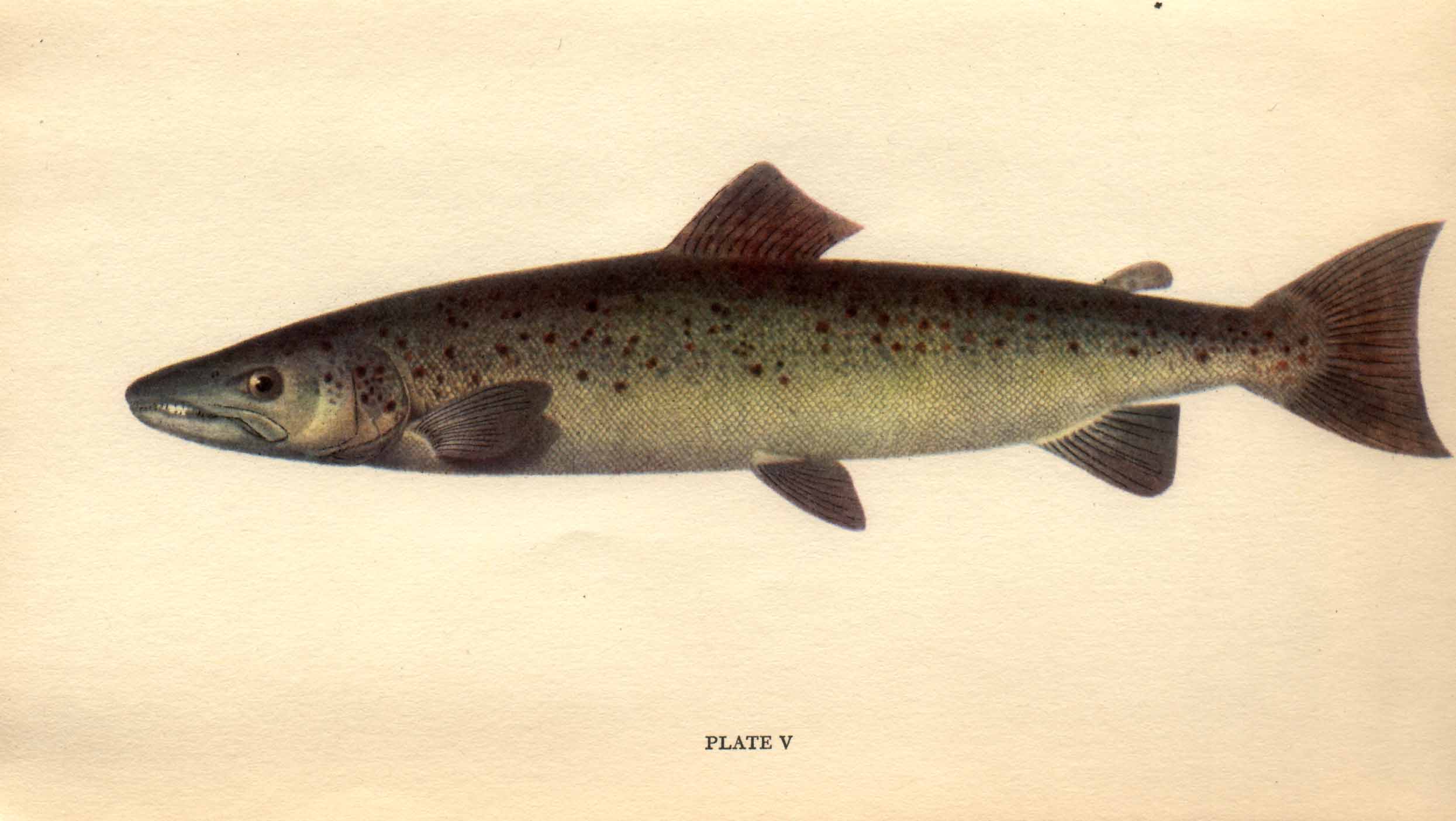
PLATE V
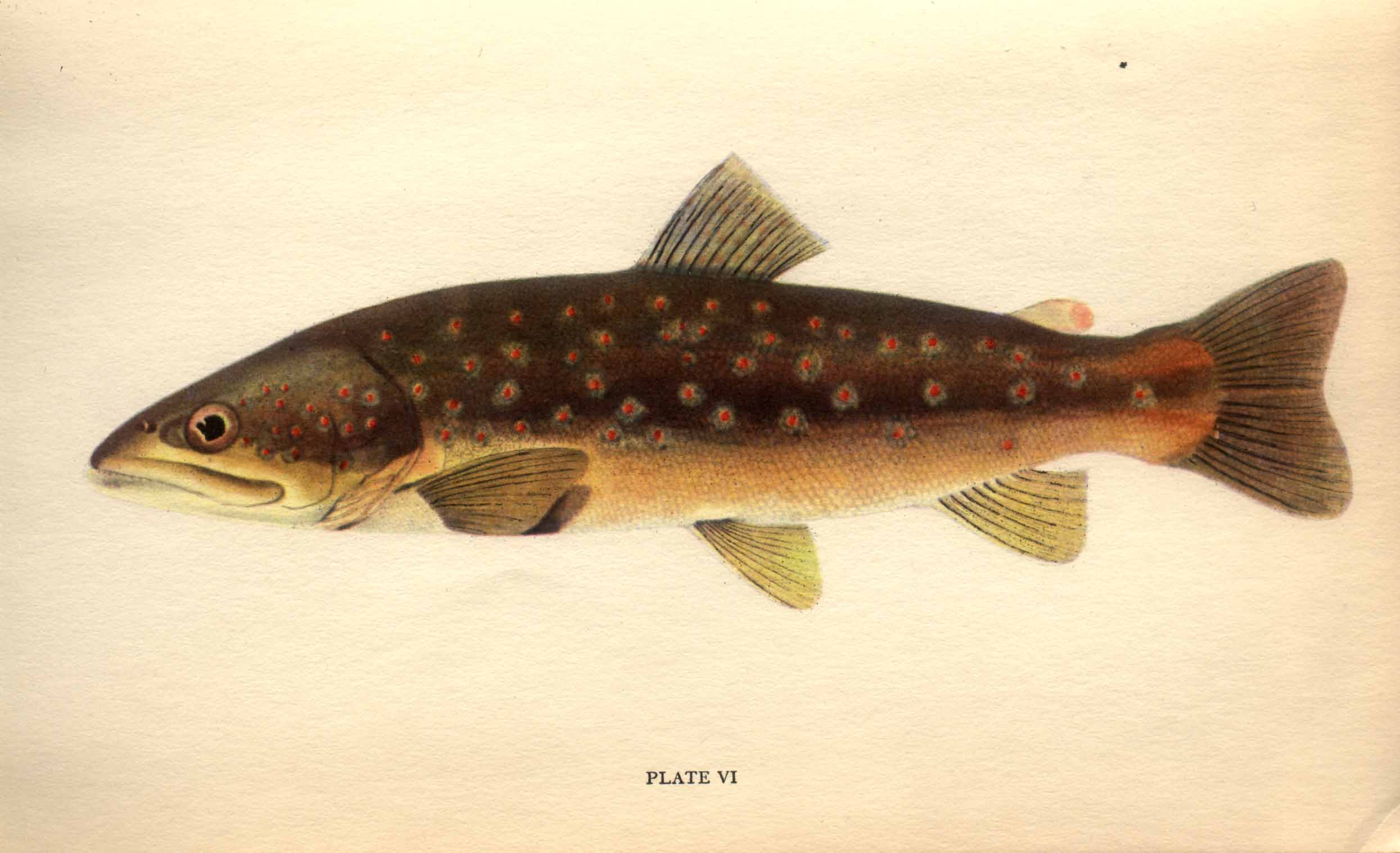
PLATE VI
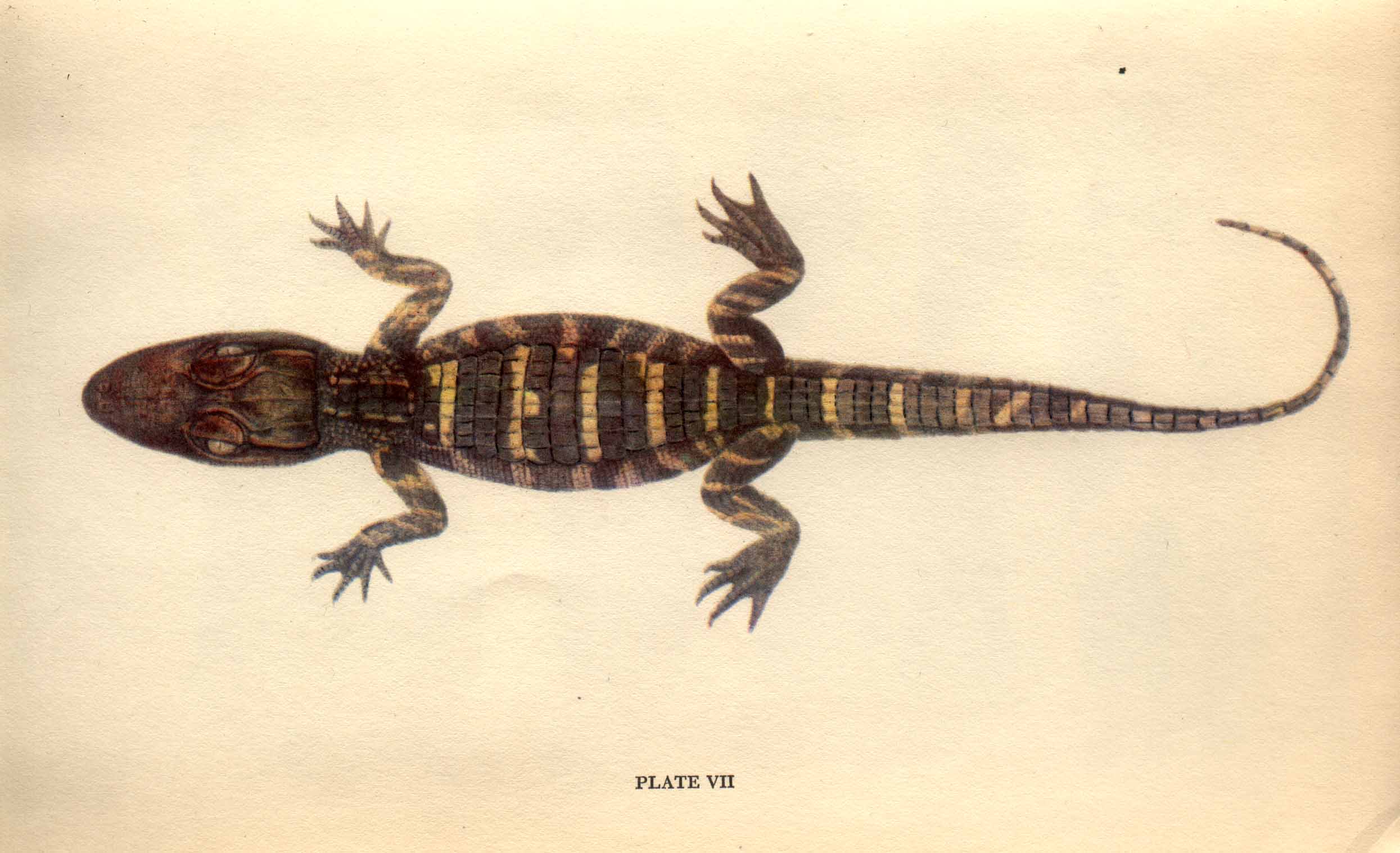
PLATE VII
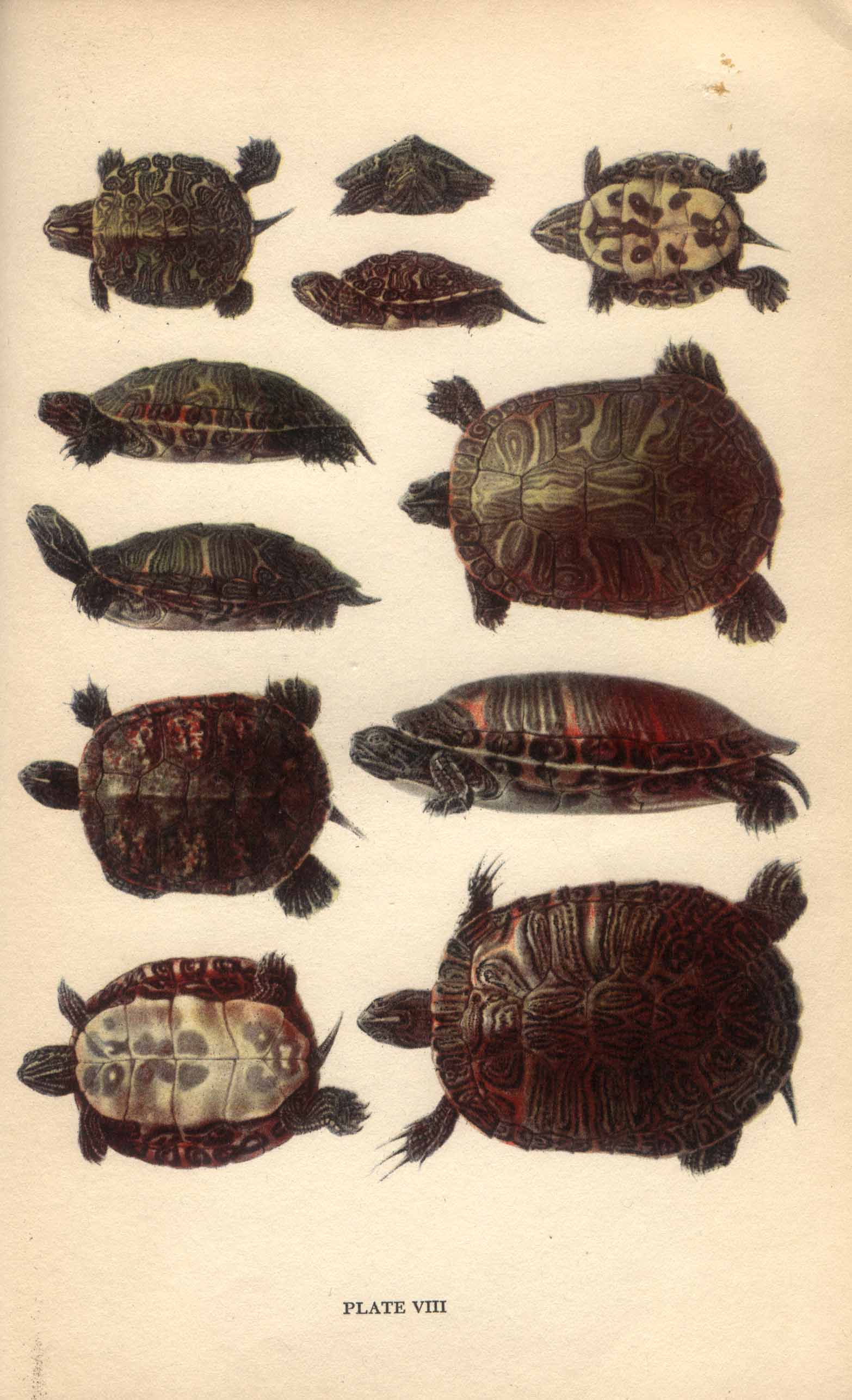
PLATE VIII
BIBLIOGRAPHY
AGASSIZ, ELIZABETH CARY, Louis Agassiz: His Life and Correspondence. 2 vols., Houghton Mifflin Co., Boston, 1886.
AGASSIZ, G. R., Letters and Recollections of Alexander Agassiz. Houghton Mifflin Co., Boston, 1913.
AGASSIZ, LOUIS, Contributions to the Natural History of the United States of America. 4 vols. Little Brown & Co., Boston, 1857-1862.
AGASSIZ, LOUIS, Methods of Study in Natural History. Ticknor & Fields, 1863.
AGASSIZ, LOUIS, & GOULD, A. A., Principles of Zoology. Gould & Lincoln, Boston, 1854.
BROOKS, VAN WYCK, The Flowering of New England. E. P. Dutton & Co., New York, 1936.
HOLDER, CHARLES FREDERIC, Louis Agassiz, His Life and Work. G. P. Putnam's Sons, New York, 1893.
HOLMES, LIVER WENDELL, "Farewell to Agassiz." Atlantic Monthly, Boston, Nov., 1865.
JORDAN, DAVID S., "Agassiz at Penikese." Popular Science Monthly, Vol. XL, pp. 721-29. New York, April, 1892.
LAND, WILLIAM G., Thomas Hill, Twentieth President of Harvard. Harcourt, Brace & Co., New York, 1927.
LONGFELLOW, HENRY W., "The Fiftieth Birthday of Agassiz." Poem. 1857.
LOWELL, JAMES RUSSELL, "Elegy of Agassiz." 1874.
LOWELL, JAMES RUSSELL, Works, Riverside Edition, Boston, 1894.
LYMAN, THEODORE, "Recollections of Louis Agassiz." Atlantic Monthly, Boston, May, 1874.
MARCOU, JULES, Life, Letters, and Works of Louis Agassiz. 2 vols. Macmillan & Co., New York, 1896.
PARRINGTON, VERNON LOUIS, The Romantic Revolution in America. Harcourt, Brace & Co., New York, 1927.
PEATTIE, DONALD CULROSS, Green Laurels. Simon and Schuster, New York, 1936.
SCUDDER, SAMUEL H., "In the Laboratory with Agassiz." Every Saturday, Boston, 1874.
THOREAU, HENRY DAVID, Works, Riverside Edition, Boston, 1894.
WHITTIER, JOHN GREENLEAF, "The Prayer of Agassiz." Poem. 1874.
Complete list of articles, reports, and books written by Louis Agassiz, published in appendix of Life, Letters, and Works of Louis Agassiz, by Jules Marcou. Period from 1828 to 1880. Number listed, 425.
CHRONOLOGY OF LIFE OF LOUIS AGASSIZ
Part I. 1807-1830
SHELTERED VALLEYS
Chapter 1. A BOY'S DAY. 1817
A gifted child in action. His fundamental interests. His relations to people. His natural equipment. Its prophecy for his future.
Chapter 2. OUT OF THE MOUNTAINS. 1800's
The background of Louis Agassiz. His birth, May 28, 1807. His inheritance from father and mother. The home they made for him. Bringing up a gifted child. Louis goes away to school.
Chapter 3. HARVEST; AND SEED- TIME. 1822
The College of Bienne finished. Home for a holiday. Diplomatic plans for the future.
Chapter 4. GROWING UP. 1822-1824
Lausanne for both boys. The kind of education offered Louis. The part which he chose. His convictions about his future. The decision to study medicine at Zurich.
Chapter 5. COLLEGE AND A GIRL. 1824-1827
Zurich takes the measure of a new student. The stream flows into its natural course. Offer of adoption. Zurich finished in 1826. Life at Heidelberg, 1826-1827. Town and gown. Louis at 20 in love.
Chapter 6. BOYHOOD TAKES ITS DEGREE. 1827-1830
A busy convalescence. Enters University of Munich, 1827. Adjustment. The Little Academy. First book, on Brazilian fishes, 1829. Contacts with Cuvier and Humboldt. Methods of handling finance and work. Ph.D., 1829. M.D., 1830. Achievements at age of 23.
Part II. 1830-1846
STEEP SLOPES
Chapter 7. THE SCHOLARS' ROAD TO PARIS. 1830-1832
The young doctor hangs out his shingle. Pastor Christinat helps him to take it down. Off to Paris, 1831. Association with Cuvier and with Humboldt. A poverty-born vacation. Neuchâtel makes an offer, and Paris lets him go. 1832.
Chapter 8. TIME TO SETTLE DOWN. 1832-1834
The gifted teacher. The young husband. The town as Cily saw it. Publication of first part on fossil fishes, 1834. England's welcome.
Chapter 9. NO MAN IS FREE FROM ANOTHER. 1830's
Men who helped shape Louis Agassiz's world.
Chapter 10. A LABORATORY-HOME. 1835-1838
A dark winter. England's help. Birth of Alexander Agassiz, Dec. 1, 1835. Wollaston Medal, 1836. Summer at Bex, 1836. Ice-age theory. Establishment of lithography. Birth of Ida, Aug. 8, 1837. Death of father, Sept. 6, 1837. Offers from Lausanne and Geneva, 1838. Household in hands of laboratory assistants. Cily goes home. Rose Agassiz takes charge.
Chapter 11. THE JUBILANT MOUNTAINS. 1839-1841
Hôtel des Neuchâtelois. Explorations of the mountains. Publication of Etudes sur les Glaciers, 1840. Ascent of Jungfrau, Aug., 1841.
Chapter 12. A MAN NEEDS ROOM TO GROW. 1842-1846
Experimental work with the glaciers. Birth of Pauline, Feb. 8, 1841. Publications. Plans to go to America. His home stripped; his house in order. Departure from Neuchâtel, March, 1846.
Part III. 1846-1873
THE HEIGHTS
Chapter 13. UR DISTINGUISHED IMMIGRANT. 1846
Stopovers in Paris and England. Off for America, Sept., 1846. Arrival in Boston. America's need of Agassiz. His impressions of America. He begins his work here.
Chapter 14. NEW PEAKS TO SCALE. 1846-1847
Lowell Institute lectures. Visit to Charleston. East Boston household. Coast Survey cruise. Summary of first year in America. Decision to remain here.
Chapter 15. A HOME UT OF CHAOS. 1847-1850
Lectures at College of Physicians and Surgeons, 1847. Offer from Harvard, 1848. Exploration of Great Lakes, 1848. Moves from East Boston to Cambridge. Death of wife, July, 1848. Arrival of son, Alexander, June, 1849. Marriage to Elizabeth Cary, 1850. Arrival of daughters from Switzerland, 1850.
Chapter 16. HIS GOLDEN ANNIVERSARY. 1851-1857
Temporary museum. Coast Survey cruise, 1851. Southern professorship, 1851. The boy, Alexander. Award of Prix Cuvier, 1852. Illness and resignation from Charleston University, 1853. Offers from Europe, 1854. Establishment of school in home, 1855. Subscriptions for Contributions to Natural History, 1856. Essay on classification, 1857. The fiftieth birthday of Louis Agassiz.
Chapter 17. FOR NO MAN STANDS ALONE. 1850's
Men who helped shape Louis Agassiz's world in the middle of the 19th century.
Chapter 18. SALVAGE OF TIME. 1859-1863
Corner stone of Museum laid, June, 1859. Home to Switzerland, summer, 1859. Dedication of Museum, Nov. 13, 1860. Teaching of Agassiz. Growth of Zoology Department.
Chapter 19. NOTHING LEFT UNDONE. 1864-1872
Lecture tour. Journey to Brazil, 1865-1866. Alexander makes his fortune. Death of Rose Agassiz, 1867. Illness of Louis. Trip West, and Cornell appointment, 1868. Growth of Museum. Dredging trip on Coast Survey steamer, Bibb, 1869. Ill again. Trip on Hassler, 1871-1872. Home to Cambridge, October, 1872.
Chapter 20. SMALL ISLAND OF LIFE. 1872-1873
Offer of Penikese, October, 1872. Marine summer school established, summer, 1873. Death of Louis Agassiz, December 14, 1873.